Detroit — Holy Week can present a family with a tricky clash of cultures.
Inside your church, the services are silent and solemn. You venerate the cross, keep vigil on Holy Thursday night, and spend time at the foot of Jesus’ cross by reflecting on the Gospel accounts of the passion.
Yet outside, you’re hit with visions of a jovial bunny, the lengthening spring days, and frequent commercial references to candy.
So comes the question to many Catholic parents trying to focus in on the solemnest week of the Church calendar with children in tow: Can we do anything to help this resonate with the young ones?
The Church is certainly trying. Some creative educational approaches can help impress on children the events of Holy Week and Easter, which might otherwise sound like a pretty tall order.
Marian Bart, director of religious education at St. Anastasia Parish in Troy, says her approach is to “help the children understand how each character in the Passion story could be them, and they can put themselves in the shoes of Peter, Veronica, Simon and even, in a sense, Judas.”
Bart says she encourages the children to ask how they themselves are like the person:. “How have I helped Jesus? How have I fought for Him, or wiped His face, or betrayed Him?”
She says she wants the children to reflect on “how Christ’s Crucifixion is personal, and not just some distant historical story.”
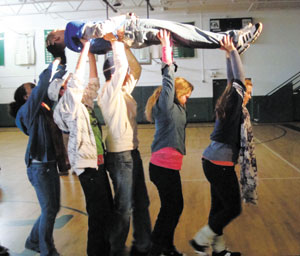
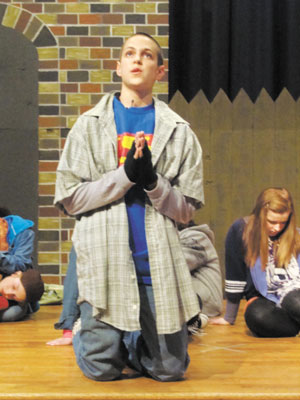
This year, the job of teaching the meaning of Holy Week and Easter at Guardian Angels School in Clawson is being helped by the production of “Godspell,” the 1970 musical by Stephen Schwartz and John-Michael Tebalak the children put on March 30-31.
Most of the play deals with the parables Christ used in His teaching ministry, but it concludes with the events of Holy Week.
Principal Sharon Hammerschmidt says the play has already borne fruit in awakening the sixth- seventh- and eighth-grade students’ appreciation of Scripture.
“Last week at Mass, when Fr. Gerry LeBoeuf was talking about separating the sheep from the goats, I could hear the kids saying to each other, ‘That’s in our play! That’s in our play!’” Hammerschmidt says.
And she says adults are not immune to the effect of the production.
“I was sitting there watching a rehearsal, and when they were carrying out Jesus’ body, I had a tear in my eye,” she adds.
Music teacher Catie McCulloch says preparing for the performances has been the most fun of any play or musical she has worked on.
Sixth-grader Ethan Groth, who plays Jesus in the production, says memorizing the lines, and learning to sing and dance at the same time has been a challenge, but also fun.
And not only have Ethan and other cast members learned more about the Gospel message, but they have had fun, too.
“I have a better understanding of the parables, and we’re all excited about this and have grown closer together,” he says.
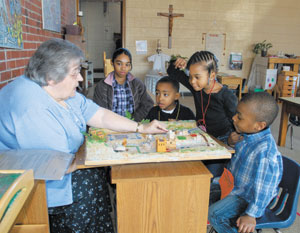
At Corpus Christi Parish in northwest Detroit, the children learn about the events of Holy Week through the very “hands on” form of religious education known as the Catechesis of the Good Shepherd.
The teaching method is used by a number of parishes in the Archdiocese of Detroit.
Two Sundays ago, for example, the day’s lesson was reinforced for the 3- and 4-year-olds through the disassembly and reassembly of a model of ancient Jerusalem, in which the sites involved in the drama of Holy Week were added back into the model as their story was told.
So, even at a young age, the children learn not only that the Cenacle was the site of the Last Supper, but also where it, and Caiphas’ palace, and Herod’s, and Pontius Pilate’s stood in relation to the Garden of Gethsemane and Golgotha.
The children are not playing with the model, but are using it as a learning tool, says Sr. Frances Gerhard, RSM, who oversees the program at the parish.
“You’re walking through it, as if you were with Jesus,” she says.
Initially developed in the mid-1950s in Italy by Sofia Cavalletti, an associate of famed educator Maria Montessori, the Catechesis of the Good Shepherd has three levels — for children 3-6, 6-9 and 9-12.
Children who have experienced all three levels of the program exhibit a very impressive understanding of the Catholic faith, Sr. Gerhard says.
“It’s marvelous, and what’s marvelous about it is the theology they absorb,” she says.
Sr. Grace Keane, OSF, who teaches the Catechism of the Good Shepherd at St. Aloysius Parish in downtown Detroit and at Gesu Parish in the University of Detroit Mercy neighborhood, says she also supplements what the children learn at church with additional materials she e-mails to the parents so that they can reinforce the lessons at home.
Of course, the Catechesis of the Good Shepherd isn’t just about Holy Week. At each level, the children increasingly learn about the Eucharist —the sacred vessels used on the altar and what the priest is doing — as well as Holy Scripture and other aspects of the faith.