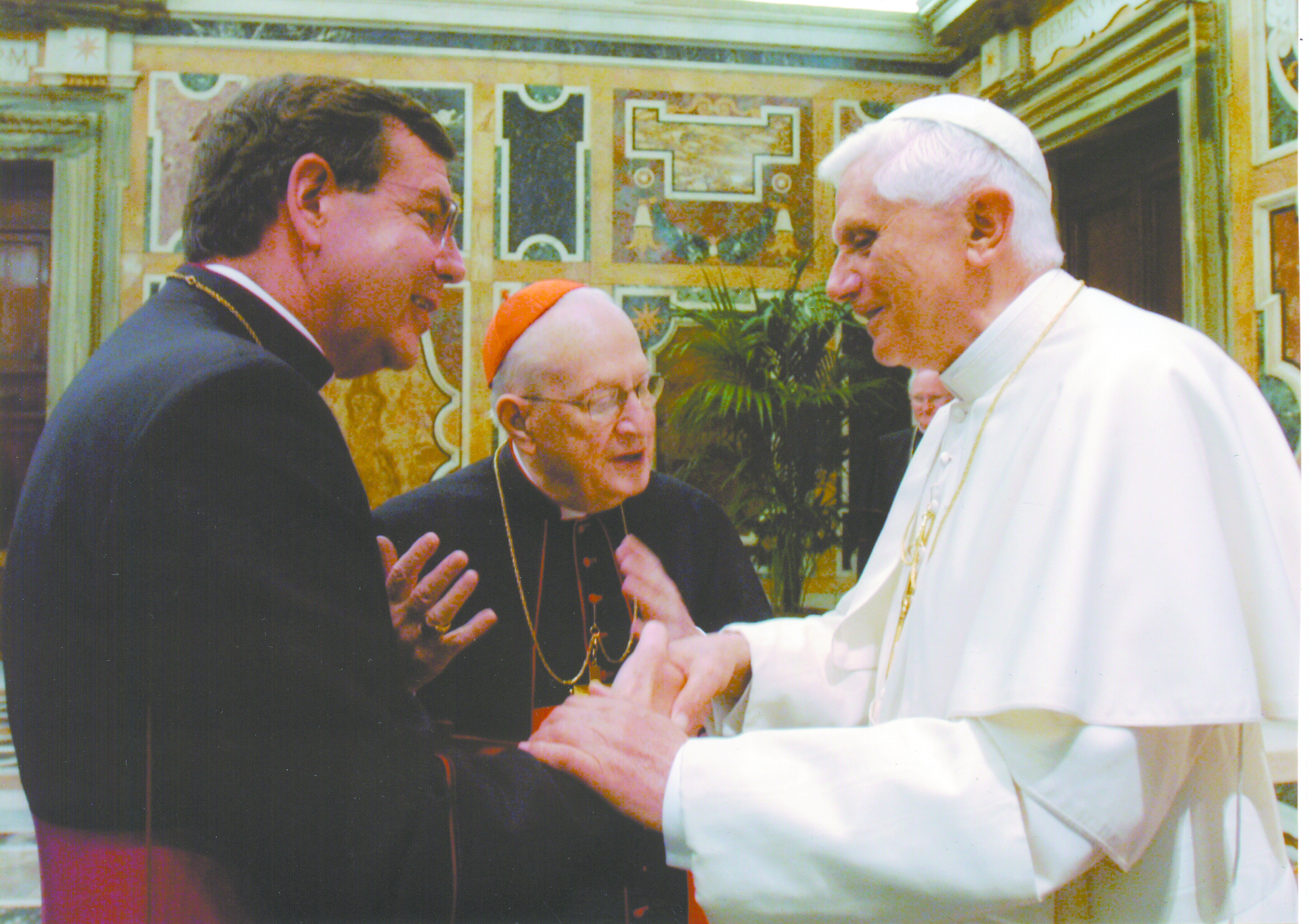
 Cardinal Edmund C. Szoka, middle, introduces Bishop Allen H. Vigneron to Pope Benedict XVI during a visit to the Vatican in 2006. Archbishop Vigneron said Aug. 21 that Cardinal Szoka's example of courage has helped in his own ministry. "I learned from Cardinal Szoka that if you are the leader, if you are the father of the family, you need to do the right thing for the service of the community entrusted to you. And move ahead with confidence," he said.
“I think the cardinal will be remembered for having the strength of his convictions that other people might have let go,” Archbishop Vigneron said at an Aug. 21 news conference at the Cathedral of the Most Blessed Sacrament in Detroit, following the announcement that Cardinal Szoka had passed away the evening before.
“About 10 days ago I anointed him with the sacrament of the sick and we prayed together,” Archbishop Vigneron said of the 86-year-old cardinal, who had died of natural causes at Providence Park Hospital in Novi.
The archbishop said that as Cardinal Szoka neared the end of his life, there was “very much the sense of (his) being in the hands of God. And happy to move forward with whatever timetable God had for him.”
Archbishop Vigneron said that he was inspired by the cardinal in his last days, “to walk courageously with faith into the future.”
This, however, was not unusual for the cardinal, who led the Detroit archdiocese from 1981-1990.
“He was a man of his convictions, and willing to do the hard thing for the good,” recalled the archbishop.
Archbishop Vigneron said that early on, when the United States bishops were first becoming aware of the problem of sexual abuse of minors by clerics, “the cardinal confronted it.”
“He brought all of the priests of the diocese together for a very important program to raise our awareness,” said the archbishop. “He didn’t shy away from dealing with what he thought needed to be handled.”
Additionally, even though it was very hard for Cardinal Szoka, he consolidated parishes during his time in Detroit, “because he knew that that was ultimately for the common good.”
Archbishop Vigneron said that because of the cardinal’s firmness in handling the consolidations, “some people might have mistaken it for being impervious to human concerns and human feelings. That certainly was not the case.”
“But like any leader, like the father of a family, he made the decisions that he thought, by his best light, were for the good of us all,” said Archbishop Vigneron. “He was a priest. He cared about the things priests care about. He wanted people to get closer to Christ.”
The archbishop also reflected on Cardinal Szoka’s determination in organizing the Vatican’s finances when he was called to Rome to oversee economic affairs at the Vatican City State in 1990.
“He was not intimidated by any entrenched views; he was going to make it right,” said Archbishop Vigneron.
Archbishop Vigneron also remembered the lighter side of the cardinal, in particular when they first met, when Archbishop Vigneron was a young priest student in Washington, D.C.
Cardinal Szoka was also studying in D.C. at the time, and the two were driving to dinner together one day. It was Fr. Vigneron’s turn to drive, and he ended up accidently going up a one-way street.
“I obviously made him very nervous,” said the archbishop, explaining that after he had returned to the proper route, “he patted me on the arm and said, ‘stick with the theoretical.’ He had a very good sense of humor.”
Archbishop Vigneron said Cardinal Szoka had “a great devotion to Our Lady, and he was always proud of his Polish heritage. It clearly enriched his life over many years.”
A particularly special memory that the archbishop treasures of Cardinal Szoka was from when the cardinal would say Mass.
“Always at the moment of the Mass, at the elevation, when the priest holds up the host … and it becomes the Body of Christ – the great devotion he showed in that act,” said Archbishop Vigneron. “(It was) obviously something he had grown up with, something of the piety that he had developed, but it was constant throughout his life.”