
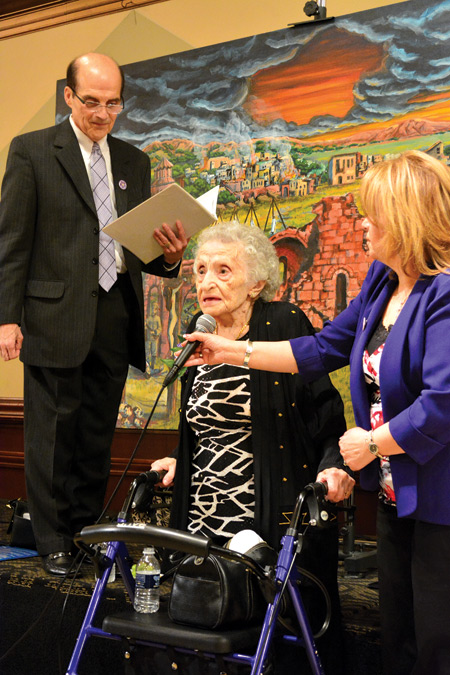
 Ramela Carman, 101, one of two remaining survivors of the Armenian genocide still living in Michigan, speaks briefly to those gathered at the St. Mary’s Cultural Center in Livonia during the 100th anniversary commemoration April 24.
Catholic, Orthodox and Protestant leaders gather to honor victims during Livonia prayer service
Livonia — Sitting on Jennifer Chiroyan Scappaticci’s nightstand are two stories her mother gave her recounting her great-grandfather’s harrowing escape from the Armenian massacres of the early 20th century.
“We heard these things growing up, and I have specific documents discussing the details of what happened. I remember in particular, my great-grandfather having to lie down and pretend that he was dead in order to escape the persecution,” said Scappaticci.
Scappaticci’s great-grandfather lost his first wife in the massacre, which his descendent didn’t hesitate to call a “genocide,” echoing the recent words of Pope Francis and Armenians across the globe who gathered this month to honor the nearly 1.5 million victims who perished in 1915 at the hands of the Ottoman Turkish Empire.
Scappaticci was one of nearly 1,500 people who packed wall-to-wall inside St. Mary’s Antiochian Orthodox Basilica in Livonia on April 24 for an ecumenical prayer service to commemorate the 100th anniversary of the tragic near-annihilation that started with more than 200 Armenian intellectuals being rounded up and killed on April 24, 1915, known as Red Sunday. Henceforth, 1.5 million others would follow as part of a forced evacuation of Armenians from their ancestral homeland in Turkey.
The prayer service was hosted by the Armenian Churches of Greater Detroit Genocide Centennial Committee, which comprises four Christian Armenian churches in Metro Detroit: St. John Armenian Apostolic Church in Southfield, St. Sarkis Armenian Apostolic Church in Dearborn, St. Vartan Armenian Catholic Church in Detroit and Armenian Congregational Church in Southfield. Catholic, Orthodox and Protestant religious leaders took part, with Archbishop Allen Vigneron giving the principal homily.
Scappaticci, a first-generation Armenian-American, noted the significance of seeing people of all faiths literally spilling out of the basilica to pray for the martyrs who gave their lives.
“Growing up, we heard stories from our grandparents and our parents’ grandparents about what our ancestors went through 100 years ago,” said Scappaticci, an Orthodox Christian who attends St. John Armenian Apostolic Church in Southfield. “On this day, it means a great deal to our culture to see not only Armenians here, but people representing all religions, including Catholics, and it makes us feel good.”
One of those Catholics was her husband, Daniel Scappaticci, who belongs to St. John Neumann Parish in Canton. He said recognition of the massacre as a genocide was crucial to eliminating such atrocities in the future.
“It’s a big deal because there’s a lot of people who tried to ignore it,” he said. “For it to be the first genocide of the 20th century, and to be recognized as that, is a big deal.”
For Archbishop Vigneron, who also referred to the mass killings as a genocide, the 100th anniversary commemoration was a time of mourning, but also a time for “rejoicing in the victory won by the Armenian Christians who endured their sufferings and went to their deaths because of their fidelity to the name of Jesus Christ.”
The archbishop continued by offering a suggestion for prayers of forgiveness.
“I am not Armenian,” the archbishop said. “It is not my own proper place to forgive those who perpetrated such atrocities on the Armenian people. However, I am by God’s grace and no merit of mine, like St. Paul, an ambassador for Christ, and after the example of the apostle, I invite you in prayer tonight to find your way forward on the path of reconciliation.”
He also encouraged those of Armenian descent to work to preserve their cultural heritage, which includes the “rich tradition of Christian civilization.” To that end, he cited the ongoing violence against Christians “because of their baptism” in other parts of the world, such as Africa and the Middle East.
“And not only Christians. We must resolve to defend the religious liberty of believers of every confession,” he said.
Attending the prayer service was one of the last two survivors of the Armenian genocide still living in Michigan. At a reception following the service, Livonia resident Ramela Carman, 101, using a walker, spoke briefly in Armenian to those gathered in front a masterful three-piece mural commissioned for the occasion.
The mural’s artist, Andrea Kalajian, told The Michigan Catholic the idea originated after she and her father attended a lecture on Armenian architecture.
“We wanted to do a mural to show the story of the Armenians,” Kalajian said. “We proposed the idea and they loved it, and we ended up doing a lot of research, going through the archives of the photos of the actual genocide, and putting together a mural or a triptych using those photos and placing them in places where it would create a narrative of what would happen over 100 years.”
The first panel depicts the persecution and genocide of the Armenians, including crucifixions, death marches and burned villages, transitioning into a second panel showing the struggles of “freedom fighters” against the Turkish army, while the third panel depicts modern-day memorials and symbols of the Armenian people’s ultimate victory.
The mural will rotate among several Armenian churches in Metro Detroit, Kalajian said, starting at St. John in Southfield.
“Each little vignette has a deep significance,” she said. “There’s a deep typology.”
The prayer service also included the lighting of candles representing each of the 12 major provinces in Turkish-occupied Armenia where victims died, and a celebration of the canonization of the martyrs by the Armenian Apostolic Church. Outside, the basilica was illuminated using projection technology celebrating historic Armenian churches.