
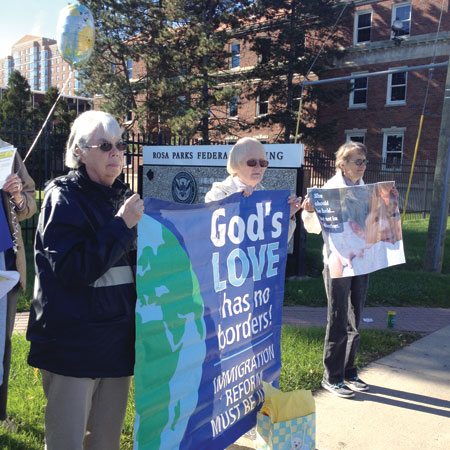
 Mercy sisters protest outside of the Rosa Parks Federal Building in Detroit over what the sisters say are unjust policies toward undocumented immigrants. (Courtesy of Sisters of Mercy)
From counseling immigrants to protesting water shutoffs, calling is ‘always there’
DETROIT — Study halls, medical clinics, protest rallies against water shutoffs — it seems the Sisters of Mercy are everywhere in Metro Detroit, regardless of what year it is.
As the Year of Mercy comes to an end, the Sisters of Mercy stay busy caring for the poor, the downtrodden and forgotten, a mission that will extend well beyond Nov. 20.
“To be merciful is certainly a Gospel value, one that always rings true,” Sr. Sarah Foster, RSM, told The Michigan Catholic. “All of us, especially Catholic through baptism, are called to be merciful as Jesus is merciful. The Year of Mercy highlights that cause, but that call is always there.”
 Sr. Sarah Foster, RSM, and her dog, Bentley, help mentor students in the Student Success Center a the University of Detroit Mercy on Nov. 2. Part of Sr. Foster's Ministry involves counseling students who feel overwhelmed or lost in the transition from high school to college. (Dan Meloy | The Michigan Catholic)
Sr. Foster works at the University of Detroit Mercy’s Student Success Center on the third floor of the university’s library, where Detroit Mercy students can go to receive free tutoring and advice.
“I’m in this office working with students who are having difficulties in any way,” Sr. Foster said. “Students can ask for a student success coach, where we meet on a weekly basis, talking about how they are doing academically, which in turn leads to a conversation about life in general.”
Sr. Foster said she herself struggled with the transition from high school to college, and taking the time to meet with students and talk things through is its own form of mercy.
“A lot of times, students come in with a lot of fear,” Sr. Foster said. “A fear of being on their own, not understanding how they’ll get through their classes, a fear of the unknown. We show them they can do this, breaking up their classes into manageable chunks, showing them how to plan out their schedule throughout the week. When they leave, they say they feel better.”
Showing relief and concern for people who feel forgotten is a common theme for the Sisters of Mercy.
On Wednesday mornings at the corner of Mt. Elliot and Jefferson in Detroit, Mercy sisters gather before the U.S. Immigration building to picket against what they see as inhumane immigration policies.
“Just a couple of weeks ago, we were involved with a joint effort with the IHM Sisters, in a push to close family detention centers in Pennsylvania and Texas that were built to house mothers and children, which is very destructive emotionally for these families,” said Sr. Karen Donahue, RSM, justice coordinator for the Farmington Hills-based Sisters of Mercy.
Sr. Donahue said the sisters organized a more local response at U.S. Immigration and Customs Enforcement offices in Detroit called “Diaper in Detention,” where the sisters brought baby supplies to ICE offices.
“We did this on Columbus Day, and then we realized the offices weren’t open,” Sr. Donahue said. “So we had a prayer service outside. We’ve been working to raise awareness about the plight of undocumented immigrants.”
For the past year, the sisters have traveled to the Monroe County jail, where most undocumented immigrants in custody have been moved. Partnering with an interfaith group organized by the United Methodist Church, the sisters visit undocumented immigrants in custody, offering to pray for them and assist in any way they can.
“We make it very clear to them we aren’t lawyers, so we can’t provide council,” Sr. Donahue said. “So we offer to pray with them and bring the presence of Christ, the presence of Jesus with them. It’s nice to have people to talk to. I tell them about our Wednesday vigils, and they’re stunned that people are thinking about them.”
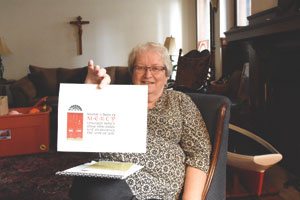 Sr. Mary Ellen Howard, RSM, former executive director of the St. Frances Cabrini Clinic in Detroit, holds a sign highlighting the Jubilee Year of Mercy. The sign reads, "Become a door of mercy through which those who enter may experience the love of God." (Dan Meloy | The Michigan Catholic)
Beyond visiting immigrants and trying to connect them with their families, Sr. Donahue said the Sisters of Mercy are also trying to lobby state and federal officials to improve the immigration system in the United States. All of this is to highlight the real-life people at the center of the immigration debate, people in need of mercy, Sr. Donahue said.
“When you meet these people, it’s a whole new perspective, not just for us, but for them,” Sr. Donahue said. “They realized they aren’t forgotten, they are still here, still a person. You get a whole different perspective on life when people show mercy.”
Acts of mercy are not only life-changing for those shown mercy, but for those giving it, too.
Sr. Mary Ellen Howard, RSM, is the public policy advocate at the St. Francis Cabrini Clinic in Detroit, where she says doctors and volunteers who spend time at the clinic are amazed at the plight of Detroit’s poor when it comes to the lack of health care resources.
“We have 100 volunteers who come because they want a chance to give back; many are Catholic, but not all,” Sr. Howard said. “We have doctors who say, ‘My private practice is my business. People I see are well, and I make them a little better. If I didn’t come here, many I see would die. I come here to remember why I’m in medicine.’ People who volunteer here learn what it’s like to be poor, sick and uninsured in Detroit.”
After working for more than 25 years in health care, from Mercy hospitals in Grayling and Muskegon to the Cabrini Clinic, Sr. Howard has shifted her ministry to the Detroit People’s Water Board Coalition, doing everything from lobbying lawmakers to protesting water shutoffs.
Sr. Howard – who once was arrested for physically blocking the driveway of a firm hired to shut off people’s access to water – said the work of public advocacy for people in need is often slow and methodic, but necessary.
“Caryll Houselander said the definition of mercy is someone who will put their hand in any water,” Sr. Howard said. “Pope Francis said we need to smell like the sheep. We need to get involved with the poorest of the poor. That’s what mercy is, what the Sisters of Mercy should be. It’s where we need to be, the door of mercy to God.”