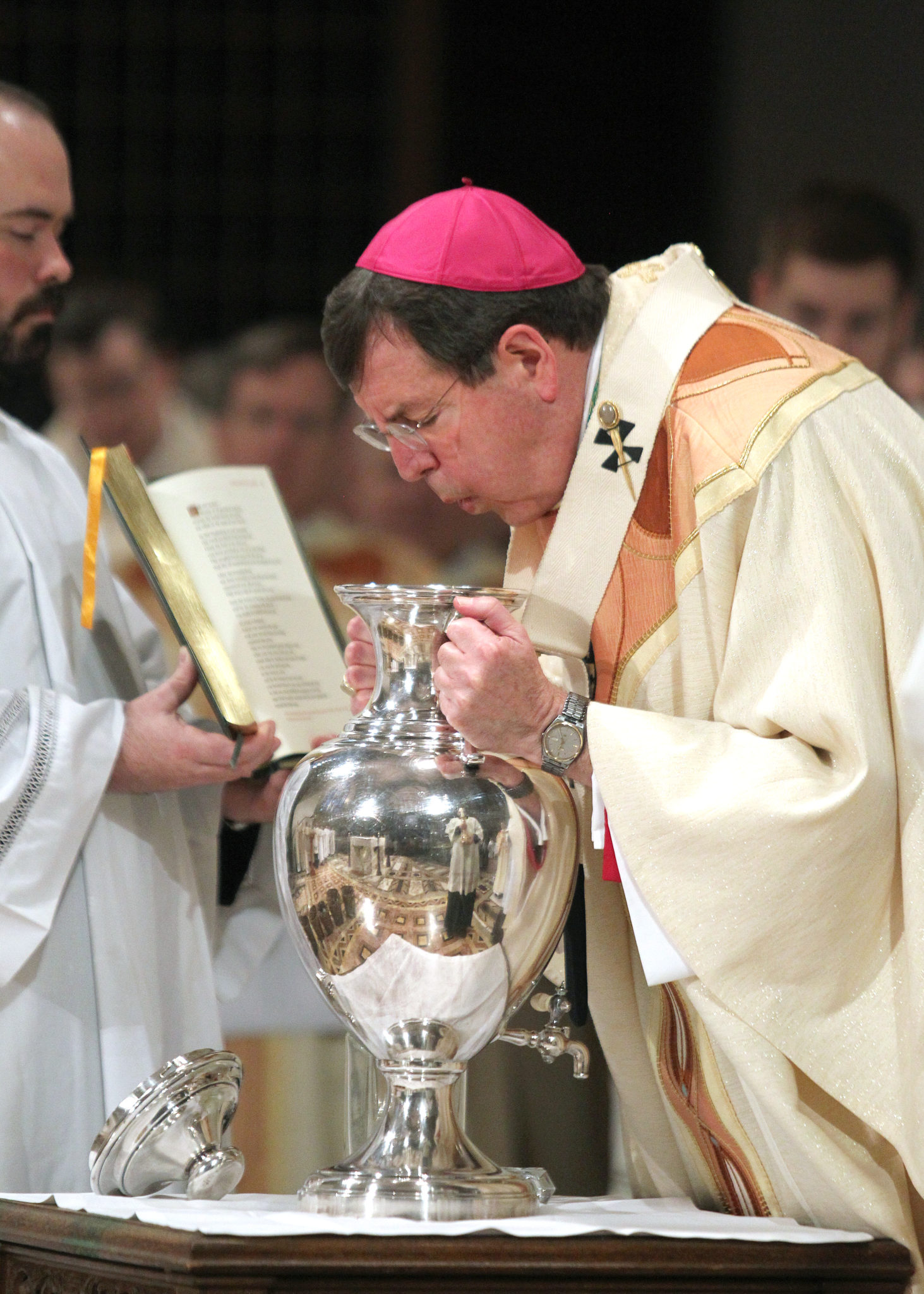
 Archbishop Allen Vigneron breathes into the Holy Chrism during the consecration of the oils during the annual Chrism Mass at the Cathedral of the Most Blessed Sacrament on Holy Thursday. (Photos by Mr. Mack Photography)
Catholics must bring Gospel's joy to apathetic culture, chief shepherd says during powerful rallying cry for New Evangelization
DETROIT -- More than 160 priests, more than 60 deacons, seven bishops -- including Archbishop Allen H. Vigneron and Cardinal Adam J. Maida -- and numerous faithful packing the pews made for a very full house for the annual Chrism Mass on Holy Thursday, April 2.
The 11 a.m. liturgy inside the Cathedral of the Most Blessed Sacrament included the renewal of vows for clergy of the Archdiocese of Detroit, as well as the blessing of the oil of the sick and oil of catechumens and the consecration of the holy chrism.
The oil of the sick is used for the anointing of the sick, the oil of catechumens is used for preparing individuals who are to be baptized and the holy chrism is used for the sacraments of baptism, confirmation and holy orders.
In his homily, Archbishop Vigneron described the holy oils as the "permeating touch of the Holy Spirit" and "a vehicle for communicating the presence of the Holy Spirit."
In a lighter moment, the archbishop noted that during his 19 years as a bishop, "sacred chrism has been an essential part of what I might call my episcopal toolkit," joking that "I’m quite confident that, if they should dig me up five, 10 years after my burial, my thumb will be incorrupt."
"As I was preparing to do my first celebration of confirmation, one of my … friends said, 'just remember, thumb, chrism, forehead. That’s simple. You can get that,'" he said to hearty laughter.
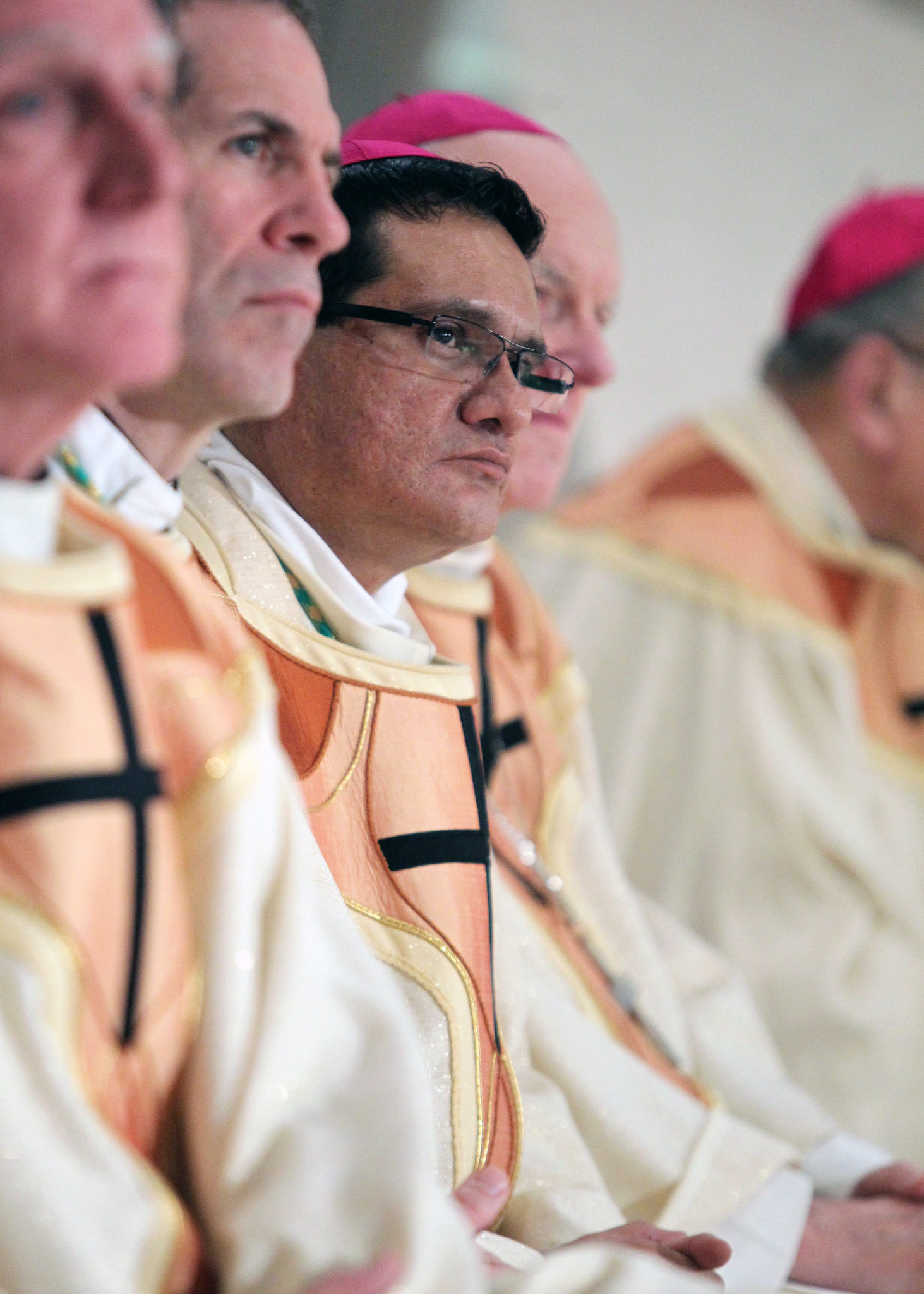 Auxiliary Bishop Arturo Cepeda looks on with other bishops as Archbishop Vigneron delivers his homily.
The archbishop cited the Pentecost sequence, in which the priest and faithful call on the Holy Spirit to fill their hearts with his love and power, even using the concrete terms "ignite the dry" and "warm the chill."
Growing more somber, Archbishop Vigneron said that the Holy Spirit’s touch is needed more than ever in the 21st century, when people have become “indifferent to the Gospel.”
"Has there ever been a time like ours when a people who once heard the Gospel, living in a culture that had over time been shaped according to the principals of the Gospel, has so willingly become asleep about the Gospel, and shed the Gospel, and become indifferent to the Gospel?" he asked. "Are we not frozen, chill, and dry? Are we not bored with Christ? Is that not the condition that the Holy Spirit needs to heal in our time?
"Have we not come to a time when, sad as it is, hearts no longer seem to be restless, but rather more drugged, befuddled? Are we not at a time when there’s a loss of confidence that there is out there, somewhere, some good worth striving for? So that the typical attitude of our time in so many is simply, 'Whatever' …?" the archbishop said.
He referenced then-Cardinal Joseph Ratzinger who once said “the deepest poverty is the inability to have joy” in both the rich and poor alike.
"The inability of joy presupposes and produces the inability to love, produces jealousy, avarice — all the defects that devastate the life of individuals and of the world,” the archbishop said.
This apathy, Archbishop Vigneron said, has been traditionally called “acedia” or “the noonday devil,” which author Dorothy Sayers described as an attitude of one “who only remains alive because there is nothing left to die for.”
“Who could remain indifferent in the face of this acedia, this noonday devil, this being bored with Jesus?” the archbishop asked.
Archbishop Vigneron called this indifference to Jesus "the great wound" of the culture, which can be combated through the work of the New Evangelization.
And what is this New Evangelization?
"It is about dedicating ourselves totally to assist the Holy Spirit in making present Jesus Christ in his compelling love," he said.
"It is the work of the Holy Spirit to present Jesus as his most attractive. Jesus healing our wounds. Jesus forgiving our sins. Jesus standing with us in our trial," the archbishop said. "It is the work of the Holy Spirit to make Christ present in the power of his Love."
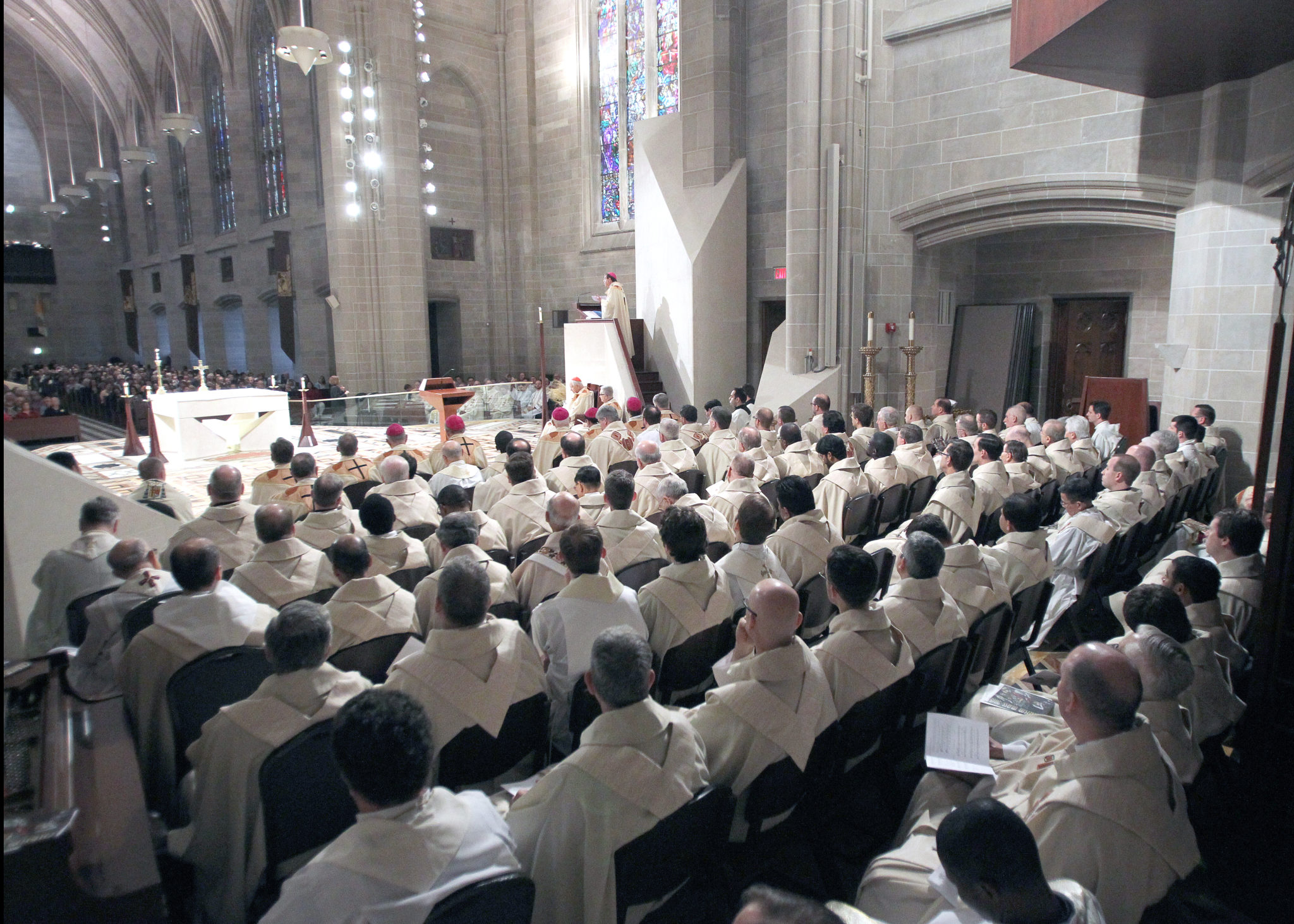 More than 200 priests, deacons and bishops attend the Chrism Mass each year, when they renew their clerical vows.
“Somebody has to teach the 21st century in the United States that each of us is made for some purpose beyond oneself,” he continued. “Someone has to teach our age about Jesus.”
Barbara Janiszewski, a parishioner of St. Margaret of Scotland Parish in St. Clair Shores, described the Chrism Mass as “beautiful” and said she liked the interchange of various languages used for those attending the liturgy.
Languages included English, Polish, Spanish and Latin, and two American Sign Language interpreters were also present for members of the Catholic deaf community attending the Mass.
Fr. Anthony Fox, OFM Conv., said that the Chrism Mass is “a great gathering for the Church. The laity and the clergy come together on this day, for this great gathering every year.”
And for Lynn Mueller, a parishioner of St. Jude Parish in Detroit, “It’s not Easter unless you attend the Chrism Mass.”
Photo gallery
Click here to see more photos from the 2015 Chrism Mass at the Cathedral of the Most Blessed Sacrament.