

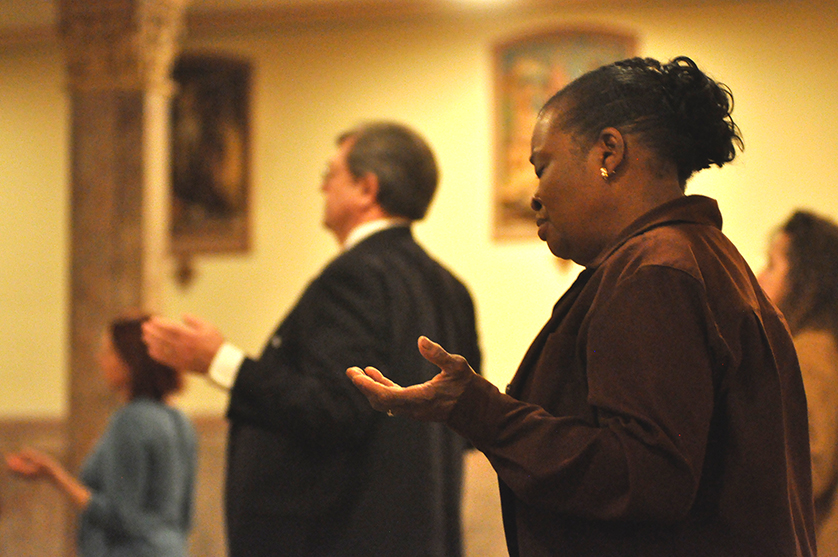
 A woman prays during Ash Wednesday Mass at St. Aloysius Parish in Detroit in 2012. For a new Lenten encounter, local Jesuits recommend Ignatian spiritual exercises — in which a person places himself or herself alongside Jesus in the Scriptures — as a way to grow closer to God on a daily basis.
Ignatian spiritual exercises a good practice for Lent, Jesuits say
Bloomfield Hills — God might very well speak to you through everyday experiences, but you might lack the spirituality to hear what He’s saying.
According to Fr. Fran Daly, SJ, spiritual director of Manresa Jesuit Retreat House in Bloomfield Hills, that’s where the Ignatian spiritual exercises could help, especially during Lent.
At its very root, Ignatian spirituality is the awareness of God’s presence in day-to-day life, and how experiences, thoughts and daydreams can be means for God communicating his work to us, Fr. Daly said.
“Ignatian spirituality still has an impact on our lives today,” Fr. Daly said. “How is God communicating to you through experiences? We live in a world with a lot of busyness, so how do you listen to God? Much of what we learn about spirituality is from interaction with the world through your faith.”
Fr. Daly outlined the history of St. Ignatius of Loyola and the Jesuits during a talk Jan. 26 at Manresa, explaining how St. Ignatius set out to establish an order focused on serving others and finding God through their experiences.
“A big part of Ignatian spirituality is the examination of conscience, growing in awareness of God in your everyday life” Fr. Daly said. “It takes 5 to 10 minutes to reflect, think about where God touched your life in love today. It’s about finding God in your feeling, contemplating where God was in our actions.”
Fr. Daly said Ignatian spirituality can be explored in one of two ways. The first is a formal retreat where a person goes to a retreat home for a set period of time to pray and contemplate Scripture.
The second option is a personal retreat, where the retreatant spaces out 30 to 45 minutes every day to pray and reflect.
Under both paths, the retreatant is guided by a spiritual director, who asks the person questions and keeps them on course.
“In a formal retreat, the spiritual director gives you four different passages of Scripture for you to read and reflect on,” Fr. Daly said. “You stay with those passages, and if you get discouraged, you have the spiritual director to talk about them.”
The spiritual exercises are meant to renew a person’s spiritual life through a series of subjects to contemplate and apply to one’s own life, according to Fr. John Libens, SJ, superior at the Colombiere Retreat Center in Clarkston.
“The spiritual exercises are four weeks of prayer,” Fr. Libens said. “In the first week, you think about God’s creation and man failing to respond properly, leading to sin. Once the retreatant knows he’s loved, he moves on the second week, and the following of Christ.”
Fr. Libens said a person going through spiritual exercises might not be ready to move on to the next week after five to seven days of prayer, which is the why the spiritual director is there to guide them, either in person or over the phone.
“The role of the director is to listen to what the retreatant is saying and listen to what is happing in the retreatant’s prayer,” Fr. Libens said. “If nothing is happening, the director may try some other props, suggest some different things to think about while the person is reading the Gospel. “
The purpose of reflection and the spiritual exercises is to get in contact with Jesus’ personal experiences, reading Gospel passages and imagining yourself in the scene with Jesus.
“These exercises are meant to get the retreatant in closer contact with God,” Fr. Daly said. “Take the story of the paralytic with his four friends dropping him in through the roof, for example. What do they hear? What do they see? Smell?
“The retreatants imagine they are the person being lowered in, they imagine being Jesus looking at this person. That’s how they move into who Jesus was, and how he interacted with the people around him.”
Ash Wednesday
Ash Wednesday, the start of the 40-day season of Lent,
is Feb. 10. While not a holy day of obligation, it is a day of fasting and abstinence for Catholics between the ages of 18 and 60. Archbishop Allen H. Vigneron is expected to celebrate Ash Wednesday Mass at 12:15 p.m. at St. Aloysius Parish in downtown Detroit. For other local Mass times, visit aod.org.
Lenten regulations
In addition to fasting and abstinence from meat on Ash Wednesday and Good Friday, Catholics older than 14 are also obliged to abstain from meat on Fridays during Lent. In fasting, individuals may eat one full meal and two smaller meals that don’t add up to a full meal. As part of abstinence, Catholics should avoid eating meat, such as chicken or beef, but may have eggs, milk products or condiments made from animal fat. Fish and shellfish may also be eaten (see The Michigan Catholic’s Lenten Dinner Directory on Pages 6-7).
The Church also encourages, but does not require, Catholics who choose to do a personal form of penance or sacrifice during Lent (i.e., “giving something up”) as a means of spiritual growth.