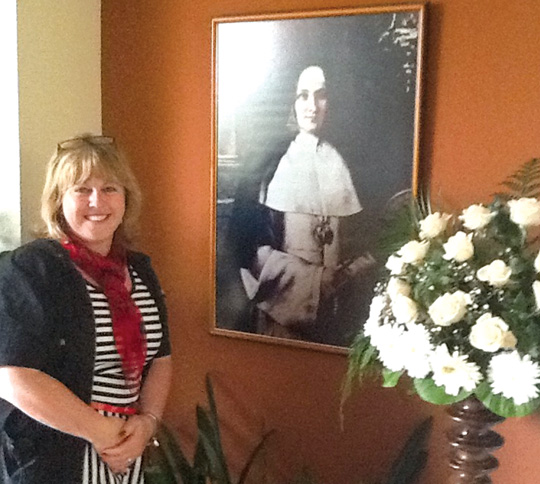
 Kathleen Galen, an attorney from Eastpointe, poses with a portrait of one of her two beatified relatives, Blessed Sr. Maria Droste zu Vischering, while on a fact-finding “spiritual retreat” in Europe. The other relative is Blessed Cardinal Clemens August von Galen, who along with Pope Pius XII worked to denounce the terrors of the Nazi regime during the Second World War.
Eastpointe— Kathleen Galen already knew she had one relative pending canonization, but she was nonetheless surprised when she discovered her relation to another blessed.
For Galen, who always believed in the importance of family, knowing her connection to Blessed Cardinal Clemens August von Galen and now finding Blessed Sr. Maria Droste zu Vischering has brought an even greater significance to researching her family tree.
“I found a footnote in one of the articles about Clemens and I looked into it and pulled up Sr. Maria’s picture,” said Galen, who is an attorney in Eastpointe. “I was shocked that she looked so much like my dad.”
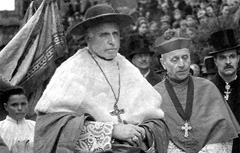 Cardinal Clemens August von Galen, bishop of Munster, Germany, during World War II, was well-known for publicly opposing Hitler’s atrocities during the height of the Holocaust.
Galen’s interest was first piqued around 2000 when she was contacted by a distant cousin who explained that they were related through Cardinal Clemens. Becoming more interested in the cardinal, who was beatified in 2005, Galen decided to look into her family history and see what she could learn about him.
She discovered not only more information about the cardinal, but also stumbled upon his lesser-known first cousin, Sr. Maria, who was beatified in 1975.
Fascinated by this unusual aspect of family history, Galen began substantial research into the lives of these two individuals — including creating Facebook pages for both of them — to increase awareness and devotion to their causes for sainthood.
Eventually, it led her to spend 40 days in Europe this past June on a quest to reconnect with these powerful lives in her family’s past.
Starting at the Cathedral of Munster in Germany, where Cardinal Clemens is buried, she later found herself in Portugal, the burial place of Sr. Maria.
‘Unconcerned about praise,
unaffected by fear’
Cardinal Clemens, Galen explained, played a highly influential role in Church history during the Second World War.
Born in 1878, Cardinal Clemens was known largely for his defiance of the Nazis and his support of Pope Pius XII during Germany’s turbulent times. He worked closely with both Pope Pius XI and Pope Pius XII, even assisting in Pius XI’s encyclical “Mit brennender Sorge” (To the Bishops of Germany: The place of the Catholic Church in the German Reich).
“Clemens exuded strength; cared very little for his own safety; was able to defend God’s law over man’s law,” Galen said, reflecting on his “courage and strength, and an iron will.”
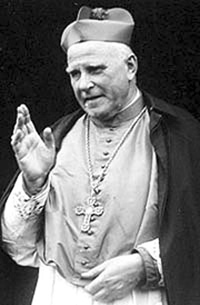 Pope Pius XII bestowed the red hat on Cardinal Clemens in 1946.
And for those devoted to clearing the name of Pius XII, who often is inaccurately accused of ignoring the plight of Jews and other vulnerable groups during the war, seeing his strong connection with Cardinal Clemens is vital.
Msgr. Russell Kohler, pastor of Ste. Anne de Detroit and Most Holy Trinity Parish in Detroit, sees the opportunity for great healing in German history through Cardinal Clemens.
“We have to bring the Church beyond this political correctness of misinformation to celebrate the truth,” Msgr. Kohler said. In reality, he said, Pope Pius XII and Cardinal Clemens collaborated to try to protect vulnerable groups from the effects of Adolf Hitler’s regime.
“He noticed that the vulnerable were occupying graves,” Msgr. Kohler said, detailing Cardinal Clemens’ public denouncement of Hitler’s “mercy killings” euthanasia program, which took the lives of the mentally ill, homosexuals, the elderly and many others.
“It wasn’t any cowering to the regime, but an immediate response from the heart,” said Msgr. Kohler, who hopes eventually to hold a seminar on Cardinal Clemens with the cooperation of the local Jewish community.
Cardinal Clemens later went on to give sermons denouncing forced sterilization, the concentration camps, the Gestapo Terror and the persecution of the Catholic Church — acts which would have threatened his life, except that Hitler wished to avoid a public battle with the Vatican.
The cardinal’s episcopal motto, “Unconcerned about praise, unaffected by fear,” was his driving force until the day he died in 1946.
Linked to the Divine Heart
Galen developed a very personal devotion to Sr. Maria during her visit to Europe, a highlight of which was getting to see her relative’s incorrupt body at the Church of the Sacred Heart of Jesus in Ermesinde, Portugal.
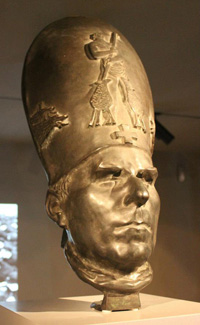 A bronze bust of Cardinal Clemens is on display during Kathleen Galen’s visit to Germany this summer to learn more about her blessed relatives.
“I didn’t anticipate going, I felt that I was pulled in that direction,” said Galen, who saw her 40-day expedition as more of a spiritual retreat.
In researching the religious sister, Galen learned that Sr. Maria — who was born Sept. 8, 1863, sharing a birthday with the Blessed Mother — grew up in an aristocratic Catholic family in Munster, Germany.
She joined the Congregation of Our Lady of Charity of the Good Shepherd at age 25, taking the name Sr. Maria of the Divine Heart. She spent the majority of her religious life at a convent in Portugal, caring for orphans and helping dissolute women get back on their feet.
Throughout her journey to acquaint herself with Sr. Maria, Galen kept returning to the theme of “love.”
“Sr. Maria’s love of Jesus, Sr. Maria’s devotion to his Sacred Heart,” Galen said. “The love she had for the children of the orphanage, the love that the people of the town had for her while she was alive, and the love that the people of Portugal have for her now in her death. That she symbolized love, that she exuded the love that she found in Jesus’ Sacred Heart.”
Sr. Maria had reported to her superior that she had mystical visions of Christ, Galen said, requesting that the entire world — not just Catholics and other Christians — be consecrated to the Sacred Heart.
Her influence eventually assisted Pope Leo XIII’s “Annum sacrum” (On Consecration to the Sacred Heart), in which the pope decreed the June 11, 1899, consecration of the human race to the Sacred Heart of Jesus.
While Galen returned to the United States with many photos, numerous memories, and a lot of information, it was the newfound familial bond with two relatives she had never even met that stood out most, she said.
“They both had a love of the Catholic Church, they both had a devotion to Jesus,” Galen said. She considered her journey to be “a success,” though it ended up being more about Sr. Maria than Cardinal Clemens.
“But it was a good journey nonetheless,” she said with a smile.
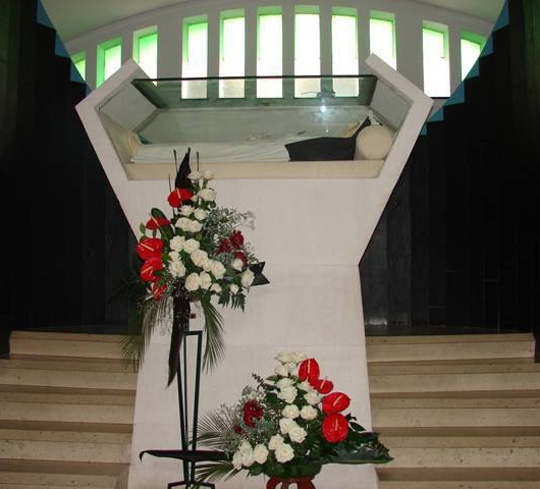 The incorrupt remains of Sr. Maria Droste are on display in the Church of the Sacred Heart of Jesus in Ermesinde, Portugal.