

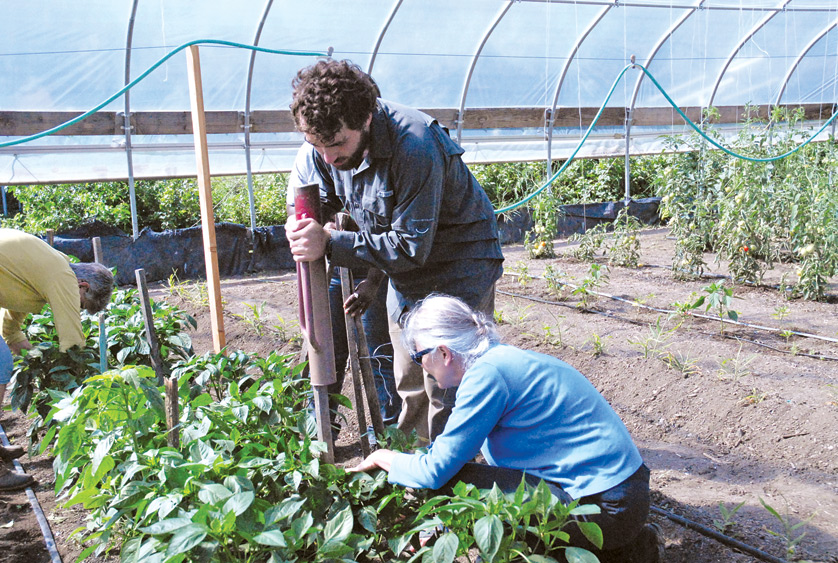
 Volunteers at the Capuchin-sponsored Earthworks Urban Farm work in the greenhouse July 15, tending to vegetables that will be used to supply the Capuchin Soup Kitchen.
Capuchin-sponsored Earthworks Urban Farm promotes sustainable living in inner city
DETROIT — It’s more than growing food; it’s growing a community.
Across Detroit, urban farms and gardens have sprung up in the past few decades, providing quality produce to the city’s residents and building a sense of community and sustainability among neighbors.
The farms are a small piece of the “green movement” of promoting sustainable living by supporting local businesses and growers.
Far before Pope Francis’ encyclical Laudato Si’ threw a spotlight on the connection between the environment and the urban poor, Detroit’s Capuchin Soup Kitchen was making urban farming and sustainability a reality on the city’s east side.
Located at 1820 Mount Elliot St., the soup kitchen has been running an urban farm since 1997, when Capuchin Friar Rick Samyn started growing a small garden. Working with the Earth and being connected to nature is important to the Capuchins, who started farming in 1883 when their monastery was then in Hamtramck.
“One of the reasons the Capuchins started growing food was the area was largely of Prussian descent and German-speaking, and this was a way to tie in the roots of the community,” said Patrick Crouch, a staff member at Earthworks, the Capuchins’ 2.5-acre urban farm, which grows certified organic produce and seeks to promote a healthy respect for the environment through social justice and education.
“The Franciscan value of connection with nature is long-standing, rooted in history,” Crouch said. “Bro. Samyn grew up in the grocery business and noticed the youth didn’t have high-quality food.”
Today, Earthworks stretches across a few blocks on Detroit’s east side, giving 95 percent of its yield to the Capuchin Soup Kitchen, which feeds the hungry in the area. Because of the farm, more than 50 different varieties of fruits, vegetables, flowers and bee hives supply the kitchen. Earthworks also sponsors agricultural classes for individuals to learn how to start their own gardens and grow their own food, especially in Detroit, where fresh produce often isn’t readily available.
Though the pope’s encyclical highlighted the need for Catholics to reduce waste and promote economic programs to help the poor and preserve the environment, it’s not a new idea.
“The thing people need to understand about urban farming is that it’s not new,” said Shane Bernardo, another Earthworks staff member. “Indigenous people and natives have been doing it for years; it’s ancient.”
Bernardo suggested those who are interested in starting an urban farm have a conversation with their neighbors and friends.
“It starts with a community garden and a chance to reconnect with people and reconnect with the land,” Bernardo said. “People who grow their own food have the ability to be more self-reliant and will have more choices for what is available. The industrial food system hides a lot of the process of what they are doing. By growing your own food, you have more of a say of how the Earth is treated.”
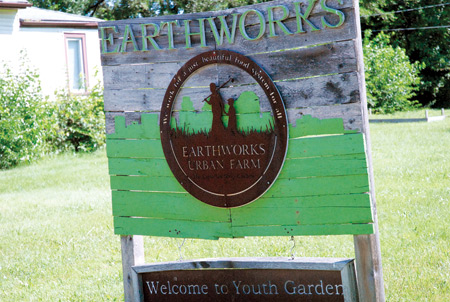 A sign welcoming visitors to the Capuchins' Earthworks Urban Farm in Detroit reads "We work for a just, beautiful food system for all."
Volunteers come weekly to the urban farm and community garden to learn new skills and tend to the crops. The Capuchins have multiple locations around their campus, including a greenhouse to grow fruits and vegetables in a controlled environment.
“In the greenhouse we grow everything from fruits and vegetables such as tomatoes, peppers, squash and cucumbers, and for the first time, we are growing ginger,” said Sharon Ray, a volunteer. “Earthworks has paid staff members who help volunteers with growing techniques and how to run their own gardens, including marketing and business lessons for selling the food.”
The farm always accepts volunteers, who in turn are sent home with a share of the crops. Businesses and schools schedule visits throughout the year, but the farm is in great need of volunteers in the fall to help with the harvest.
Volunteers gain valuable gardening and agricultural experience, but getting down in the dirt and working with the Earth helps personal growth as well, Crouch said.
“These farms and gardens are so much more than food security; it’s people sharing in culture. It gets people to come to the city and serves a deep feeling. There is something meditative about gardening; it’s a quiet time when you get to think and learn from the plants and from each other.”
That personal growth spread throughout the city, which is fighting the stereotype that it’s barren of locally grown produce.
“You hear the term ‘food desert’ a lot when people describe Detroit, and that’s not true,” Crouch said. “Food is deeply connected to culture; we don’t give up on our traditional foods. A food desert would be barren of culture, and Detroit is not void of culture. It has a rich and full history.”
Rather than relying on big chain grocery stores to revitalize the city’s diet, Crouch believes small, independent groceries and urban farms will perpetuate the idea of self-sustainability in the city and build relationships within the community.
“Detroit has a lot of independent grocery stores,” Crouch said. “I’m not saying they’re perfect, but it shows the city is not helpless.”
Earthworks Urban Farm
In addition to providing food to the Capuchin Soup Kitchen, Earthworks sells produce at a farm stand from 11 a.m. to 2 p.m. every Thursday at 1264 Meldrum St. in Detroit. For more information on how to volunteer at Earthworks or to learn more about urban farming, visit www.cskdetroit.org/earthworks.