
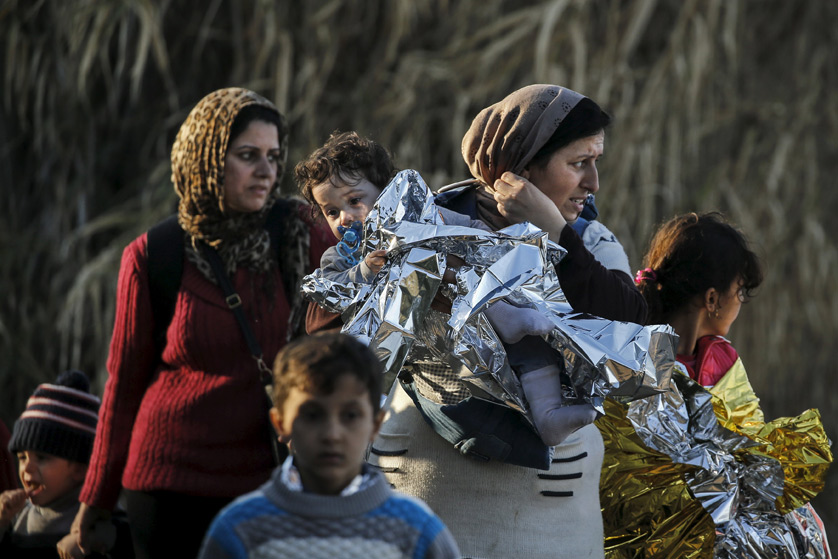
 A Syrian refugee carries her child in a thermal blanket as refugees and migrants arrive Nov. 10 on an overcrowded boat on the Greek island of Lesbos. The extensive vetting process that all refugees undergo before arriving in the United States, "screens out any possible threat of terrorism," said the executive director of the U.S. bishops' Migration and Refugee Services.
Alkis Konstantinidis | CNS photo
DETROIT — As war continues to rage in Iraq and Syria, hundreds of thousands of refugees have fled their homeland to find security, regardless of what the future may hold.
Refugees making their way toward Europe and America are seeking a better, safer life, just as many politicians and citizens have begun debating the United States’ moral and political responsibility when it comes to assisting those in need and defending the country’s borders.
Catholic Charities of Southeast Michigan has already settled 400 refugees in the state, and wants to help more in collaboration with federal and state officials. Along with partners including the U.S. Committee for Refugees and Immigrants and Lutheran Social Services of Michigan, the agencies have settled an estimated 1,500 refugees in the Metro Detroit area.
 Hattar
Jeralda Hattar, director of refugee and immigration services for CCSEM, said there are many misconceptions about resettling refugees from Iraq and Syria in Michigan, adding refugee resettlement here is nothing new.
“The majority of these cases have been Iraqi refugees; so far we’ve only settled two Syrian families,” Hattar told The Michigan Catholic. “The majority have been Iraqi Chaldean families who have ties in the area. When a refugee has a U.S. tie, that location would determine the destination of the refugee in order to reunite families.”
There are more than 150,000 Chaldeans in the Metro Detroit area — the largest community in the country — and the area is home to the largest Arab population in the U.S. per capita.
“The state of Michigan resettles an average of 6 percent of the refugees coming into the U.S.,” Hattar said. “This is in part because of our demographics, but also because have so many welcoming communities with Detroit, Washtenaw County and Grand Rapids. We’re one of the top five states in refugee resettlement.”
Hattar said Catholic Charities of Southeast Michigan has worked to educate the public on the situation facing refugees, including those from Syria. Nearly 75 percent of Syrian refugees are women and children, she said, and of those who are men, a large majority are older.
Additionally, she added, calls from some Americans to accept only Christian refugees into the U.S. are unrealistic.
“That’s never going to happen,” she said. “What the Christian community needs to keep in mind is, whatever you advocate nationally that is against accepting Muslim refugees ultimately affects both Muslim and Christian refugees regardless because the federal government will not distinguish in their security process.”
In November, 31 state governors — 30 of whom were Republican — said their states would not welcome any more Syrian refugees, citing safety concerns, despite claims from legal scholars on whether governors have such authority.
Hattar said Catholic Charities of Southeast Michigan has been in contact with Gov. Rick Snyder’s administration regarding the state’s refugee policy. She said the state is still accepting refugees — despite media reports seemingly to the contrary — while the governor discerns whether to go forward with a proposed expansion of the program.
“The governor’s administration has been very interested in making Michigan a welcoming place,” Hattar said. “His administration established the Office of New Americans, working on issues of integration, making sure refugees are successful when they arrive.
“He established a task force to look at how we work on different issues regarding refugees and what we can do to increase the number of refugees in collaboration with the federal government. His intention is to put the plan to increase the number of refugees coming in on hold until he gets written confirmation from the federal government about the security process.”
Gov. Snyder received a letter from U.S. Secretary of State John Kerry, reassuring the governor of the security screenings refugees go through. But for now, the governor hasn’t resumed the expansion of the refugee resettlement program.
Unfortunately, Hattar said, confusion over Michigan’s stance on refugees has led to a cascading effect in other states.
“The order from the governor has had no impact so far (on halting refugee resettlement); no cases have been delayed,” she said. “Unfortunately, this has had a very negative result for other communities and other governors who are shutting their doors completely.”
Hattar and CCSEM are in constant communication with Gov. Snyder’s staff, she said. She expects the governor to put a proposal together soon to request an increase in the number of refugees allowed by the federal government.
Since President Barack Obama announced a plan to resettle an additional 15,000 refugees, Hattar said CCSEM has the capacity to accommodate 1,100 refugees in Michigan.
For now, CCSEM has resettled 294 out of a projected 650 refugees for the 2015 fiscal year — even though CCSEM originally asked the U.S. Conference of Catholic Bishops to resettle 850.
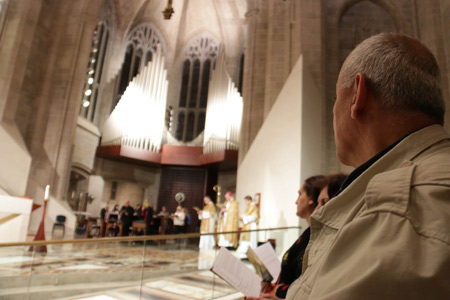 A man prays during a special service Nov. 20 at the Cathedral of the Most Blessed Sacrament in Detroit for the protection of Christians in the Middle East.
Jonathan Francis | Archdiocese of Detroit
Reasons for not meeting the goal include a widespread delay in security clearance acquisition for refugees; exit visa issues as well as asylum law changes in Turkey; refugee interviews and referrals being halted in Lebanon due to embassy logistical constrains; and no interviews being held in Baghdad since June 2014.
Many are concerned about the vetting process refugees undergo in order to reach the United States — concerns that were compounded when a terrorist who participated in a November attack on Paris was found with identification papers from a refugee checkpoint in Greece.
When refugees apply for asylum in the United States, the United Nations High Commissioner for Refugees provides camps for temporary living arrangements. The UNHCR then refers the refugees to a third-party nation for possible resettlement.
Before arriving in the United States, the U.S. State Department, the Department of Homeland Security and the Federal Bureau of Investigation vet the candidates’ background — a process that can take up to 24 months to complete.
Upon being cleared by the United Nations and the State Department, refugees are assigned to organizations like the USCCB, which study each case to determine where a refugee could be settled. When the USCCB assigns a case to CCSEM, Catholic Charities interviews the refugees to find out where they want to live, what language and work skills they have and whether they have family in the area who might assist in the relocation process.
“Our goal is to work with every individual refugee to get them to the point of self-sufficiency,” Hattar said. “We consider what living preferences they might have, and if they’re people of the same culture in the area. But we do promote diversity, because we don’t want to create ‘refugee communities’ that would not be economically viable and would not set people up for success.”
As more refugees come into the area amid increasing debate among lawmakers, Hattar encourages local Catholics to call their government officials to show support.
“I would encourage all Catholics to review Catholic social teaching, read the many verses of the Bible concerning people on the run and Jesus calling on us to help a stranger,” Hattar said. “Contact your politicians, educate yourself. If you’d like to know more about refugees, contact CCSEM, we’d love to help in any way we can.
“For those who want to do more — volunteer,” she added. “We have a big need for household items; winter boots, coats and hats. We need people to mentor refugees as they transition into life in America. Help us make our community a welcoming place and encourage them in the integration. But most of all, be open-minded.”