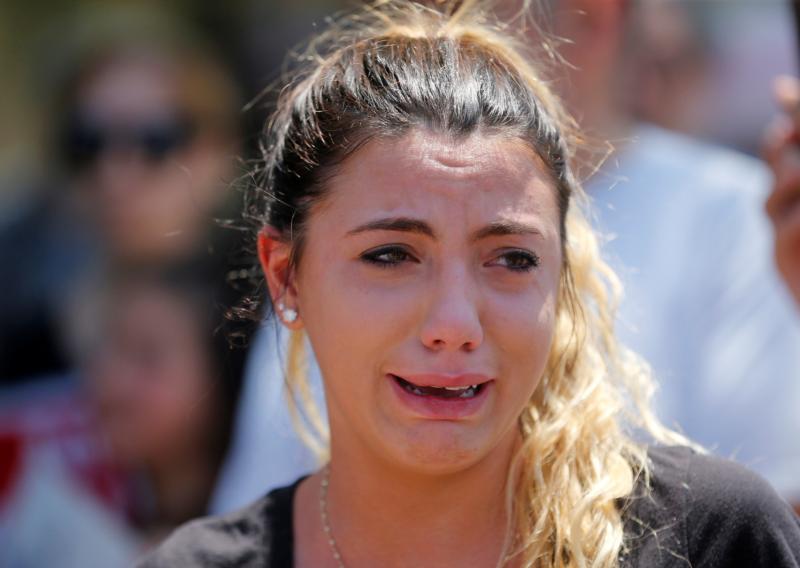
 Chaldean-American Lavrena Kenawa cries during a June 12 rally outside the Mother of God Chaldean Catholic Church in Southfield, Mich. Her uncle was among dozens of Chaldean Christians who were arrested by federal immigration officials over the weekend of June 10 and 11 in the Detroit metropolitan area, which members of the local church community said left them sad and frustrated.
 Detroit — Local Catholic leaders are troubled over federal immigration officials’ arrest of more than 100 local Chaldeans June 10-11, urging federal officials to reconsider their position.
News reports said about 40 people were arrested near or at their homes and put on buses June 12 to be taken to a federal detention center in Youngstown, Ohio. The same day, a rally outside Mother of God Chaldean Catholic Church in Southfield drew dozens of people, many of whom said the federal government's actions had left them sad and frustrated.
Bishop Francis Y. Kalabat of the Southfield-based Chaldean Eparchy of St. Thomas the Apostle, the spiritual base for Chaldean Catholics in the eastern half of the United States, called the roundup a “very strange and painful day for our community in America.”
“With the many Chaldeans that were awakened by Immigration Customs Enforcement (ICE) agents and consequently picked up for deportation, there is a lot of confusion and anger,” Bishop Kalabat said, adding the eparchy is working with federal agencies, representatives and the U.S. and Iraqi embassies to “try to stop this bleeding.”
Chaldean leaders and others expressed concern over the possible deportation of local Iraqi Christians, given the dangers posed by the Islamic State and militant groups targeting Christians in their native land.
Federal officials defended their actions in the Detroit Free Press, saying the immigrants they detained have criminal backgrounds and were targeted for deportation after a deal struck with the Iraqi government.
"As a result of recent negotiations between the U.S. and Iraq, Iraq has recently agreed to accept a number of Iraqi nationals subject to orders of removal," said Khaalid Walls, spokesman for the Michigan office of ICE (Immigration Customs and Enforcement). "As part of ICE's efforts to process the backlog of these individuals, the agency recently arrested a number of Iraqi nationals, all of whom had criminal convictions for crimes including homicide, rape, aggravated assault, kidnapping, burglary, drug trafficking, robbery, sex assault, weapons violations and other offenses."
Bishop Kalabat said the eparchy does not oppose justice or the rule of law, but stated many of the individuals detained by ICE posed no threat to society.
"The church does not oppose justice; all hardened criminals that are a danger to society should be picked up," Bishop Kalabat said. "Many who were picked up are not hardened criminals, but for the last decades have been great citizens."
Bishop Kalabat added the deportations stand in contrast with U.S. government's recent declaration of the ongoing atrocities committed by the Islamic State as "genocide."
"The genocide bill that was just passed by Congress last week to protect Christians goes against this very thing," Bishop Kalabat.
A statement from Catholic Charities of Southeast Michigan, which helps resettle refugees in the area, said the agency was “deeply concerned” by the arrests, questioning the motive and timing of the sweeps.
“CCSEM recognizes and respects the need for law enforcement among citizens as well as documented and undocumented immigrants and refugees, especially in situations where individuals have committed violent and serious drug-related felonies,” the statement said. “However, enforcement targeting immigrant and refugee communities appears uneven, inconsistent, and with little to no substantive explanation from the federal authorities regarding the criminal records of those detained or how these sweeps make communities safer.”
Catholic Charities added sending Chaldean-Christians to Iraq, many of whom aren't familiar with Iraq or even speak Chaldean, is cruel and inhumane given the recent violence against Christians in the Middle East.
"CCSEM wonders why the authorities are evidently targeting individuals who may have criminal records from offenses committed decades ago, who apparently have had no further brushes with the law," Catholic Charities stated in a release. "We are particularly troubled by the possibility of Chaldeans being deported back to Iraq, a country in which persecution of Christians has lessened only because there are so few Christians remaining there."
Catholic Charities added it is working with local agencies to discern what can be done to help families and individuals affected.