

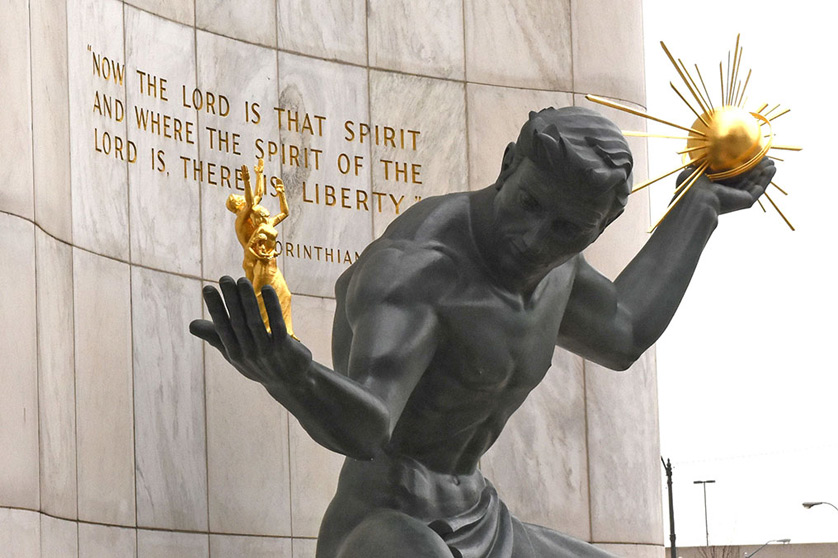
 The Spirit of Detroit, with a Scripture verse behind it, represents the spirit of man with a symbol of God in one hand and a symbol of the family in the other. Late Supreme Court justice Antonin Scalia embodied the ideals of liberty, family and faith, and blended them seamlessly into his work as a justice, Detroit-area Catholic , lawyers say.
Mike Stechschulte | The Michigan Catholic
A proud Catholic, late justice did his best to serve both God and country
Detroit — On Feb. 13, the nation learned of the death of Justice Antonin Scalia.
Scalia, appointed to the Supreme Court by President Ronald Reagan in 1986, left an incredible mark on American legal history as a staunch supporter of originalism — the legal theory of interpreting the Constitution as the Founding Fathers intended — and a proud, professed Catholic.
“Justice Scalia was an important and significant part of the history of our constitutional legal system, and he was one of us,” said G. Christopher Bernard, communications secretary of the Catholic Lawyers Society of Detroit. “The fact that he was, and for eternity is, Catholic should be a source of pride for all of us who practice the faith, whether you agreed with his opinions or not.”
Scalia made history as the first Italian-American appointed to nation’s highest court. Analyst said Scalia was proud of his Catholic faith, but it didn’t necessarily drive his legal decisions.
“Scalia wasn’t shy about his Catholicism in his personal life, but in his understanding on how to interpret legal text, I don’t know if that was driven by theology or religious faith,” said Richard Broughton, associate professor of law at the University of Detroit Mercy Law School. “There were times when he was against the prevailing thought of Catholicism and its interpretation of the law.”
Broughton noted Scalia rigorously opposed abortion, while at the same time rejecting the notion that the death penalty was unconstitutional. The Church strongly opposes abortion, and recent popes have spoken out against the death penalty and urged modern nations to move away from it.
During his time on the court, Scalia was noted for his scathing dissents and standing up for his principles, something Bernard said should inspire lawyers.
“He was a follower of Christ Jesus who took to heart the Lord’s teaching to treat everyone with justice in mind and to have a servant’s heart,” Bernard said.
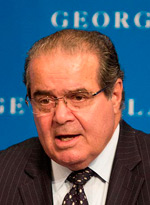 Supreme Court Justice, Antonin Scalia
Upon his death, the Supreme Court now has five remaining Catholic justices, meaning the nation’s highest court will still have a Catholic majority — an amazing feat, Broughton argues, given the predominantly Protestant history of the United States.
“A majority of the Supreme Court has been Catholic for some time, Vice President Joe Biden is Catholic and we’ve had plenty of Catholic governors,” Broughton said. “It’s a triumph of religious liberty in this country, where Catholics aren’t discriminated against in the world of politics.”
As for the impact of having a Catholic majority, Broughton said it’s hard to tell how much a justice’s faith affects how a person decides a case, given the political diversity among the Catholics on the court.
“Justice Anthony Kennedy is a great example of showing that it’s hard to categorize someone by their faith in comparison to their decision making,” Broughton said. “When you look at the Catholics on the court, on one end you have Roberts, Alito and Thomas, then you have Kennedy on the court and then you have Sotomayor among the liberal wing.”
While Scalia may not have agreed all the time with his fellow Catholics, such diversity speaks to what the late justice valued in legal opinion-making: a court focused on judging the law in an unbiased manner, regardless of background.