
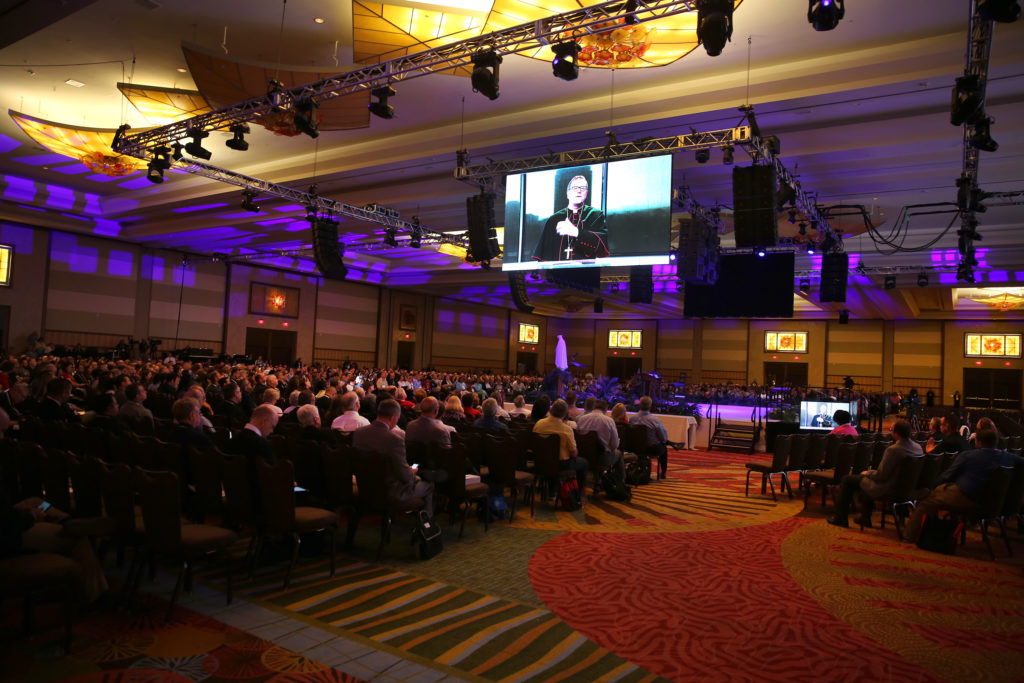
 Delegates listen as Los Angeles Auxiliary Bishop Robert E. Barron is projected on a screen July 4 during the "Convocation of Catholic Leaders: The Joy of the Gospel in America" in Orlando, Fla. Leaders from dioceses and various Catholic organizations gathered for the July 1-4 convocation. (CNS photo/Bob Roller)
 Orlando, Fla. — Delegates at the “Convocation of Catholic Leaders: The Joy of the Gospel in America” conference have their work cut out for them, but they are equipped to do it, said speakers at the final plenary session July 4.
“The saints always loved a good fight, and we should like a good fight, too,” said keynote speaker Auxiliary Bishop Robert E. Barron of Los Angeles.
 The bishop, known by many of the delegates for hosting the documentary series “Catholicism” and the website “Word on Fire,” was unable to get to the Orlando hotel where the convocation was taking place because of problems with his flight, so he greeted the crowd through a video hookup.
At the start of his talk, he cited sobering Church statistics about the decreasing number of Catholics today that some delegates heard during the breakout sessions. For every Catholic who joins the Church, six leave, he said, also citing the number of “nones” — those who claim no religious affiliation even if they were Catholic.
The bishop let this sink in and then went straight to encouraging delegates to move forward saying: “It’s an exciting time to be an evangelist.”
A major obstacle challenging Catholics who want to evangelize the modern world is that they are up against, as he put it: “a culture of meh,” which is akin to a shrug of the shoulders, or an attitude of “whatever” or anything goes.
Fr. Jeff Day, the newly installed deputy moderator of the curia for the Archdiocese of Detroit, attended the convocation along with several others from Detroit. He told The Michigan Catholic that ministering to the “nones” needs to begin with “shallow entry points” to the faith, building a relationship of understanding and compassion.
 “We need to be understanding of who is in the periphery of your parish,” Fr. Day said. “What I heard was some good news, in fact. Most of the ‘nones’ are not atheists, they haven’t made a philosophical statement saying they don’t believe in God. They’ve just drifted out of the practice of their faith.”
Fr. Day added the best way to reach people on the peripheries is through a joyful witness of the Gospel, showing people how giving one’s life to Christ enhances their lives.
The national convocation was a chance for bishops, priests and lay ecclesial leaders from around the country to discuss the state of the Church and what U.S. dioceses need to do to bring the Gospel to people in the 21st century.
“It felt like a national conversation Detroit has been having for the last three or four years,” said Fr. Stephen Pullis, director of evangelization, catechesis and schools for the archdiocese. “But to hear what that looks like in rural Nebraska, or the Hispanic community of Brownsville, Texas, or from other urban areas was eye-opening.”
Fr. Pullis said the conversations he had with priests from around the country showed him the archdiocese was on track with recent events such as Synod 16 and the release of Archbishop Allen H. Vigneron’s pastoral letter, an item many at the convocation read and asked Fr. Pullis about during the convocation’s breakout sessions.
 “There is a line in the archbishop’s letter on how God loves to set dry wood on fire to start the flame,” Fr. Pullis said. “And it really focused on how Detroit has had all the problems that are well known in the country with the civil unrest, the blight, and people leaving the city. It really put us in a privileged position to say that we have been brought low and we have the freedom to have this total dependency on God to use what I see as a grace we have.”
Auxiliary Bishop Donald Hanchon said he was inspired by the talks from Archbishop Jose H. Gomez of Los Angeles and Cardinal Joseph W. Tobin of Newark, N.J., about the need to go out and minister to the people, regardless of what the situation or protocol might dictate.
“Archbishop Gomez gave a great talk about immigration and the Church’s need to call for reform,” Bishop Hanchon said. “Cardinal Tobin talked about how we need to address the things we see. He talked about how with Pope Francis, becoming pope improved his perception of reality. When he was the Archbishop of Buenos Aires, he didn’t have to deal with immigration or migrant issues. But a couple of weeks after his election, there was a terrible shipwreck of migrants. He was so moved by this, said he wanted to go there. His secretary said, ‘You have just been made the pope; when you travel it sends a message.’ Then the next week, the secretary of state got a call, saying Jorge Mario Bergoglio just booked a seat on a plane.”
—Catholic News Service contributed to this report