

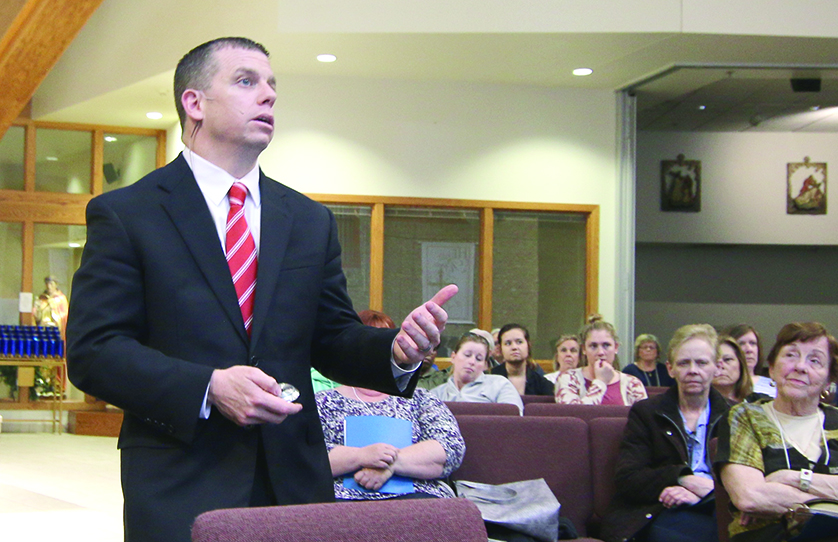
 Kevin Mulcahy, executive assistant U.S. attorney for the Eastern District of Michigan, talks about how the U.S. Department of Justice investigates and prosecutes perpetrators of human trafficking May 12 during a symposium at St. Thomas a’Becket Parish in Canton.
Canton — When people think of slavery in America, it usually conjures images from the 19th century — a practice from a different time, before the Emancipation Proclamation in 1864 or the passage of the 13th Amendment in 1865.
While that form of slavery is gone, another kind has crept into American life: human trafficking.
On May 12, Catholic and Protestant communities gathered with law enforcement at St. Thomas a’Becket Parish in Canton for a symposium on human trafficking in Michigan, hosted by the Pearls of Great Price Coalition, a interfaith group dedicated to raising awareness and fighting the scourge.
Pearls of Great Price Coalition founder the Rev. Carrie Wood, a retired United Methodist pastor, opened the symposium by saying churches need to confront that human trafficking happens in southeast Michigan.
“Sex and labor trafficking is happening our communities,” Rev. Wood said. “Michigan has been reported as the No. 2 state in the country in human trafficking. You can only sell drugs or a gun once, but you can sell a person over and over again.”
The symposium featured clergy and law enforcement discussing what leads to human trafficking, what fuels the illicit industry and what’s being done to stop it.
Rodney Riggs, special agent with the Department of Homeland Security Investigations in Detroit, offered examples from Michigan’s own backyard.
“Trafficking involves force, fraud, and coercion methods used by the trafficker to have control over a person,” Riggs said. “In Bad Axe, we had a case where a man promised undocumented immigrants $30 an hour, but it turns out he paid them $8 an hour. He then threatened to have them deported if they complained or left the job.”
Riggs said traffickers have unlimited control over people, which is why many victims don’t escape.
“Traffickers take advantage of people not knowing the law, they take away their identification, make it so the victim is completely dependent,” Riggs said.
The Rev. Angelique Labadie-Cihanowyz of Stroudsburg Wesleyan Church in Pennsylvania spoke about how pornography creates and many times bankrolls the trafficking industry.
“The aspect of human trafficking not often talked about is how pornography creates demand for human trafficking,” Labadie-Cihanowyz said. “Would you support a business if they abused their employees? Most pornography doesn’t want you to think about the forced coercion, the violence related to human trafficking.”
Kevin Mulcahy, executive assistant U.S. attorney for the Eastern District of Michigan, talked about how the U.S. Department of Justice investigates and prosecutes traffickers.
“Predators know it’s easier to exploit children online,” Mulcahy said. “Kids need to be taught, once you send a picture of yourself to someone, you’re giving them power.”
Mulcahy discussed social media sites such as Kik, an anonymous texting app law enforcement identifies as being popular for predators because it’s hard for law enforcement to track down the IP address of perpetrators.
“Parents need to tell their children how hard it is to get images off the Internet,” Mulcahy said. “And my final piece of advice, make a rule, you have to be their friend on social media. If they don’t want to do that, get a snitch. I know you all have a niece or nephew your child looks up to, make that person your snitch.”
At the end of the conference, Rev. Wood told The Michigan Catholic that churches must be leaders in fighting human trafficking in southeast Michigan.
“The Church needs to be willing to talk about the hard issues,” Rev. Wood said. “It was good to see so many come here today, so many topics were covered. … Jesus tells us to look out for the marginalized, and I can’t think of a group more marginalized today than victims of trafficking.”
Polaris Project
The Polaris Project is a leader in the global fight against human trafficking, endorsed by the U.S. Department of Justice and the Federal Bureau of Investigation. It operates the national human trafficking hotline, 1-888-373-7888, for anonymous tips on suspected human trafficking.