
Archbishop Vigneron inaugurates extraordinary Jubilee of Mercy in Archdiocese of Detroit
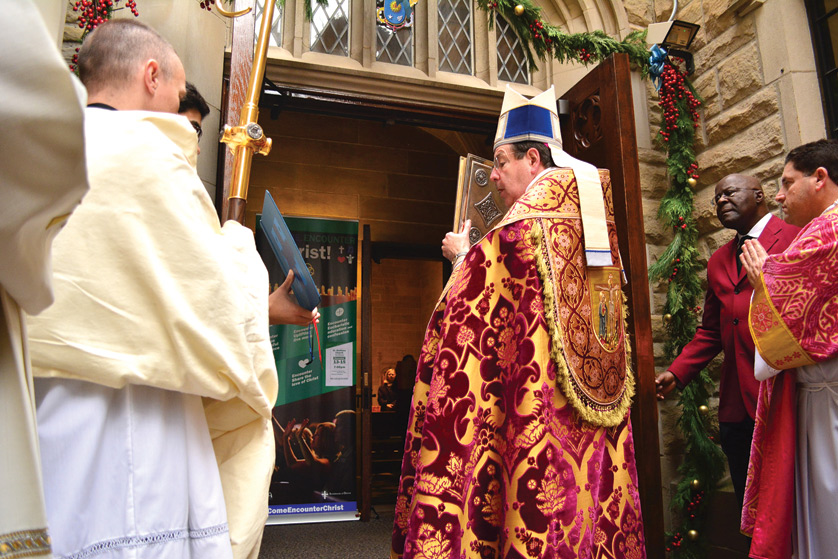 Archbishop Allen H. Vigneron holds the Book of the Gospels as he processes through the Holy Door at the Cathedral of the Most Blessed Sacrament on Dec. 13. The opening of the Holy Door also marks the beginning of the extraordinary Jubilee Year of Mercy for the Archdiocese of Detroit, which will continue until the feast of Christ the King on Nov. 20, 2016 and the end of the Archdiocesan Synod on Evangelization.
Mike Stechschulte | The Michigan Catholic
DETROIT — Donna Lally of Marine City entered the Cathedral of the Most Blessed Sacrament on a misty Sunday morning and left a quarter-century’s worth of baggage at the door.
Through the Holy Door of Mercy, Lally returned to the Church of her youth, receiving the Eucharist for the first time in nearly 25 years during the Mass that followed.
“I just recently returned to the Church after being away for nearly 25 years. A friend of mine kept telling me bits and pieces about this, and I went online and started reading about it. Everything just fell into place this whole week,” an emotional Lally told The Michigan Catholic afterward.
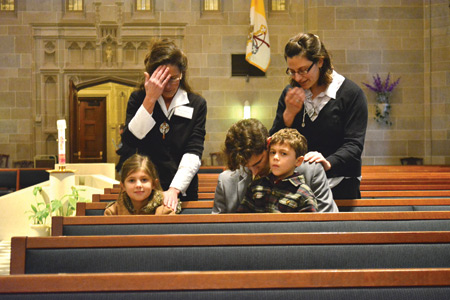 Volunteers from the Dive Mercy Center in Clinton Township pray with families inside the Cathedral after Mass.
“I came back to church, I went to confession, I came down here and had Communion for the first time in how many years,” she said. “It’s like everything is coming together inside. I feel it in my heart, my stomach, my soul. It’s all coming together in peace.”
If that’s not the perfect start to an extraordinary year of grace, nothing is.
Lally, of Marine City, was one of nearly 800 pilgrims who attended the Mass and opening of the Holy Door of Mercy on Dec. 13 with Archbishop Allen H. Vigneron, who ushered in the Jubilee Year of Mercy proclaimed by Pope Francis for the world.
“The archbishop said it today, it’s that mercy,” said Lally, who received confession two days earlier at Holy Cross Church in Marine City and is considering joining St. Augustine Parish in Richmond. “I’ve been looking for it. Just come to Communion, you can have mercy, and you get grace. It was like opening the door (for me); it brought me back.”
The jubilee year, which began Dec. 8 on the feast of the Immaculate Conception and will continue until Nov. 20, 2016, the feast of Christ the King, is a reminder that God himself revealed to Moses that His very name is Mercy, Archbishop Vigneron told the congregation during his homily.
“Mercy is the face of God’s infinite and eternal love when he comes into the world to love us sinners,” the archbishop said. “So mercy is, we might say, the very DNA of salvation history. It’s the nuclear reactor, the engine that makes all grace powerful. It’s what lives in the heart of Jesus himself.”
Before Mass, the archbishop stood at the cathedral’s rear doors as Deacon Kevin Breen read the decree inaugurating the Holy Year in the Archdiocese of Detroit. The archbishop then led a
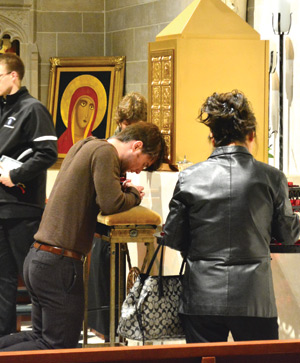 A man prays before the tabernacle after completing his pilgrimage through the Holy Door.
procession outside to the Holy Door, adorned with holly and ribbons, and knelt for a moment in prayer.
Standing up, he proclaimed, “Open the gates of justice,” and pulled open the door to cross its threshold, followed by the procession of faithful.
The Catholic tradition of Holy Doors dates to the Middle Ages and is historically connected with jubilee years. While there are only a handful of permanent Holy Doors in the world — mostly in Rome — Pope Francis has invited dioceses across the world to participate in the tradition during the Jubilee of Mercy.
The symbolism of such a tradition can be “a sacramental sign of something profound,” Archbishop Vigneron said, because of its connection to the everyday acts of “leaving and entering.”
“What’s up with the door?” he said. “It’s about leaving behind our junk, our garbage — whatever impedes us from accepting God’s mercy,” such as grudges or hurts, or the lie the devil tells that “it’s hopeless, it really can’t get any better, and you’re a loser.”
“There are many things that keep us from entering the door of mercy,” the archbishop said. “The jubilee is a time to put all of that behind and keep going ahead forward; there’s no other way to go.”
While the Holy Door is about leaving the past behind, he said, it’s also about entering to receive what’s on the other side: “And here at this cathedral, I’m especially glad that what’s exactly on the other side of our Door of Mercy is the Blessed Sacrament.”
“Christ is both the door, the way into mercy, and he’s what’s on the other side of the door,” the archbishop said. “And especially here in the archdiocese, we are also called to share what we find on the other side of the door; we’re called to invite other people to walk through the door with us.”
Archbishop Vigneron said Pope Francis has asked bishops across the world to participate publicly in the spiritual and corporal works of mercy as an example during the jubilee year, “and I will,” he said. “I will visit the imprisoned, I will go to the sick, counsel the doubtful.”
The spiritual and corporal works are equally important, the archbishop said, but “the ultimate act of mercy that we are all called to share is to love, especially those who find themselves loveless.”
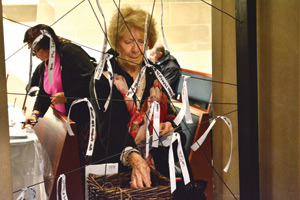 A pilgrim ties her prayer ribbon to the chapel wall inside the cathedral.
After Mass, the faithful were invited to participate in a pilgrimage around the cathedral plaza, stopping at various stations where salvaged doors were set up to reflect on the various “doors” of life and ways to show mercy to others.
After ending the path at the Holy Door, pilgrims entered the Blessed Sacrament chapel to spend time in prayer. People were invited to write prayer intentions on ribbons, which would be left on the chapel’s wall, and to take someone else’s ribbon and pray for them. During the Year of Mercy, the prayer intentions left inside the chapel will be offered up during Masses at the cathedral.
Inside the cathedral, volunteers from the Divine Mercy Center in Clinton Township were also available to pray with people.
Eric Agustin, a father of seven, brought his family to the cathedral because “we need that spirit of mercy in our household,” he said.
“We prayed a little bit right before we walked through the door, trying to make sure our interior disposition is where it’s supposed to be as you go through the door that is Christ, approaching Christ in the tabernacle,” Agustin said. “It’s such a crazy, fast world these days, it’s hard to slow down. I feel like the Catholic Church and the pope is trying to help us do that.”
Sandy Schroeder, a parishioner of St. Mary, Our Lady of the Annunciation in Rockwood who stopped to reflect at one of the stations, said the pilgrimage is a good way “not just to receive mercy, which we all need, but to give mercy.”
“That was a big thing I came away with,” she said, “Not just to accept God’s mercy for everything that’s been done, but to give it to others.”
Pilgrims are invited to take the pilgrimage all year long, with a plenary indulgence attached to the Holy Door, which will be open from 1-3 p.m. every Sunday, and 9 a.m. to 2 p.m. on the first Friday of the month. Groups of more than 15 can schedule a group pilgrimage by visiting the archdiocesan website.
A plenary indulgence — as opposed to a partial indulgence — is the complete remission of the temporal punishment due to sin. An indulgence does not forgive sins; rather, to receive an indulgence a person must be in a state of grace after sacramental confession, have received Holy Communion recently, pray for the intentions of the pope and be completely detached from sin.
Indulgences may be granted to the faithful who perform certain pious acts, such as visiting a basilica with reverent intentions on a prescribed day or walking through a Holy Door.
Photo gallery
For more photos from the opening of the Holy Door, visit gallery.themichigancatholic.com.