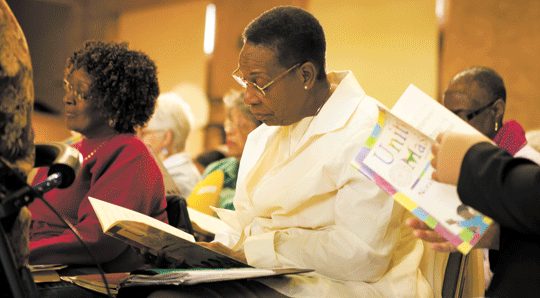
DETROIT — Almost everybody has heard something about forthcoming changes in English-language Masses and the music used with them, but many may not be quite clear about just what is changing, the reasons for the changes, and precisely when those changes are coming.
|
Catholics throughout the English-speaking world will begin using the new translation of the Mass as of the first Sunday in Advent, Nov. 27 (including vigil Masses celebrated the evening before).
The translation was done with the intent of better reflecting the meaning of the Latin text of the Novus Ordo Mass (the Latin being the authoritative original to which all vernacular translations should conform).
But even before use of the new English translation becomes mandatory, many Catholics in the Archdiocese of Detroit will begin experiencing portions of the revised liturgy as early as next month.
In order to help people get accustomed to the changes, the U.S. bishops have given permission to use the new translations of the Gloria, the Sanctus (or Holy, Holy) and what used to be called the Memorial Acclamation at all Masses at which these parts of the Mass are sung, beginning the weekend of October 22-23.
And some parishes taking advantage of this dispensation already have begun rehearsing those portions with their choirs.
The changes in the portions of the Mass sung or said only by the priest — or said by priest and people, such as the Creed — still cannot be used until the first weekend Masses in Advent, and even the portions being introduced ahead of time cannot be used at said Masses until then.
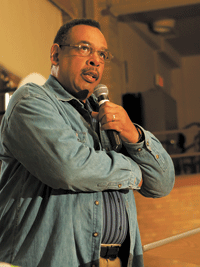
The reason there has to be new music for the revised texts is because “the old music wouldn’t fit the new words,” explains Ronald Prowse, A.Mus.D., associate professor of music at Sacred Heart Major Seminary.
And, Prowse adds, one of the reasons many parish music directors had requested permission for some advance preparation was that they didn’t want parishioners to encounter the revised Gloria for the first time on Christmas Eve or Christmas Day, since the Gloria is omitted during Advent.
Some of the musical settings are brand new, while others are adaptations of existing music, so some parishioners will find their parish using a revised version of Marty Haugen’s “Mass of Creation,” while others might encounter an entirely new setting, such as the “Unity Mass” by Norah Duncan IV, former associate director of the archdiocesan Office of Worship.
The new translation of the Mass into English follows the principles set forth in “Liturgiam Authenticam” (“Authentic Liturgy”), a Vatican document issued in 2002, says Dan McAfee, director of the archdiocesan Office of Worship.
The new translation and the one it replaces reflect differing philosophies about how translations should be done. The old translation was done in a spirit of “dynamic equivalence,” which allows for considerable leeway in presenting the content of the original Latin in familiar English, McAfee explains.
The approach called for by “Liturgiam Authenticam,” on the other hand, places greater importance on finding English words that more precisely convey the exact meaning of the Latin, even if that means using words that are less familiar and a more formal style of speaking.
The translators who worked on the new text “were not trying to do a slavish translation, but trying to get to the heart of the Latin original, because sometimes there’s a real theology embedded in the words and sometimes we lost that with the dynamic equivalence approach,” McAfee says.
And if the revised language seems more formal, well, that’s only appropriate, he continues: “When we talk to different people, we talk to them in different ways, for example, if you were in front of a judge. When we talk to God, the Creator of the universe, we address him a little more formally.”
To prepare for the change, many of those involved in music ministry have been or will be attending workshops offered by the archdiocese, and McAfee has been speaking about the forthcoming changes at parishes across the archdiocese.
The Knights of Columbus are giving copies of the new Roman Missal to all priests who celebrate weekend Masses, and the archdiocese is supplying parishes with pew cards.
Fr. Gary Smetanka, pastor of Our Lady Star of the Sea Parish in Grosse Pointe Woods, says the new translation is “very rich” in meaning, “and opens us to other images, perhaps other feelings than has been the case with the other translation.”
“It comes at a good time for all of us in the United States, as we use the new prayers to renew our understanding of the importance of the liturgy and how we celebrate it. It’s an exciting time for us to be renewed in our celebration of the Eucharist. I think we should let the Holy Spirit work, and see the fruitfulness that comes out of it,” Fr. Smetanka adds.
The Cathedral of the Most Blessed Sacrament is one of the parishes where the new Mass settings will be introduced early, with distribution of a booklet, “Understanding the Revised Mass Texts,” this weekend, says Nancy Deacon, its director of music.
Then, until new hymnals arrive early next year, pew cards with the portions sung by the people will be distributed each Sunday once the revisions begin being used in October, she adds.
Not all parishes are planning to use the new texts ahead of time, however. At Our Lady of Hope Parish in St. Clair Shores, Susie Taylor, director of music ministries, says she will start rehearsing the new settings with the choir on Oct. 5, and will give short presentations about the forthcoming changes before Mass on the three weekends before Advent, but the new settings won’t be used during Mass until Advent begins.
“I think the changes will be embraced by the community — they’re not all that difficult,” Taylor says.
Her counterpart at St. Edith Parish, Livonia, Heather Nofar, is also waiting until the first weekend of Advent.
“I think the changes are beautiful, because they glorify Jesus in the Eucharist a whole lot more. It’s exciting, and an opportunity to accept and embrace change in a positive way in order to glorify Christ more,” she says.
But based on her own experience with the introduction of changes last year in the Chaldean Mass at her home parish, Nofar says she believes it is best to just introduce the changes without a lot of fanfare.
“That’s what we did at St. Thomas (Chaldean) in West Bloomfield Township, and the people had no problem accepting it,” she says.