
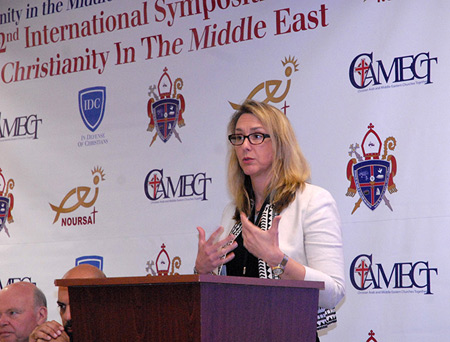
 Kristen Evans, executive director of In Defense of Christians, said it is the responsibility of citizens - especially Christians and Muslims - to call their congressional representatives to put more pressure on the U.S. government address the ISIS threat.
SOUTHFIELD — Pray for those oppressed, organize into one cohesive voice for good and call on others to commit to action to promote peace.
These were the themes emphasized by religious and secular leaders at a three-day international symposium on Christianity in the Middle East from July 17-19 in Southfield.
Speakers from around the county and the world described the peril facing Christians in the Middle East amid threats from radical groups such as the Islamic State, urging Christians in the United States to help their brothers and sisters in Christ.
St. Thomas the Apostle Chaldean Catholic Eparchy hosted the symposium, titled “Christianity in the Middle East: Ever Ancient, Yet Ever New,” for the second time with Chaldean leaders from around the world, including Patriarch Louis Raphael Sako of Babylon, and leaders of institutions that promote the protection of Christians worldwide. The symposium was also sponsored by Noursat, a Middle Eastern Catholic satellite station, Christian Arab and Middle Eastern Churches Together (CAMECT) and In Defense of Christians.
“There are not enough people who know what’s going on and what we need to do to help our brothers and sisters in the Middle East,” said Bishop Francis Y. Kalabat of the Southfield-based eparchy. “The situation in Iraq and Syria is dire, and the situation is complicated. We don’t want Christians to live in an area where they are in danger, but we don’t want them to leave their ancestral homelands.”
The symposium featured a video message from Patriarch Sako, who discussed the importance of Christians in Arabic culture and how peaceful coexistence between Muslims and Christians is in the best interest of all in the Middle East.
“Christians have roots in the orient; they are the keepers of culture in the Middle East,” Patriarch Sako said in a message played July 18. “Christians have contributed much to Arabic culture for many centuries, and they have always been seeking peace and stability in the region.”
Jacques Kallassy, CEO of Tele Lumiere, the first Christian broadcasting station in Lebanon, gave attendees a firsthand account of the situation in the Middle East and the reason for the withdrawal of Christians from the region.
“The decline of Christianity in Lebanon is alarming,” Kallassy said. “Christians are feeing Lebanon, and it’s weakening the political position of Christians in the country. This will lead to the extermination of Christianity in Lebanon if ISIS is not stopped.”
An estimated 500,000 Christians have fled Syria and an estimated 100,000 have fled Iraq in the wake of attacks and anti-Christian messages from media outlets across the Middle East.
“The persecution and exodus of Christians from the region has left a brain drain on the economies in Middle Eastern countries,” Kallassy said. “We’ve been oppressed for 2,000 years, but now Christians are in a permanent state of fear.”
Despite the oppression, Kallassy and others said Christians desire to stay in their homeland and not surrender lands that have been Christian since the first century A.D.
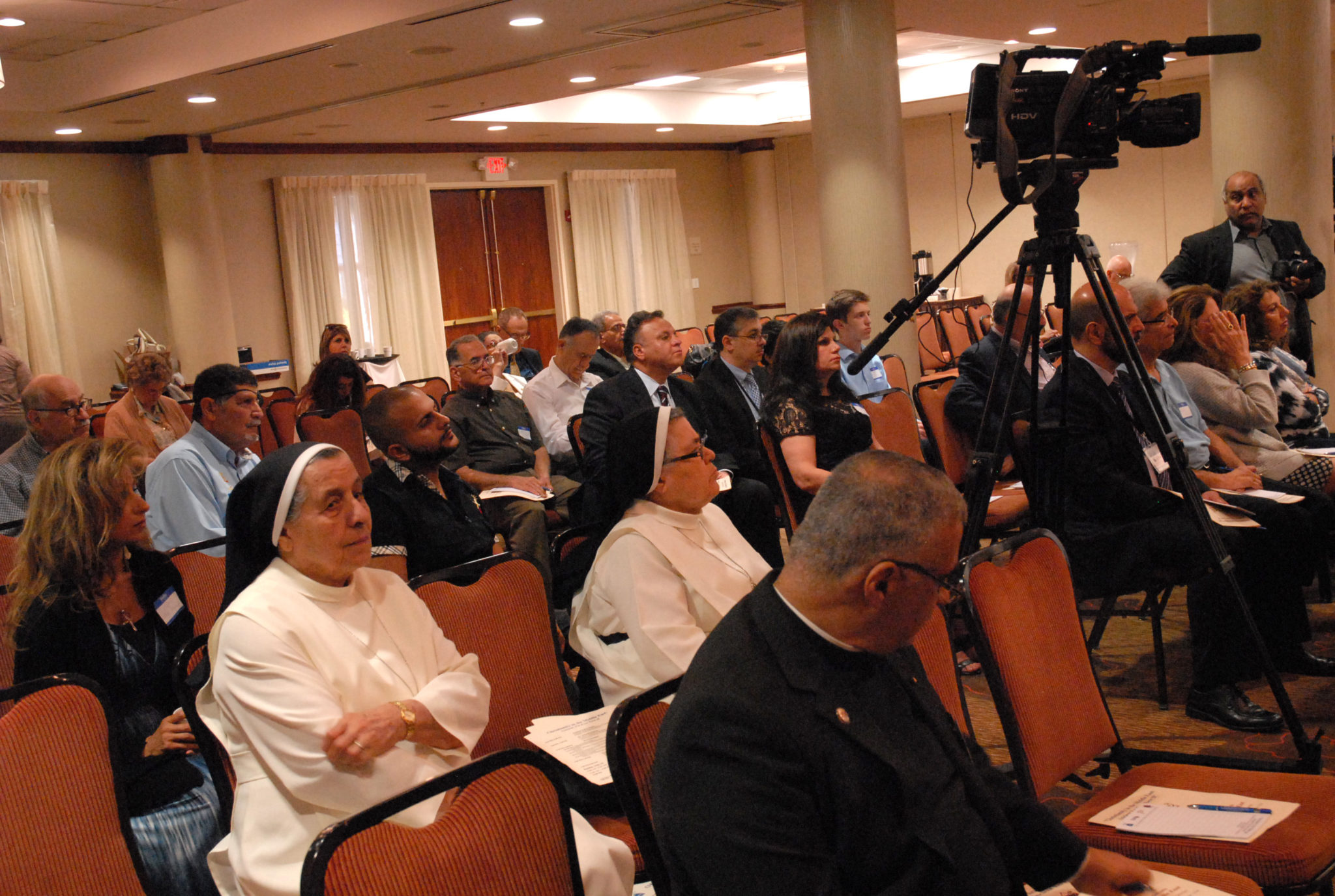 Attendees of the second international symposium on Christianity in the Middle East learn about the plight of Christians suffering persecution at the hands of ISIS in Iraq and Syria.
“We recommend the media promote a culture of change and peace,” Kallassy said. “We need to broadcast messages that value intercultural understanding and a dialogue of religious experiences. Small changes in the media can make a big difference. We should not fear for Christians if they leave the Middle East; we should fear for the Middle East if the Christians decide to leave.”
Gregory Stanton, a former U.S. Department of State employee and now founder and president of Genocide Watch, assessed the political situation in the region and talked about what international governments can do to halt ISIS.
“It’s important for us to first recognize who we need to help and how we’re called to help,” Stanton said. “Genocide is defined as the intentional destruction, whole or in part, of a group based on national, religious or ethnic identity. We need to recognize that this is genocide. The U.S. State Department doesn’t want to use the ‘G-word,’ because if we call it genocide, we’d feel obligated to do something about it.”
Stanton highlighted atrocities committed in the region by ISIS, including the attack on 14 churches in Egypt only two months after the Muslim Brotherhood came to power and the systematic targeting and identifying of Christians for state-sponsored persecutions and purges.
Stanton said ISIS targets any group that thinks differently and uses fear to force the population into submission.
“I’m a great believer of nonviolent resistance, but with genocide, I’m an interventionist,” Stanton said. “This is a spiritual and ideological battle. Humans are spiritual beings, so we must attack ISIS spiritually, talk to Muslim leaders about reforming Islam, have moderate speakers come out and condemn ISIS and promote diversity.”
Kirsten Evans, executive director of In Defense of Christians, a Washington, D.C.-based advocacy group, said action from governments will only happen when citizens demand it.
“People ask, ‘What can the government do?’ and the answer is, it can do a lot,” Evans said. “The question is, what willpower does the United States government have? It will be the American people who have to lead on this; their actions will lead the government to action.”
Evans recommended Christians call their congressional representatives about the importance of preserving Christianity and stability in the Middle East.
“This situation calls for Christian unity across the globe,” Evans said. “This should be a point of concern for every baptized Christian; we need to get all Christians to know the story. Unity, awareness and advocacy will solve this problem.”
The panel of speakers agreed the fight against religious intolerance is one everyone needs to address — both Christians and Muslims — everything from supporting charities that help refugees to pressuring policymakers to address the situation.
“We have three courses of action we can take,” said Maronite Bishop Gregory Mansour of the Eparchy of St. Maron in Brooklyn, N.Y. “We can pray and have good feelings about the situation. We can work as one group focusing on what we do. Or finally, we can all work together to promote change, to live in communion with other people.”
Before Saturday’s talks, a benefit dinner to support Christians in the Middle East took place at Farmington Hills Manor following an evening prayer session at St. Rafka Maronite Church in Livonia. On Sunday, the symposium concluded with final remarks and a Mass at Mother of God Chaldean Cathedral in Southfield.
“This is the illness of ISIS, to hate those who think different. We invite others to think different, to allow collaboration,” Bishop Mansour said. “That’s our antidote to defeat ISIS. This communion will suck out the poison and allow the region to heal.”
How to help
For information on how to help Christians in the Middle East, visit:
- www.helpiraq.org
- NOURSAT: www.noursat.tv/en
- Christian Arab and Middle Eastern Churches Together: www.camect.org/online
- In Defense of Christians: www.facebook.com/indefenseofchristians
- Genocide Watch: www.genocidewatch.net