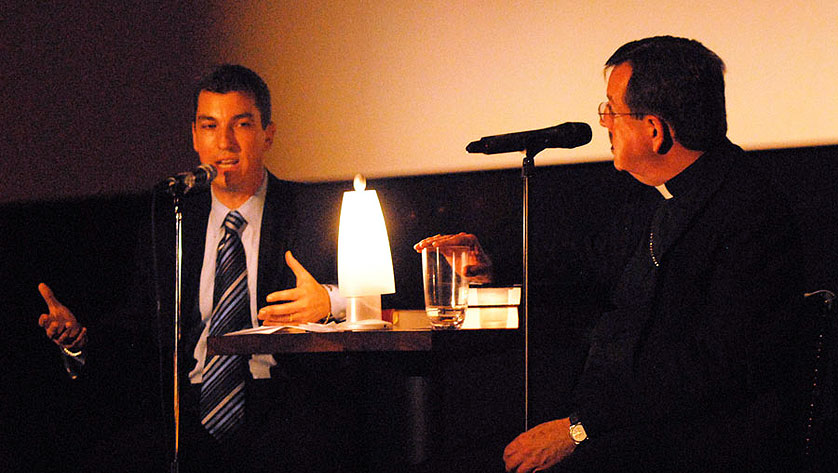
 Archbishop Allen H. Vigneron and Rabbi Joseph Krakoff meet Oct. 6 to discuss Catholic and Jewish understandings of the Garden of Eden story.
‘Historic’ discussion draws on Catholic, Jewish perspectives from biblical narrative
BLOOMFIELD HILLS — The two men sitting in the front of Theater No. 1 inside The Maple Theater on Oct. 6 were the reason for the lengthy line outside, as well as the packed seating for more than 300 people.
Rabbi Joseph H. Krakoff of Congregation Shaarey Zedek, and Archbishop Allen H. Vigneron were meeting for what they called a “historic” moment, as the two faith leaders were to discuss the similarities and differences of their traditions on a familiar story: the Garden of Eden.
This event, titled “In the Beginning,” was the first of a two-part series of ecumenical dialogue between the rabbi and archbishop.
As the event began, Rabbi Krakoff explained that “this is not a disputation, but a conversation among friends,” recalling that he first met Archbishop Vigneron at a clergy breakfast when the archbishop first came to the Archdiocese of Detroit.
Sitting at the same table that morning, Rabbi Krakoff said they began a conversation “that truly resulted in the friendship that we have today.”
“One of my goals in being here is to learn,” said Archbishop Vigneron. “I’m always happy to learn more about the meaning of God’s own word to us.”
What about the seven days?
The rabbi opened the conversation by asking about the Catholic view on the seven days of creation: “A question I often talk about with Jewish students, and I’m interested in the Catholic perspective – are we talking about seven 24-hour days?”
Archbishop Vigneron said from early on in the life of the Catholic community, the sense has been of “seven days” in poetic time. “And so, the seven days are certainly not seven 24-hour days,” he said. “It is part of the way to talk about how the world unfolds after God speaks.”
Rabbi Krakoff said he agreed: “We would say that this is ‘God’s time’ spoken of in the Torah, not ‘man’s time.’ So these seven days could have happened over many hundreds, many thousands, maybe even millions of years.”
Rabbi Krakoff said the seven days of creation are the origin of the Jewish seven calendar days in a week.
“From a Jewish perspective it’s particularly noteworthy the way the days are created: it says there was evening, and then there was morning,” he said. “Every Jewish day begins at sundown, and continues into the next day.”
Archbishop Vigneron said one of the many “borrowings” of the Catholic Church from the life of the synagogue consists in the similar Catholic tradition of days beginning at sundown.
“We, too, especially for our important days, say that the day begins the evening before,” he said. “So for our Lord’s Day, Sunday, it begins at sundown on Saturday.”
What was Eve’s role?
The two also discussed the creation of Eve as helpmate to Adam in the Garden of Eden, and how this structures the Catholic and Jewish views of man, woman and marriage.
“The woman stands as helpmate to the man,” Archbishop Vigneron said. “She is not made from his feet, not made from his head, but made from his side so that they partner one another.”
Rabbi Krakoff added to this from the Jewish tradition.
“This concept of this helpmate that they need to be with someone of a similar kind,” he said, giving the Hebrew term “ezer kenegdo.”
“’Ezer kenegdo’ literally means you have to find someone who isn’t always going to say ‘yes dear,’” explained the rabbi. “But you have to find someone who is actually going to challenge you. The only way they’re going to help us is if they don’t always agree with us, but they’re going to push us to be the best that we can be.”
The Tree of Knowledge
In thinking about the Tree of the Knowledge of Good and Evil, the theological question of good and bad was also discussed. While their traditions have some similarities here, Archbishop Vigneron and Rabbi Krakoff also acknowledged several differences.
“Our understanding is that our first parents, Adam and Eve, made a choice that had implications for their descendants,” Archbishop Vigneron said. “And when they made this choice they created a wound in the very fabric of human beings. For this wound we use the word ‘Original Sin.’”
He said Catholics therefore believe every person who comes into the world needs some kind of healing, since “we’re already behind on the score when we’re born.”
The archbishop said that healing comes through baptism, which the Church compares to circumcision: “It’s a way to become a member of a covenanted people.”
Rabbi Krakoff said in terms of how a person is born into the world, “I think this is a place where our traditions definitely converge away from one another.”
He explained that from a Jewish perspective, people are born morally neutral, with the capacity to do good and the capacity to do evil.
“Those inclinations fight themselves out on a daily basis,” said the rabbi.
When someone does choose the bad inclination, “when we fall short, we have to take responsibility, we have to be accountable for our sins, and we have to go to that person that we hurt, that we sinned against, and ask for their permission to be forgiven,” he said.
Archbishop Vigneron agreed on the moral responsibility of the person who does wrong, adding that in the Catholic tradition, confession with a priest speaking in the person of God will remove the sin of the person.
A common origin
In closing, the rabbi and the archbishop agreed that the story of the Garden of Eden is essentially everyone’s story.
“I think that’s the beauty in our ability to share these texts and to learn them together,” said Rabbi Krakoff. “There’s no question that it has brought the two of us together, and God willing, it will continue to bring our communities closer.”
Judy Loebl, director of adult Jewish education with the Jewish Federation of Metropolitan Detroit’s Alliance for Jewish Education, said she was “thrilled” at the turnout of the event.
“It turned out exactly as we envisioned it,” said Loebl, who spearheaded the plans for this lecture, as well as another upcoming on Nov. 3, on the binding of Isaac.
“A way we can really get along is to understand each other,” she said.
Michael Hovey, coordinator of ecumenical and interfaith relations with the Archdiocese of Detroit, said he was impressed with how “both religious leaders ‘spoke with authority.’”
“It was a fascinating and thoroughly enjoyable evening that both nourished my Catholic faith, and deepened my appreciation and love of the Jewish tradition and our Jewish ‘elder brothers’ (and sisters), as Blessed John Paul II called them,” he said.
The binding of Isaac
What: The second of a two-part “In the Beginning” series of interfaith discussions on the Book of Genesis that will focus on the story of the binding of Isaac from both the Catholic and Jewish perspectives
Who: Archbishop Allen H. Vigneron and Rabbi Joseph Krakoff
When: 4-5:30 p.m., Sunday, Nov. 3
Where: The Maple Theater, 4135 W. Maple Road, Bloomfield Hills
Register: $15 (unless registered for both lectures); call (248) 205-2557 or visit jewishdetroit.org/inthebeginning.