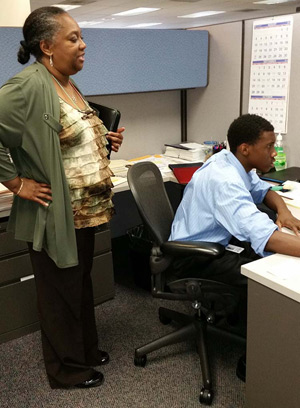
 A Loyola student is supervised while working for DTE Energy as part of his school's Work Experience Program, which prepares juniors and seniors with real-world experience.
Detroit — Loyola High School doesn’t just graduate students — it graduates young men who have financed part of their education through professional work experience.
The Loyola Work Experience Program (LWEP) requires all juniors and seniors to do what most students must wait until after college to do: use the personal and professional skills they’ve acquired in the classroom in a real-world workplace environment.
Loyola, which provides an educational option for approximately 150 young men, gives preference to students who might not have performed to their academic and social potential, said Fr. Mark Luedtke, SJ, the Jesuit school’s president. Now in its 22nd year, Loyola was founded as a response to the need for improved education for inner-city males, and the work program is an extension of that, he added.
“The LWEP program has been critical to the development of our students in particular, who often lack resilience and positive feedback,” said Fr. Luedtke. In workplace environments, these students can become more confident and self-assured. “It’s a blessing to see the young men thrive in the professional environments, and we expect that same behavior when they are back in the classroom,” Fr. Luedtke said.
Loyola’s work-study model, which began in 2003, is different from nearby Cristo Rey High School, in which students work all four years while attending high school. By contrast, Loyola’s work program doesn’t begin until students’ junior year, keeping underclassmen in the school to concentrate on academics.
What Loyola students would earn as part of their work experience is given to the school to help reduce the gap between what students pay in tuition (an average family contribution of $2,100) and the actual cost of their education (about $18,000).
“We fulfill our mission by working with the students we have, and keeping class sizes small to assist our students,” Fr. Luedtke said.
The work model reinforces the apprenticeship relationship, whereby adolescents quickly learn that the professional he is working alongside cares about him and his future.
“These meaningful relationships send a message of empowerment to our young men,” Fr. Luedtke said. “They can and do find success in school and in the workplace.”
At their workplace sponsors, which vary from multinational corporations to small firms and nonprofits, Loyola juniors and seniors work one day a week in entry-level clerical positions at law and accounting firms, hospitals, manufacturers, and other service providers. In addition to their weekly jobs, students also work one Friday per month.
Loyola provides students with transportation to the work site in the morning and back to the school at the end of the workday. Prior to entering the program, students undergo an intense, weeklong training session that includes sessions on Microsoft Word and Excel, diversity in the workplace, clerical skills and business etiquette.
LWEP Director Joe Kidder works directly with every student and his sponsor.
Betsy Schulte, director of volunteer services at Beaumont Hospital in Grosse Pointe, recalled Loyola student Terry Davis as a perfect example of the rewards of the program.
“He became more personable and seemed to enjoy the challenge of his busy workday,” Schulte said.
Loyola’s Work Experience Program director Joe Kidder, who works with each student and their sponsors, said the positive work experience is something freshmen and sophomores come to look forward to during their upperclassmen years.
“Knowing the program is coming in their junior year incentivizes the young men as freshmen and sophomores,” Kidder said.
When the year ends, students leave with the knowledge that real-world professionals at many local organizations believe in them, which Schulte confirmed.
“I have a personal, vested commitment to the overall success of this program,” she said.
Loyola student Cory Hewitt, while placed at IHS Automotive, was given a college-student mentor whom he said transformed him into a positive and self-motivated individual.
“More than anything, I am grateful for meeting such a person, who, other than my parents, I can call my hero,” Hewitt said.