
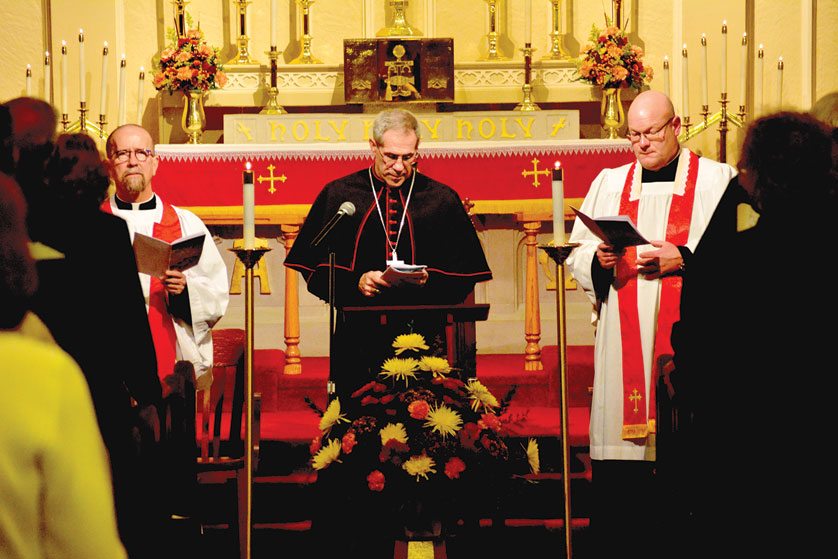
 Archbishop Michael J. Byrnes joins Fr. Stephen Rooney, left, pastor of Our Lady on the River Parish in Marine City, and the Rev. Troy Waite, pastor of St. Martin’s Lutheran Church, in an ecumenical prayer vigil Oct. 30 to mark the start of a year commemorating the 500th anniversary of the Protestant Reformation. (Mike Stechschulte | The Michigan Catholic)
Prayer service marks start of 500th anniversary of Protestant Reformation
MARINE CITY — When Fr. Martin Luther tacked his 95 theses to the church door in Wittenburg, Germany, in 1517, few would argue his intention was to start a movement that would divide western Christianity for the next 500 years.
Luther, in fact, was a Catholic, and while thousands of Protestant churches today trace their spiritual lineage back to his proposed reforms, both Catholics and Lutherans agree that such division is not what Christ intended.
On the eve of Pope Francis’ trip to Sweden to commemorate the start of the 500th anniversary of the Protestant Reformation, members of both faith communities gathered at St. Martin’s Lutheran Church in Marine City on Oct. 30 to pray for an end to division and the start of a new era of communion and cooperation.
Led by Auxiliary Bishop Michael J. Byrnes — who the next day would be appointed by the pope as coadjutor archbishop of Agana, Guam — the joint prayer vigil included clergy from Our Lady on the River Parish in Marine City as well as St. Martin’s and St. Paul’s Lutheran Church in Casco.
“Martin Luther reminds the church constantly that it’s through the grace of faith that we are Christians,” Archbishop Byrnes told those gathered. “This is our common unity: we abide not in a church, but we abide in a Person. Jesus Christ is the one upon whom our institutions rest, yes, but he must be the object of our intention.”
Fr. Stephen Rooney, pastor of Our Lady on the River Parish, said the idea for the joint prayer service grew out of previous ecumenical gatherings among Catholics and Protestants in Marine City. Fr. Rooney joined the Rev. Kristen Ulmanis of St. Paul’s Church, the Rev. Troy Waite, pastor of St. Martin’s Church, and Fr. David Bechill, associate pastor of Our Lady on the River, in praying with Archbishop Byrnes during the service.
“We’re all part of an ecumenical pastors group. On Good Friday, we do the Stations of the Cross together and do interfaith events during Lent especially,” Fr. Rooney said. “Pastor Kristen of St. Paul’s brought up the idea that because the pontiff is going to Sweden, it would be a good idea to do something locally.”
While the Reformation gave birth to the Protestant communities, the Catholic Church wasn’t immune to its effects, Fr. Rooney pointed out.
“The Reformation didn’t just affect the Protestant churches, but it had ramifications for Roman Catholics as well,” Fr. Rooney said.
Fr. Rooney said while some of Martin Luther’s reforms contradicted Catholic teaching, others were necessary given the state of the Church at the time — and in fact were eventually implemented.
“Much of what the Lutherans were looking for during the Reformation, we’re doing in the Church now — liturgy in the vernacular, Communion under both forms, greater lay participation in the life of the Church. And that’s not just because there’s a shortage of clergy, but it’s very much a movement of the Spirit that came out of the Reformation,” Fr. Rooney said.
Archbishop Byrnes lamented the “counterwitness” of divisions within Christianity, given the current culture of “nones,” or the growing number of people who profess no faith at all.
“They’ve rejected the institutions, but their heart still yearns for the Person, because he’s the only one who can satisfy their hunger,” Archbishop Byrnes said. “People are dying and they don’t know it. They’re starving and they don’t know it.”
Roland Woelkers, a member of Holy Cross Church in Marine City who attended the service, said while there is much that still divides Protestants and Catholics, unity can start with a common witness to Jesus Christ.
“I think the bishop hit it on the head when he said the largest growing religion is the non-religion,” Woelkers said. “The Christian community is getting smaller in our secular society, so we need to have that common Christian faith in Jesus Christ to bring us together and bring in all of those brothers and sisters who are going off on the wrong path.”
Randy Young, of St. Mary Parish in St. Clair, agreed.
“I work in the funeral industry, so I visit a lot of churches, and there’s a common bond between us,” Young said. “We’re all striving to be in the same place, on the same path.”
Fr. Rooney said ecumenical gatherings are a way for the Church today to continue striving toward the goal of unity, even if there remains much to be resolved.
“Part of the difficulty is the last prayer of Jesus at the Last Supper — ‘that they may be one’ — is the one prayer that has not been answered,” Fr. Rooney said. “We are not one. Our coming together is not only good for the Church, but it’s good for the world. It’s not just a theological exercise, but it’s an attempt to bring to fruition our Lord’s prayer that we may be one.”