
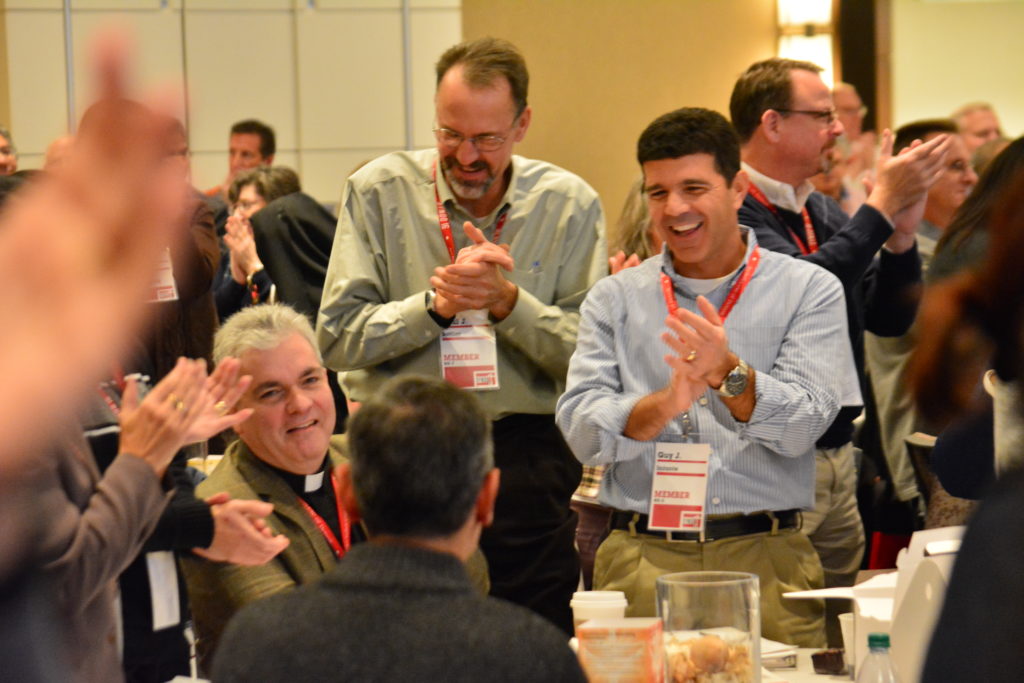
 Synod members clap and cheer in a round of applause for priests during the fourth and final session of Synod 16, on Archdiocesan Central Services, on Nov. 20. Sitting is Fr. Chris Talbot, pastor of St. Francis of Assisi-St. Maximilian Kolbe Parish in Ray Township. (Mike Stechschulte, The Michigan Catholic)
Archbishop Vigneron, in his introduction to the theme, told synod members he used to get a laugh at parishes when he would introduce himself by saying, “Hello, I’m Archbishop Vigneron. I’m from the archdiocese and I’m here to help.”
“In the upper level organization, people don’t always think of it that way, but I want to begin by assuring you that that is how my coworkers do think,” Archbishop Vigneron said.
“That said, please look at these propositions and ask yourself ‘How can the archbishop and his coworkers help the parishes and other communities of the archdiocese be missionary disciples?” the archbishop said. “The question is, how can we better serve? We really do want to hear that.”
In their small groups, members were asked to choose three propositions from among a group of 11 initiatives. After their deliberations, Fullam reconvened the assembly and revealed the top propositions.
Far and away, the top proposal was to, “build a framework for mutual accountability between pastors, parishes, schools and the Central Services. To build a foundation for this, heal wounded relationships, build trust and practice transparency.”
Vickie Figueroa, of Corpus Christi Parish in Detroit, felt healing — especially given the tensions of parish mergers and closings, strained finances and racial stresses — was paramount.
“We chose proposition No. 7 because of the many wounds and prejudice in the archdiocese, especially in the Central Region, which need to be healed,” Figueroa said. “For many, the Church needs to be a place where we make sure the people are heard, that they are loved. But Jesus is awesome, and once we get in the spirit of that, we’ll be joyful missionary disciples.”
The second highest vote-getter was to, “invest in people, processes and tools that ensure effective, anticipatory and responsive communication to all those engaged or seeking engagement with the Church.”
Ernesto Bridgnanan of Divine Child Parish in Dearborn, felt it was important for the archdiocese to “recognize that each parish is different, with different cultures and challenges.”
“We can’t have a ‘one-size fits all’ strategy, but we’d like to see Central Services develop a leadership structure that adapts to the growing needs of each parish,” Bridgnanan said.
Three other propositions tied for the third highest: developing formation around key areas of missionary activity; break down racial, ethnic and socioeconomic divisions; and supporting the re-envisioning of the mission, funding and governance of Catholic schools.
Each synod session was steeped in prayer, with members gathering for Mass or a prayer service to begin and end each day.
After the final session, Archbishop Vigneron celebrated the closing Mass at St. Aloysius, thanking members for their service and promising to reflect deeply on the synod’s results.
“For three days together, the Holy Spirit has been at work to show us how to share these saving graces with our neighbors and those we love,” Archbishop Vigneron said. “We give thanks that together, in the ballroom and in the hallway, we have shown publicly our allegiance to our crucified king.”
Following the synod, Archbishop Vigneron is expected to meet with the expert-advisers — whose task was to record notes about the synod discussions and serve as non-voting participants — before issuing his own account, likely in the form of a pastoral letter, by Pentecost 2017.
Archbishop Michael J. Byrnes, outgoing Detroit auxiliary bishop and a leading voice in organizing Synod 16, said whatever comes of the archbishop’s discernment, it’s likely to involve a call to a radical recommitment to Christ for every person in the Archdiocese of Detroit.
“The archbishop captured it well when he said this is personal, rather than programmatic. Evangelization is personal because Christianity is personal,” said Archbishop Byrnes, who in the week after the synod was scheduled to fly to Agana, Guam, to begin his new pastoral assignment as coadjutor archbishop there.
“And that’s something that for decades of living an institutional life, honoring the institution of the Catholic Church — which is an awesome institution — this is making us step back and say, ‘Wait a minute; this is about Jesus.’”
Archdiocesan Central Services
For the Archdiocesan Central Services theme, synod members were asked to identify which three propositions would be most critical to the task of forming a “joyful, missionary presence in southeast Michigan.” Of the 46 tables that voted, here are the top two propositions,
with a three-way tie for third:
76.1% (35 votes)
Build a framework for mutual accountability between pastors, parishes, schools and the Central Services. To build a foundation for this, heal wounded relationships, build trust and practice transparency.
35.9% (16.5 votes)
Invest in people, processes and tools that ensure effective, anticipatory and responsive communication to all those engaged or seeking engagement with the Church (internally, as well as with parishes, parishioners and the public).
28.3% (13 votes)
Partner with Sacred Heart Major Seminary to develop practical and ongoing formation opportunities for clergy, lay ecclesial ministers
and lay faithful around key areas of missionary activity (e.g. homiletics, family culture, building teams, daily life evangelization and Catholic principles of social justice).
Build cultural competency among individuals, parishes and archdiocesan leadership to acknowledge and break down barriers that divide us — including race, ethnicity, sex and socioeconomic status.
Actively support the re-envisioning of the mission, funding and governance of Catholic schools.