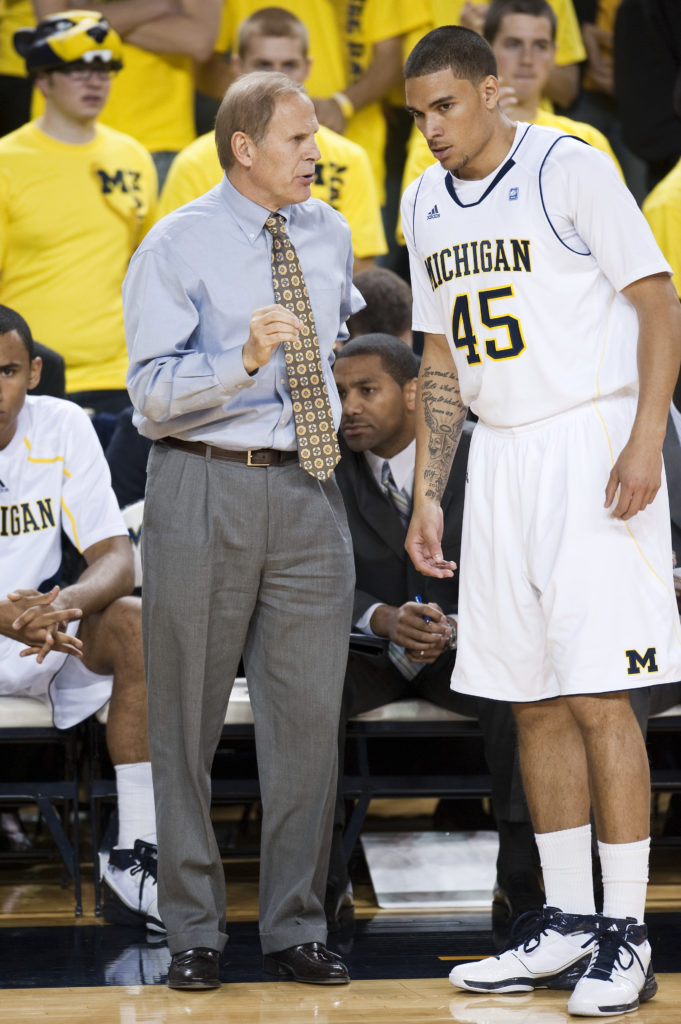
 University of Michigan basketball coach John Beilein credits commitment to prayer as source of his strength. | Photo courtesy of the University of Michigan
University of Michigan coach John Beilein gives guidance to a young Division I college basketball program, while receiving his guidance from God’s Word
Chris Kudialis
Special to The Michigan Catholic
ANN ARBOR -- The door to Crisler Arena opens at 10 a.m. as University of Michigan head basketball coach John Beilein represents the first of many staff members and players to enter the arena for an early-season Wolverines’ game that evening against the Utah Utes. He’s faced with the challenge of leading one of only four teams in the entire NCAA without a senior on its roster, and a Michigan Wolverines squad that media outlets nationwide are predicting to be irrelevant in the Big Ten in 2011.
Beilein smiles at the fact, as his greatest joy comes from coaching young teams, or as he phrases it, “putting the puzzle together.” Although tip-off isn’t until 7 p.m., Beilein’s day begins more than 12 hours earlier to fully prepare himself and his team for one of their last non-conference games of the 2010-2011 season. In leading such a young and inexperienced team, he acknowledges losses are part of the learning process and that mistakes are going to happen, but moves forward with an integrity and humility that has landed him a leading position on the NCAA Ethics Coalition. He approaches the challenges of being a leader both on and off the court with a foundation that has defined the majority of his life: faith.
In a recent interview, Beilein shared stories of his faith life and how he incorporates his beliefs into leadership positions as a coach, a father, and a role model.
A calling to coach
 John Beilein coaches the University of Michigan men's basketball team during a game against Saginaw Valley State University on Nov. 5, 2010.
Upon walking into the basketball office, a family atmosphere is evident. An enormous framed photo of the 2010-2011 team standing in front of the Eiffel Tower, with arms draped around one another, hangs in the lobby between the coaches’ offices in remembrance of the team’s nine day trip to Europe this past summer.
The fourth-year head coach of the Michigan Wolverines sits cross-legged in a matching set of blue sweats on a couch in his own office, and I grab a chair to the side of him. We chat around a miniature wooden table shaped like a basketball court, filled with maize and blue pegs of specific numbers to represent a player’s position on the court. Above the couch where Beilein is sitting hangs a frame with a full-court shot of Crisler Arena during the second half of the Wolverines’ 2008 upset victory against Duke.
Game days for John Beilein begin the same as almost every other day: with prayer.
“Usually in the morning, I start the day to try and get in touch with my faith,” says Beilein. “And then on the weekends and during Lent, I make daily Mass as often as I can, but it’s not more than two or three days a week.”
He cites the three-minute prayers from Loyola Press, a Catholic Jesuit Ministry, as a foundation that strengthens him throughout a 16 hour game day during the week that usually begins around 6 a.m. and finishes about 10 p.m., depending on the starting time of Michigan’s game.
“It gives me great structure for how I should live my life,” Beilein says of his Catholic faith and morning prayer habits. Following prayer, he immediately dives into film study of the team’s practice from the day before. The day continues as Beilein reviews the game plan and scouting reports for Michigan’s opponent one final time with his assistant coaches in the morning and then with the team in the afternoon before tip-off in the evening.
Since graduating high school, Beilein knew his calling was to become a coach. On his first date with Kathleen, his wife of 31 years, he recalls telling her that one day she was going to see him on television coaching against the likes of Bobby Knight. In 2005, his West Virginia Mountaineers knocked off Bobby Knight’s Texas Tech Red Raiders to advance to the Sweet 16 in that year’s NCAA tournament. Throughout his 35 year coaching career, starting at a high school junior varsity level in 1975, to becoming a highly successful NCAA Division I head coach at Canisius College, Richmond, W.Va. and now Michigan with some stops in-between, Beilein has relied largely on his Catholic faith and a determination to lead by example in coaching his players. Of course, every player on his team doesn’t necessarily follow a Christian faith, but that doesn’t prevent Beilein and his assistants from fully living the positive principles of their faith around the team. To reach out to his squad, Beilein relies mostly on being a humble example while supporting players who desire to pursue religion.
“If they want to worship in some way on Sundays or if they want to express their faith in some way, we try to encourage them,” he remarks. “I think our locker room has a very great respect for people with many religions, and some players are more outgoing in their faith than others, but we respect everyone’s.”
Faith in the family
 The Beilein Family: (Back from left) sons Patrick and Mark, (Front from left) son Andrew, wife Kathleen, John, daughter Seana, and son-in-law Ryan. | Photo courtesy of the University of Michigan
If there is anybody who can relate to a religious upbringing, it’s John Beilein. The eighth of nine children, Beilein developed his religious roots from his Roman Catholic family, who he largely credits for the enduring strength of his faith. “There was never any discussion whether we were going to attend Mass on Sunday,” he says. “It was a given – it was happening, and basically I’ve lived my whole life like that.”
Growing up as an altar boy in St. Charles Borromeo parish in his hometown of Olcott, New York, Beilein’s Catholicism was fostered by the devotion of his family as well as a priest at St. Charles Borromeo, Father Eugene Wagner.
“He was a very good athlete and had a tremendous interest in our well-being,” says Beilein of the late priest. His grandmother also worked as a housekeeper within the church where Beilein received the Sacraments of First Communion, First Reconciliation, and Confirmation. He was baptized and married in different parishes, as he and Kathleen tied the knot in St. Mary’s parish in nearby Lockport, New York. Church wasn’t a Sunday obligation for the Beilein family, but a part of life.
The Michigan coach’s faith was put to test at a young age. When Beilein was a teenager, his brother, Tom, served in Vietnam, while his sister, Kathleen, served in Korea at the same time.
“Faith was always part of our lives that we were all very proud of, but most importantly it gave our family strength during some very important times,” he remarks while reflecting on his siblings’ service in the military and also citing several heart attacks his father endured during the coach’s childhood. “There are some very difficult times when you have a family that big, but faith helped us get through it.”
Now, as a father himself, Beilein has played a more direct role in the faith and spiritual direction of his family, and he embraces that role with joy. Although the ages of sons Patrick, Mark, and Andrew, and daughter Seana, range from 20 to early 30s, and the four are well out of the house, Beilein hopes the examples of both he and his wife will continue to have an impact in the faith lives of their children. However, he acknowledges it is ultimately their decision how they choose to worship. He’s also careful to dedicate enough time to spend with his family despite the often demanding schedule of being an NCAA Division I head coach.
“Balancing time is always a concern of mine during the season because if I lean too much toward basketball, it would be choosing my occupation instead of my family,” admitted Beilein. “And it’s something really important to me that I try focus on, but sometimes you view the team as a type of family as well.”
Life and basketball
 For Michigan basketball coach John Beilein, faith and basketball go hand in hand.
Although Beilein is quick to point out the differences between basketball and real life, he acknowledges many of the lessons he teaches on the court can translate to a healthier approach to life off the court. The philosophy holds especially true with Michigan’s 2010-2011 squad, as the coaching staff strives to establish core values in both basketball and life in one of his youngest teams Beilein has ever had as a college coach.
“I think with this particular group, our mindset is to really establish a strong core of intangible values you really need to have to win on the court and in life.” He cites integrity as a valuable standard he most strongly emphasizes to players.
When asked what he wants his players to take away from their time playing under him, Beilein pauses and solemnly remarks, “I want them to have learned a great deal about the important things of life — of things about gratitude, about appreciation, of what hard work can accomplish, of what persistence can accomplish. In the end it won’t be about the trophies or the NCAA tournaments, it’ll be more about what was learned in the process of achieving them. And hopefully we do have more NCAA tournaments and we get to a Final Four. All those things are the material things that we strive for during that time, but just as big will be the education and all the other core values they’ve learned during that time – integrity — so many different things that we have preached to them – teamwork — there are a lot of things they’re going to use later in their life.”
Whether the Wolverines win or lose, Beilein speaks with the media following each game and returns home where he confesses to indulging in pizza with pepperoni and green olives or other guilty pleasures like a cheeseburger and buffalo wings to cool his remaining adrenaline and relax after a long day. He hands me a prayer booklet titled My Daily Bread and points out passages he reads and prays as a way to reflect after games. For wins, Beilein’s favorite selection is titled “Gratitude to God,” while after losses, he reads a couple different excerpts that emphasize the joy and value in learning from adversity.
As the interview concludes, Beilein pauses and asks about the Catholic center at U-M, St. Mary’s Student Parish, citing he has yet to attend Mass there, but would be interested in speaking with students and spending some time on a Wednesday night. The coaching just never stops.
We depart as he shares one final thought based on an interesting excerpt he read that morning. “I don’t think God wants you not to value possessions on Earth while you’re here, He just doesn’t want you to value them too much. And that very often gets in the way—just being successful, working hard, and not looking at the bigger picture. You may not appreciate what you have right here in front of you. You may not smell the roses, and you need to do that.”