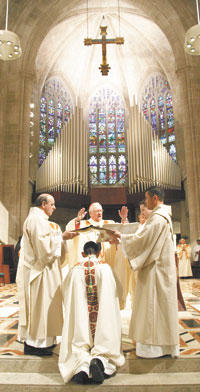
“It’s actually very ancient,” says Dan McAfee, director of the Archdiocese of Detroit’s Worship Office. “One of the oldest documents that we have — dating from 217 A.D. — is the ‘Apostolic Tradition of Hippolytus,’ and he has an ordination rite in there for a bishop.
The document from St. Hippolytus, who is considered one of the fathers of the Church, was only discovered in the 1840s and also contains the oldest written text ever found of a Eucharistic prayer. In fact, McAfee notes that the Eucharistic Prayer II in the current Order of the Mass was adapted directly from this text.
Referring to the ordination rite for a bishop given by St. Hippolytus, “He’s claiming, in 217, that it’s already an ancient tradition,” McAfee continues. And he adds that those who discovered the work more than 1,600 years later were amazed how close the rite had remained to the practice of the primitive Church.
McAfee says the ordination Mass begins with the Liturgy of the Word pretty much as usual, but then includes a number of special elements before the Liturgy of the Eucharist.
After a hymn, the bishop-designate is presented to the consecrating bishop by a priest of the diocese. The principal consecrator enquires whether there is a mandate from the Holy See.
The apostolic letter, which is the papal document authorizing the consecration of the new bishop, is then read. After the reading, the congregation assembled for the ceremony either applauds or exclaims, “Thanks be to God,” to indicate their consent.
After the homily comes the Examination of the Candidate, at which time the principal consecrator puts nine questions to the candidate for Episcopal ordination. The bishop-designate is asked whether he is resolved “to discharge to the end of your life the office the apostles entrusted to us, which we now pass on to you by the laying on of hands?”
He is asked whether he will be “faithful and constant in proclaiming the Gospel of Christ,” and whether he will “maintain the deposit of faith, entire and incorrupt, as handed down by the apostles and professed by the Church everywhere and at all times.”
The future bishop is asked whether he is resolved “to build up the Church as the body of Christ” and remain united to the Church under the successor of St. Peter.
He is asked whether he will sustain and guide the people of God in cooperation with the priests and deacons who share his ministry — also whether he will show kindness and compassion to the poor, to strangers, and to all who are in need.
The final questions ask whether he will “seek out the sheep who stray” and gather them into the fold of the Lord, and whether he will pray for the people of God and carry out his duties.
Next follows the Litany of the Saints, during which the candidate lies prostrate before the altar.
Then comes the age-old tradition of the Laying on of Hands, in which the principal consecrator and the co-consecrators lay their hands on the heads of the future bishop.
Next is the Prayer of Consecration with the Book of the Gospels held over the new bishop’s head. His head is then anointed with the oil of chrism, and he is presented with the Book of the Gospels before being invested with his Episcopal ring, mitre (the bishop’s hat) and crozier (the bishop’s staff).
After the exchange of peace, the Liturgy of the Eucharist follows, but one more special action remains — the new bishop confers his first Episcopal blessing on the gathered congregation, typically making a circuit of the church in which the ceremony takes place.