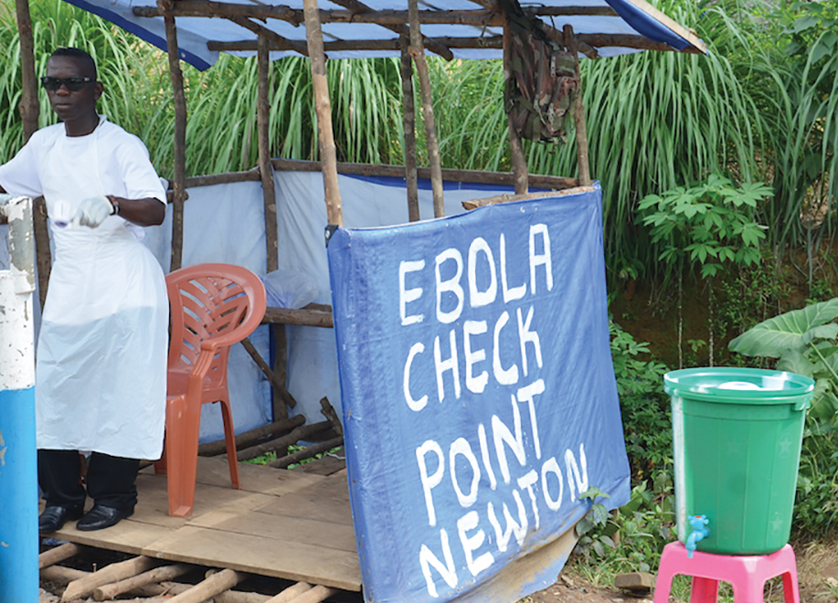
 An Ebola check point outside of Freetown Sierra Leone where travelers temperatures are checked with a heat gun or thermal scanner.
Catholic Relief Services has committed more than $1.5 million in private funds to continue its emergency response to the Ebola outbreak in West Africa. The number of deaths and people infected with the virus continues to increase rapidly. CRS and its Caritas partner have been working to train more than 400 volunteers on key messages about Ebola as well as psychosocial counseling for those who’ve lost loved ones to the disease. Education is the only way to stop the spread of the disease, so CRS has been working on public awareness campaigns aimed at teaching the population about Ebola, including its spread and prevention.
Photo by Michael Stulman/Catholic Relief Services
Detroit — Whether in Nigeria where Ebola was successfully stopped, in Sierra Leone and Liberia where the battle still rages or in the U.S. where the issue remains highly debated, anxiety about the deadly virus continues.
Ebola is something that if you want to contain it, “a lot of sacrifices demand it,” said Fr. Peter Ben Opara, a Nigerian priest who has served in Michigan for the past seven years.
Today a chaplain at St. Mary Mercy Hospital in Livonia, Fr. Opara had been paying close attention to the Ebola outbreak in Nigeria, where family members still reside. He said he is grateful that Nigeria has been declared Ebola-free.
“The people are really conscious and serious about it,” said Fr. Opara. “By the grace of God we hope we’ve done away with it.”
Michael Stulman began working in Senegal with Catholic Relief Services this past June, serving as CRS’s regional information officer in West and Central Africa. Around that time, the Ebola outbreak was “beginning to escalate, cases were being reported across several countries.”
“Several alarms were going off that this was a major issue,” said Stulman, who called The Michigan Catholic on Oct. 20 shortly after arriving in Sierra Leone to document CRS’s efforts in curbing the deadly virus.
The Findlay, Ohio, native said he had visited Sierra Leone this past July, but made the decision to go back.
Stulman spent seven days in Sierra Leone — where CRS staff has already been serving for more than 50 years — followed by a seven-day trip to document relief efforts in Liberia.
At the time of his phone conversation with The Michigan Catholic he had gotten only a glimpse of Sierra Leone’s condition, but he could already tell the severity of the outbreak: “The situation’s gotten worse.”
Auxiliary Bishop Donald F. Hanchon of the Archdiocese of Detroit told The Michigan Catholic that with the currently few Ebola cases in the U.S., he advised to “dial down the panic a little bit” but explained that attentiveness is important “because it is such a serious illness.”
However, “it is a very good reminder to support our health authorities, keep our hands clean, since so many infections spread just because people don’t wash their hands, (and) pray for the people who have it,” said Bishop Hanchon, who did mission work in Nigeria several years ago.
Bishop Hanchon pointed out that the new practice of avoiding contact with others is quite difficult for the countries who are suffering the most: “It goes against their culture.”
He emphasized efforts to “truly care about one another and support efforts to get people who are potentially afflicted the medical attention they need,” though in terms of donations to help “the most important donation you need to make is prayer.”
Ebola “has no friend,” explained Sr. Clare Emeruom, HVM, who serves in Nigeria with the Sisters, Home Visitors of Mary, a religious order based in Detroit.
She recently corresponded with The Michigan Catholic over email, explaining her thoughts on Nigeria’s successful crackdown and elimination of its Ebola outbreak.
“The nation and the Church embarked on a serious war against Ebola,” said Sr. Emeruom. She said that the awareness created was “so immense” that even the illiterate were well-informed on how to protect themselves.
She said the public education about Ebola was done on television and radio, in marketplaces, offices, churches and schools — “almost everywhere and in different languages.”
Additionally, the Church in Nigeria encouraged communion in the hand and “stopped the kiss of peace at Mass,” though “people did not stop the normal handshake and hugging which is part of our greeting as Africans.”
Sr. Emeruom said that in Abuja, where she works, “we said five decades of the rosary after every Mass. I think prayer is the best perspective together with taking precautions.”
In Sierra Leone where the outbreak persists, Stulman said that the virus has already killed thousands of people.
“It’s obviously brutal and a really terrible situation; impacted every aspect of life,” he said. “Schools are closed, which means teachers are not working and students are not learning in the classroom, so it’s a major challenge.”
Stulman said that the outbreak has also affected families who rely on agriculture to survive: “Farmers have died and abandoned the fields… people are cut off from the land. Food prices have gone up for some of the most staple items, like rice.”
Stulman said that the secondary impact is that “the health system was already strained, but now it is really difficult, and sometimes dangerous, to treat non-Ebola issues.”
He listed issues like HIV, tuberculosis, malaria and receiving regular immunizations as being difficult to address because “some people don’t want to go to the hospitals, don’t trust they’re safe. Some clinics are closed.”
Despite all of the distress, however, Stulman said that there is some good news too.
“I can tell more people are taking more precautions to protect themselves,” said Stulman. “There are chlorine buckets (for hand washing) everywhere, radio programs, people avoiding direct contact with each other,” though with the close-knit culture of Sierra Leone, avoiding contact is “obviously a difficult situation.”
West Africa Emergency Fund
Catholic Relief Services assists the suffering throughout the world, including those in the current Ebola outbreak. Here are some ways to help their efforts in the Ebola outbreak.
- Donate directly at donate.crs.org/ebolacrisis.
- Call (877) 435-7277 from 8 a.m.-11p.m., EST
- Mail check or money order to Catholic Relief Services, P.O. Box 17090, Baltimore, MD, 21297-0303.