Although amended in response to at least some of the questions and concerns raised when it was introduced the previous day, the message, “The Hope of the Gospel in Difficult Economic Times,” still failed to receive the required two-thirds majority needed for passage.
The vote was 134-84 in favor, with nine abstentions, from the bishops gathered for their annual fall general assembly, but it wasn’t enough for passage.
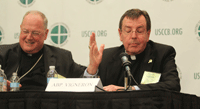 Copies had been made available to the bishops early in the day, so Archbishop Vigneron spoke only briefly about its contents when he introduced the document Nov. 12. Saying the document drew on the thought of Pope John Paul II and Pope Benedict XVI, he said it was written so as to be Christ-centered and hopeful, with an emphasis on marriage and family.
In speaking of the economy, the archbishop said the message maintains the principle that “the dignity of the human person should be at the center of the economy, and that the economy should serve the person, not the other way around.”
Following his remarks, the bishops had an opportunity to ask questions, and though the rules did not allow for debate, Archbishop Joseph A. Fiorenza, former archbishop of Galvestons-Houston, critiqued the document.
“I fear that this draft, if not changed in a major way, will not be very well received,” he said.
Archbishop Fiorenza called for the document to discuss the right to unionize, the “right of the poor to have sufficient access to economic goods,” the “growing gulf between the haves and the have-nots,” and redistribution of wealth. Without such changes, he said the document should be withdrawn.
Archbishop Vigneron responded that the document was never intended to be a comprehensive statement on the economy, but rather a message of hope in the present circumstances.
Cardinal Roger Mahony, former archbishop of Los Angeles, praised the document, but said he thought a much shorter message, which could be printed as a brochure for general distribution to the faithful, would be more useful than the 13-page message presented to the bishops.