Though aided by the Church, parents are primary educators of children when it comes to faith
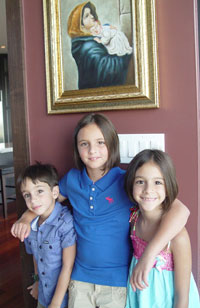
Metro area — Ava Randazzo, 7, says that whenever she sees a rainbow, she thinks of Jesus.
Her catechism teacher at St. Andrew Parish in Rochester taught her this, and she was happy to repeat it to anyone who listened — replete with a gentle smile.
Ava and her younger brother, Antonio, and older sister, Audrey, attend a nearby public school. While they learn a lot about their Catholic faith through religious education classes at St. Andrew Parish, it’s at home with their parents where their faith is also an inherent aspect of their lives.
Margie Crooks, director of Evangelization, Catechesis & Schools for the Archdiocese of Detroit, says the responsibility of learning about their faith begins at home with their parents, who must set an example to their children, as well as the Church.
“As it has been noted in more than once by the Church, that while it is true that parents are the first and foremost educators of their children, it is also true that the Church and Her members also share a responsibility,” she says. “All must be ready to proclaim the Gospel message through their words, and witness to it in what they do.
“In families, parents are to see that their children receive the message given to us by Christ and passed on through the Church,” she says. “Parents are also called to reinforce this message through their actions and choices, so what children hear does not conflict and cause confusion and doubt by what they see.”
She notes that the call to our faith begins at baptism.
“Baptism enables (us) to believe in God, to hope in Him, and to love Him through the theological virtues,” she says. “Thus, Catholic education is a call to relationship that leads to action.”
Evelyn Randazzo, Ava’s mother, is happy with the faith education her children are receiving, and knows that learning about their faith is a constant way of life.
“I love it,” she says, adding that she enjoys hearing from them what they’ve learned in class.
She is aware that she and her husband, Anthony, serve as role models to their children. Anthony and Evelyn, in turn, learned a lot about their faith from Anthony’s mother, Rosie Randazzo. “She is very much into her Catholic faith and she talks about it so naturally,” Evelyn says. “It’s just a natural part of conversation.”
Evelyn also stresses to her children the importance of treating one another with respect, and “to always be kind to one another.”
Audrey Randazzo, 10, nods her head and says she’s learned a lot in her catechism classes, including the Ten Commandments, and has also learned how to look up verses in the Bible.
“I’ve learned that Jesus is loving and kind,” she says softly, “and that God sent us the Ten Commandments from a mountain.”
Kenlin Botello, director of religious education at Immaculate Conception Parish, Lapeer, offers some insight as to how parents can be assured that their children are learning about their faith: “Parents are their child’s first Catechist through their example of faith lived out in the home.”
“Stay involved in your child’s daily schedule, and I mean more than by being their driver to the next event. Pray the rosary together as a family and help your children with their prayers every day,” Botello says. “Take time out for faith and making God a priority in a family’s life. There is always time to have as a God moment for the family on the run.”
Parents also can learn more about their faith from their children, simply by talking to them about it. “Ask your kids to perform an act of kindness as they are heading out for school, and follow up later with them later to see what they did and share what you did with them,” Botello says.
Lorie Bronson, pastoral minister at St. Mary Parish, Monroe, says it’s the children who see the world through their parent’s eyes first, because it is the parents who “assure that their children are formed in their Catholic faith in many ways.”
This includes communicating their faith to their children through their actions and words, she says.
“When this is done lovingly, children perceive the genuine faith of their parents. The reciprocal love and trust that develops between parent and child sets the stage in which parents can be credible teachers for their children in matters of faith and morals.”
She stresses to parents to “pray with their children, worship with their children, serve those in need with their children, read Scripture with their children, discuss current social and political issues through the lens of our faith with their children, and actively participate in the life of the parish with their children.”
In other words, she adds, “do and reflect upon everything in light of our faith. Children catch and internalize that which their parents value.”
The value of faith formation cannot be overstated, she adds. “For students who attend faith formation programs that facilitate these opportunities, they provide a valuable service to our parents and to parish life. We set the stage for growth and conversion by providing and inviting parents to take advantage of these opportunities.
“Coupled with our prayer, asking the Holy Spirit to pour forth God’s grace, we expect that our children (and their parents) will grow in their ability to know, love and serve the God who calls them by name.”
On a classroom level, Botello says that it is the parent’s responsibility to see to it that their children receive formal faith education for their children.
“Religious education feeds the children,” she says. “It really gives them the meat and potatoes of our Catholic tradition. Being in a classroom with other kids gives them the sense of Church. All of us, believing and working together.”
Parents can always seek advice from those in their parish and Catholic community as a whole for ideas or help. At Immaculate Conception Parish, “We work with the kids as a whole to show the needs of our parish first.”
Botello stresses the importance of living out their faith in any surrounding. “With a family living out their faith at home and the children participating in a well-rounded religious education program at their parish, working together in a partnership, we can produce true living stones in God’s Church.
“We are all called to be workers in the vineyard of the Lord. So answer, ‘Here, I am, Lord!’” Crooks agrees and adds, “Catholic education is all of our responsibility. By baptism we have been made one with Christ. We are made sharers in His Divine Life. We have been called to a life of holiness. It is our privilege to as individuals, as families, as parishes, and as Catholic schools to pass on this great treasure!”
Ava Randazzo likes to continue with her own story about God.
“The first rainbow came with Noah’s Ark,” she says, and then pauses to think. “And there were bunny rabbits on his boat, too…”