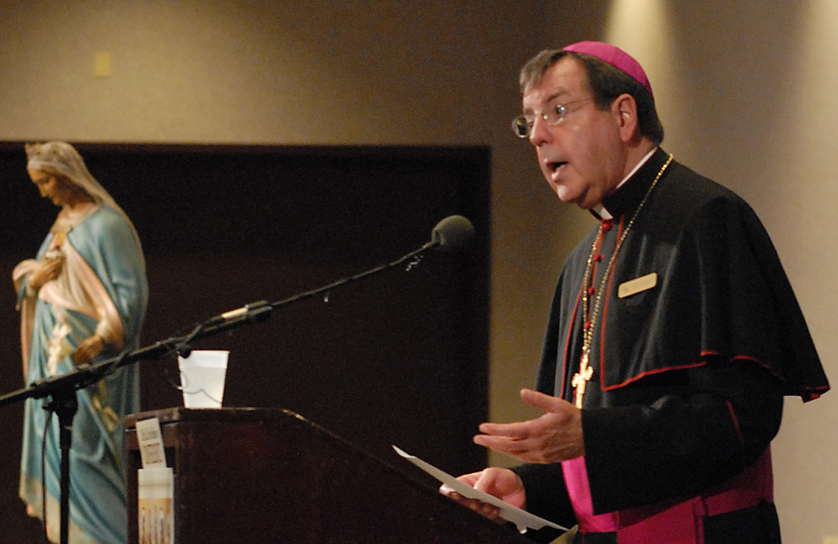
 Archbishop Allen H. Vigneron cited St. Therese of Lisieux and St. Maximillian Kolbe as examples of heroic virtue in action during the 15th Call to Holiness conference Sept. 12-13.
STERLING HEIGHTS — The faithful are called to be “heroically virtuous” said Archbishop Allen H. Vigneron in his keynote address to the Sept. 12-13 Call to Holiness conference in Sterling Heights.
The conference, drawing about 250 people on Friday evening and more than 400 people on Saturday, was the 15th for Call to Holiness, which was founded in 1996.
This year’s event was based on the theme, “Sainthood: Is It Possible Today?”
Speakers included Dale Ahlquist of the American Chesterton Society; Peter Kreeft of Boston College; Sr. John Dominic Rasmussen, OP, of the Dominican Sisters of Mary, Mother of the Eucharist; and many others.
Archbishop Vigneron’s presentation, “The Charity of the Heart of Christ: the Living Soul of Christian Virtue,” demonstrated how virtuous living “is the very ‘stuff’ of holiness.”
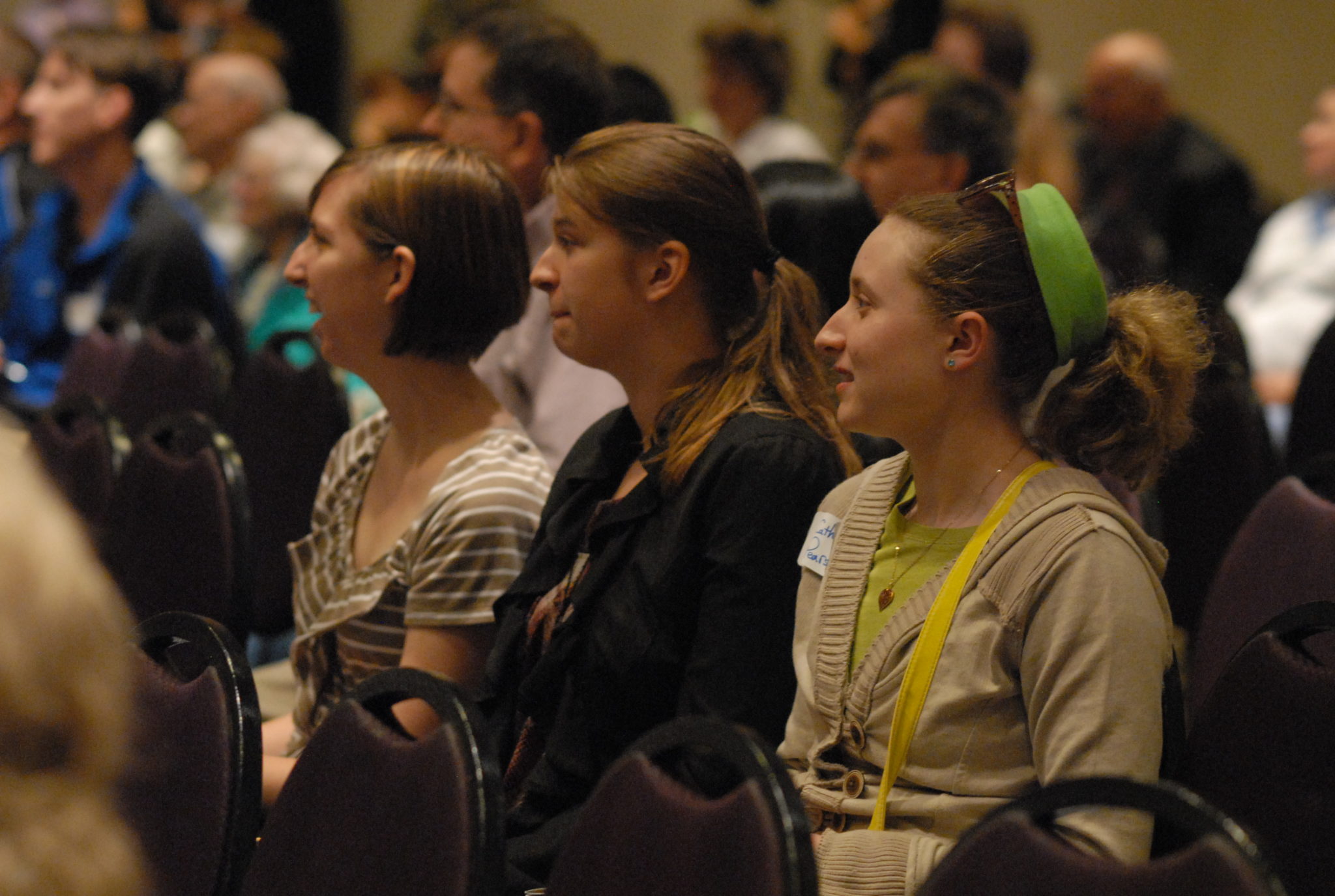 Young people listen intently to Dr. Ray Guarendi's Saturday afternoon presentation.
 The archbishop cited the Catechism of the Catholic Church, Nos. 1803-1829, as reference for his talk, and explained that using the virtues through mere human power is “not enough to make us holy.”
“What is needed is the action of the spirit of Jesus Christ; the spirit of holiness,” he said. “We need the grace of God to operate within our virtues in order to elevate them to the level of Christian virtues. And in elevating them, the Holy Spirit leaves intact their dynamic.”
Therefore, explained the archbishop, “Christ Jesus is the model of all of our virtues,” and that to be a saint means aspiring to share in the “ready dispositions of the heart of Jesus Christ to love the Father and to love one another.”
“This is who a saint is; this is who we all want to be,” he added.
Archbishop Vigneron offered examples of several saints that particularly illustrated lives of virtue, such as St. Therese of Lisieux’s virtue of zeal in praying for the missions, St. Gianna Molla’s virtue of chastity in being a wife and mother, and St. Maximillian Kolbe’s virtue of constancy amid trials.
Ahlquist, the president of the American Chesterton Society, which promotes the life and writings of British journalist G.K. Chesterton, served as the dinner keynote speaker Friday evening.
Ahlquist said Chesterton’s great gift was his “ability to point out the obvious; to explain the obvious.”
“The obvious is the hardest thing to explain,” Ahlquist said. “(Chesterton) does have this ability to point out the obvious things that we stop seeing. The great paradox of not being able to see a thing because it’s too big or too obvious — because we’ve forgotten how to see them.”
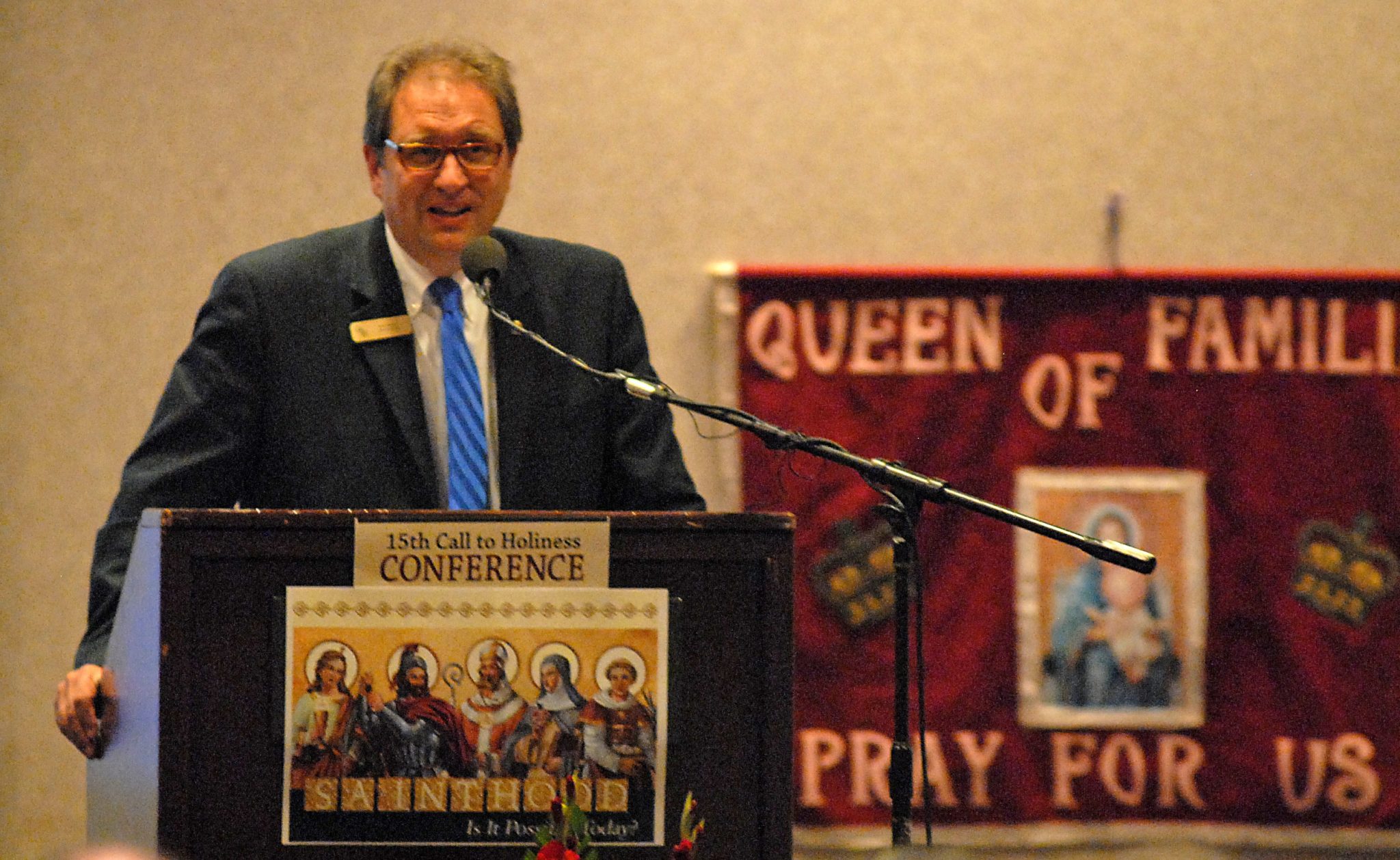 Dale Ahlquist, president of the American Chesterton Society, discusses "G.K. Chesterton and the Wholeness of Holiness" during dinner on Sept. 12.
Ahlquist, who referred to Chesterton as an “overgrown elf who used to amuse children at birthday parties by catching buns in his mouth” explained that Chesterton once wrote an essay for the Illustrated London News inspiring Gandhi, and a book called “The Everlasting Man” that inspired C.S. Lewis to convert from atheism.
Chesterton also agreed to write the introduction to the Ph.D. thesis of a young American student, “God and Intelligence in Modern Philosophy;” this student became Venerable Fulton J. Sheen.
Ahlquist said Chesterton truly lived a life of grace, where he was “always giving thanks.”
He quoted Chesterton: “You say grace before meals? All right, but, I say grace before the play and the opera and grace before the concert and the pantomime, and grace before I open a book and grace before sketching, painting, swimming, fencing, boxing, walking, playing, dancing, and grace before I dip the pen in the ink.”
Sr. John Dominic Rasmussen, OP, one of the founding members of the Ann Arbor-based Dominican Sisters of Mary, Mother of the Eucharist, discussed why education in virtue is essential for children.
“If we’re a disciple of Jesus, we want to become like Jesus. You want to become like that master,” she said. “As parents, you want (for) your children to set that example.”
“A very simple definition of virtue is the habit of doing good, just as vice is the habit of doing bad,” said Sr. Rasmussen, who helped develop the “Disciple of Christ: Education in Virtue” program.
She pointed out that for the saints to be beatified and canonized, they had to have heroic virtue or undergo martyrdom, the highest way to express the virtue of fortitude.
“If we don’t know what virtue is, and we don’t teach children and we don’t understand it ourselves, how can we become saints?” she asked.
Other speakers included Dr. Ray Guarendi, a clinical psychologist and author with a show on Ave Maria Radio, and Fr. William Casey, CPM, the superior general of the Congregation of the Fathers of Mercy.
A youth track for the conference also drew more than 60 teens.