
Intercultural Consultation Services helps ease the burden of transitioning to a new culture
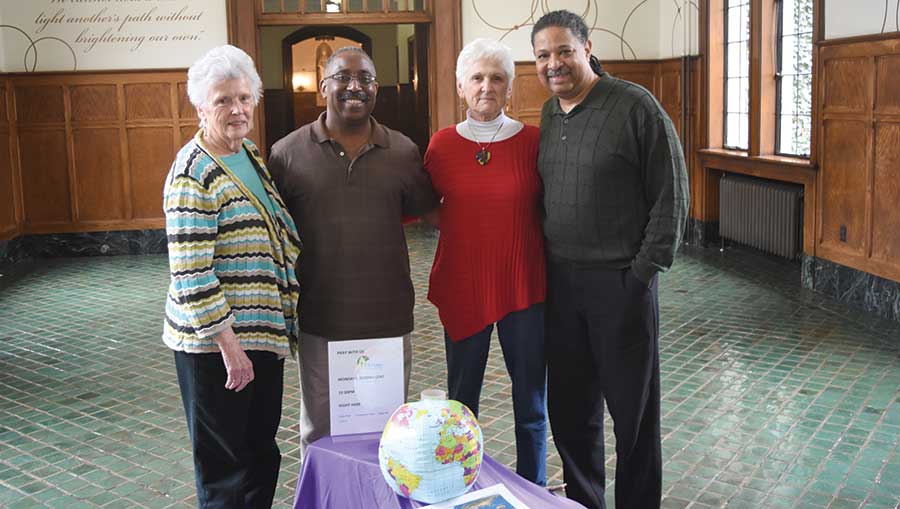 Intercultural Consultation Services trains incoming and outgoing ministers to adapt to the cultures where they’ll be ministering. Left to right, Intercultural Consultation Services advisory director and founder Sr. Kathryn Pierce, IHM, stands with board members Reuben Pye and Connie Soma and former board member Jesse Cox. Dan Meloy | The Michigan Catholic
Detroit — When a missionary enters a new country for the first time, the task of evangelization can be daunting.
Evangelization can already be intimidating in the evangelist’s own culture, but when language, economic and cultural barriers exist, the task of spreading the Gospel can seem almost impossible.
That’s where Sr. Kathryn Pierce, IHM, comes in, preparing the missionaries of today for tomorrow’s evangelization.
Sr. Pierce is the advisory director and founder of Intercultural Consultation Services, a nonprofit faith-based organization established in July 2006 to train individual missionaries and religious communities seeking to minister in other cultures.
“So many missionaries get to where they are supposed to be, and they have a hard time understanding the culture,” Sr. Pierce said. “We also have international ministers coming to the United States, so we work with them and the parishes where they’re ministering to make sure they adapt.”
Sr. Pierce and her team host four-week workshops for ministers entering and leaving the United States, a sort of crash course on the culture where they’ll be ministering.
For any kind of evangelization to be successful, cultural competency is vital, Sr. Pierce said.
“Cultural diversity exists in other countries and in neighborhoods here in the United States,” Sr. Pierce said. “We teach people to understand these differences and realize that these differences aren’t a bad thing. We help people come with a sense of respect, so there is no antagonism and the missioned person goes to mission understanding the culture.”
The workshops also cover the role of the missionary — which is not necessarily to tell people who God is, but where God can be found.
“It’s critical for the missionary (to understand) they don’t know everything,” said Connie Soma, a board member of Intercultural Consultation Services. “Many people see missionaries as going to bring people to Jesus. It’s not. You go to see where they are.”
Part of the work of a missionary in a new culture is adapting the means of bringing the Christian message to people, realizing that in God’s universal Church, there are many different ways for people to reach God.
“We work to train people to share the Gospel,” said Jesse Cox, another board member. “We do damage when we don’t see the Christ already in someone. A missionary needs to learn how to be critical of parts of the culture that is un-Christian, but also learning what in their own culture is un-Christian.”
Sr. Pierce and her team also work with missionaries returning from abroad and dealing with the culture shock of coming back to the United States after working with a culture that is, in many cases, much poorer.
“So often, missionaries are living with such poverty where they are sent, but here we have so many different kinds of dog food, such extravagance,” Sr. Pierce said. “It’s why there can sometimes be a struggle. They’ve changed a great deal since they were gone. So it’s coming home to yourself.”
The group also works with priests and religious sent to the United States, breaking down stereotypes of what the Church in southeast Michigan looks like, as well as the spiritual needs of its people.
“Sometimes, physical poverty doesn’t mean spiritual poverty,” Cox said. Especially in the city of Detroit, he said, “there are people with rich, strong faith.”
“But when an African priest comes to Detroit, to pair them up with African-American cultures, well no, that’s a different culture,” Cox said. “There is a huge difference between the African church and the African-American church.”
Intercultural Consultation Services offers training to incoming priests and their new parish councils to work to bridge the cultural gap.
“There is no training of any kind for these parishes when it comes to welcoming a priest from Africa or Asia, but that has to come from the parish stepping up,” Sr. Pierce said. “There needs to be a mutual understanding.”
Sr. Pierce said a noticeable disconnect can often exist between churches in the suburbs and parishes in the city even within the Archdiocese of Detroit, but she is hopeful the discernments of Synod 16 will begin to break down those barriers.
“The synod was a wonderful opportunity to learn from the whole archdiocese, so we’re hopeful we’ll see more of a message about the need for cultural diversity,” Sr. Pierce said. “It’s what we need to be if we are to be a Church that ministers to the people of Detroit, of southeast Michigan.”