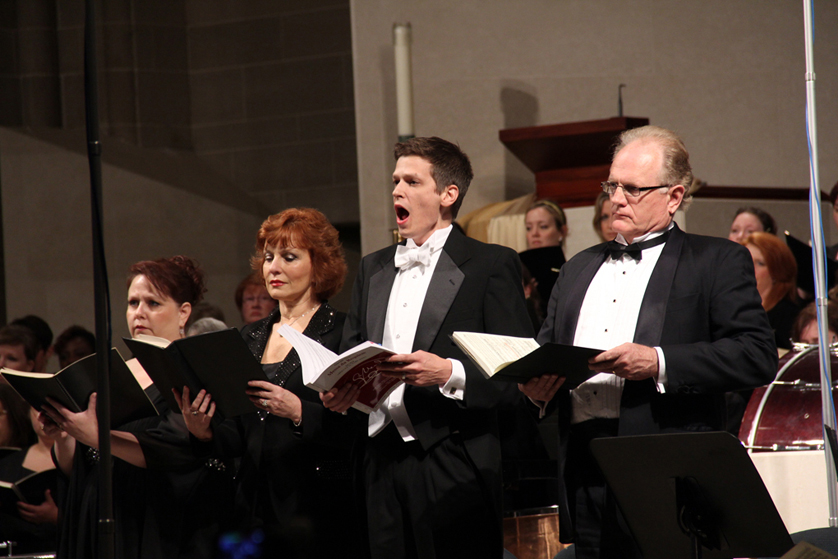
 The Community Chorus of Detroit performs Giuseppe Verdi’s “Requiem” in memory of the victims of the Terezin concentration camp May 18 at the Cathedral of the Most Blessed Sacrament.
Detroit — “It was the spring of 1944 when a group of Nazi senior officers attended what at first appeared to be a soaring rendition of a choral masterpiece,” explained Rabbi Joseph H. Krakoff of Congregation Shaarey Zedek in Southfield.
“It was in essence though a subversive condemnation of the Nazis and a desperate message to the outside world,” said Rabbi Krakoff, speaking at the Cathedral of the Most Blessed Sacrament prior to a performance of Giuseppe Verdi’s “Requiem” on May 18.
The performance — conducted by Ed Maki-Schramm — was a commemoration of the Terezin concentration camp prisoners who 16 times performed the musical score. The score had been smuggled into the camp as a subtle defiance of the Nazi regime.
The requiem was performed by the Community Chorus of Detroit, which included the Archdiocesan Chorus of Detroit, the Cantata Academy Choral, the Jefferson Avenue Presbyterian Church Chancel Choir and Metropolitan Opera soloists.
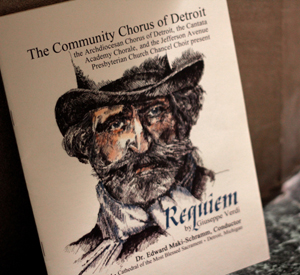 A program for the performance lies beside a pew.
Rabbi Krakoff said the 150 Jewish inmates, many of whom were artists, musicians, poets and writers, “fought back by performing one of the world’s most difficult and powerful choral works … a Catholic work re-imagined by the imprisoned Jews as a condemnation of their captors.”
“We must promise to educate future generations to ensure that such a tragedy can never take place again,” said Rabbi Krakoff. “And we must work for peace in every relationship, in every realm of influence, in every corner of the world.”
Also speaking before the performance were Roey Gilad, Consul General of Israel to the Midwest; Rochelle Riley, a columnist for the Detroit Free Press; and Detroit Archbishop Allen H. Vigneron.
Archbishop Vigneron told the audience that “in the face of every child of Adam and Eve we see the likeness of God himself.”
“This afternoon we recall that in the time of the Shoah, evil men and women, out of a malevolence almost beyond reckoning, worked with totalitarian zeal to obliterate this truth,” he said, “most particularly in the case of the children of Israel, the very people through whom it was first revealed.”
The archbishop said he was proud that the Catholic community in Detroit was able to participate in the tribute. He expressed his hope that the concert would witness to the convictions that “no human life is of lesser worth or dignity than any other; that every work of human genius and art is part of the patrimony of us all.”
Speaking with The Michigan Catholic later, Rabbi Krakoff explained the significance of having such a diverse chorus perform the requiem.
“We often use different words but we have similar human experiences,” said Rabbi Krakoff, who added that many of his congregants had attended the performance.
Rabbi Krakoff said that he hopes the outcomes of the performance will be that individuals do not necessarily “agree all the time — but certainly work in pursuit of peace.”
“I find that when we learn about other people and develop relationships, it’s a lot harder to hate,” he said.
Rabbi Krakoff said he cherishes the friendship he has with Archbishop Vigneron: “People need to take time to talk, to get to know one another; that they can learn from one another.”
Joe Balistreri, director of music for the Archdiocese of Detroit, said the performance was the “capstone concert” of the 2013-14 Cathedral Cultural Series.
Balistreri was among the organizers and singers for the performance and said that by 3:45 that afternoon, the 4:30 event was completely full with standing-room only, and “there were 75 people in the choir loft.”
Balistreri said the event had moved him. “At the moment when we sang the words ‘eternal rest,’ I had tears in my eyes,” he said.
The “civic and sacred” performance gave the opportunity to “celebrate the contribution of all of us,” he said, but also to keep in mind that “collaboration is key: we can do more.”