

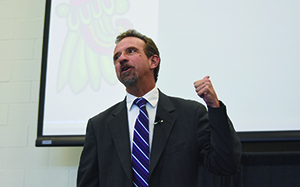
 Gregory Dhuyvetter, superintendent of schools for the Diocese of Orange, Calif., speaks to Detroit Catholic school teachers about the importance of innovation in the classroom during the third annual K-12 Teachers and Administrators Conference on Aug. 9 at the University of Detroit Mercy.
Speaker challenges Detroit’s Catholic teachers to inspire lifelong learning
DETROIT — What goes into being a Catholic school teacher? Educating students, inspiring minds, planting seeds of faith, showing children how to follow in the footsteps of Christ and slaying dragons.
Slaying dragons?
Yes, according to Gregory Dhuyvetter, superintendent of schools in the Diocese of Orange, Calif., who took the stage at the University of Detroit Mercy for the Archdiocese of Detroit’s third annual K-12 Teacher and Administrators Conference.
“In old-timey maps, cartographers said ‘Here there be dragons’ as a way of saying, ‘I don’t know what’s there, but it’ll probably eat you,’” said Dhuyvetter, introducing his presentation, “‘Here there be Dragons!’” Sailing off the Map into the New World of Education.” “But some few went straight for the dragons, because they thought there’s something there that’s amazing.”
Dhuyvetter said that “something” in the 21st century Catholic classroom is technology, which teachers — like it or not — need to use both in the classroom and personally for professional development.
“We are in a tech revolution, which has changed education and will continue to change, and we’re not going back,” Dhuyvetter said. “The method and means of education have changed, and the reason for education has changed. Teachers used to be the only ones who knew things, so spending time with the teacher was the only chance to learn. Now, I carry 1,000 Encyclopedia Britannicas around.”
Today, teachers don’t just give students knowledge, but teach them how to acquire knowledge, Dhuyvetter said, a transformation educators should learn to embrace.
“We’ll still be teaching them how to learn, how to think, how to acquire knowledge and live with others — those are things that aren’t going away,” Dhuyvetter said.
Besides technology, Dhuyvetter said other “dragons” in the classroom include changing the class schedule, breaking from tradition or not using the textbook as the primary tool in planning lessons.
But most of all, Dhuyvetter said, the biggest “dragon” a teacher must slay is fear of failure or change.
“Dragons can be problems we can’t or won’t overcome in the classroom, be they real or imaginary problems,” Dhuyvetter said. “But the thing we as educators must always remember, we can do more good for students than any harm we could ever cause. You may ask yourself, ‘Who am I to change education, to break the cycle of ‘We’ve always done it this way.’ I’ll tell you, you are a child of God, you are strong, innovative and smart.”
At the start of his presentation, Dhuyvetter asked how many attendees were on Twitter, encouraging them to sign up and join Catholic school teacher groups to share ideas and lessons plans with one another.
“You will find online no lack of teacher resources, full lesson plans, outline examples,” Dhuyvetter said.
“You’ll find it all, and you teach the lesson, and your students will stand up and applaud you, because they’ll think you’re a genius,” Dhuyvetter joked. “Teachers are the biggest plagiarizers out there, but I don’t want you to stop.
“Use other resources, show students that you cite sources, and most importantly, show students that you’re a learner, too. Always show you’re learning and you’ll set an example for them for life.”
Dhuyvetter said problems will arise from incorporating new technology and teaching concepts into the classroom, but said teachers shouldn’t be afraid of failure, but rather, be wary of not trying something new.
“Don’t say that everything is going to be great, rather, just say there’ll be problems, but we will work through things together,” Dhuyvetter said.
Keeping with the mythological theme, Dhuyvetter compared teachers to Odysseus, the hero in Greek mythology tasked by Poseidon to carry an oar inland until a person didn’t recognize what an oar was.
“Odysseus brought knowledge further than ever before,” Dhuyvetter said. “Taking knowledge further each and every year. This year, you’re taking that oar of knowledge of faith a little bit further.”
Before Dhuyvetter’s keynote address, Kathleen McCann, chairwoman of the archdiocese’s Catholic Schools Council, gave an update on the council’s work. Auxiliary Bishop Arturo Cepeda celebrated Mass and gave the opening blessing before Antoine Garibaldi, Ph.D., president of the University of Detroit Mercy, and Brian Dougherty, Ph.D., superintendent of Catholic schools for the Archdiocese of Detroit, addressed the conference.