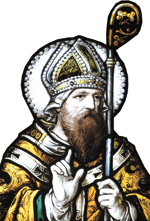
Detroit — St. Patrick’s Day is a time of hearty celebration, especially for the Irish and those of Irish descent, but Msgr. Patrick Halfpenny thinks many people will take part in that celebration without much thought about the teaching or example of the great apostle to the Irish.
“My hope is they would go to the altar before anything else,” said Msgr. Halfpenny, the Irish-American pastor of St. Paul on the Lake Parish in Grosse Pointe Farms. “Otherwise, I’d say they’re celebrating their Irish heritage from before Patrick preached the Gospel.”
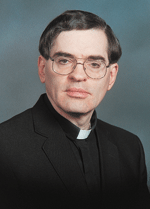
The partying associated with St. Patrick’s Day in the United States attracts a great many people who aren’t Irish at all, but so should his teaching and example, said Fr. Joseph Esper, pastor of St. Edward on the Lake Parish in Lakeport.
“St. Patrick is a universal saint; he’s too great to be limited to the Irish. On March 17, everyone can claim a degree of Irishness,” said Fr. Esper, who is of German descent.
Fr. Esper said there is nothing wrong with having a good time, but “the best way of celebrating St. Patrick’s Day is to reconnect ourselves to that Catholic faith to which he dedicated his life.”
“Catholicism leaves plenty of room for partying and other legitimate enjoyments, so long as we always place God first,” he said.
St. Patrick was a Romanized Briton who is thought to have lived from about 387 A.D. to about 460 A.D. or maybe as late as about 493 A.D. While there is considerable uncertainty about the year he died, it is believed that he died on March 17, hence the date of his feast day.
|
Patrick was kidnapped as a teenager from the coast of Britain by Celtic raiders from Ireland, Msgr. Halfpenny said. Enslaved by his captors, he tended livestock for six years before he was able to escape and return home.
But safely back with his own people, “he had a dream in which a man dressed as a Celt begged him to return and preach the Gospel.”
The young Patrick studied for the priesthood and was eventually consecrated as a bishop at the Monastery of Lerins on an island off the French Riviera.
Legend has it that Patrick did not have much success until he fasted for 40 days and 40 nights on Croagh Patrick, a mountain — if you call a 2,500-foot elevation a mountain — in County Mayo, after which he came down and made his first convert.
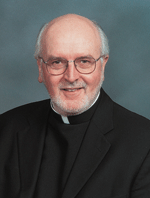
Some of the legends associated with St. Patrick are doubtful, to say the least. Take the one about him casting all the snakes out ofIreland: Msgr. Halfpenny said the Sligo woodcarver from whom he purchased his statue of St. Patrick told him Ireland would never have had snakes in the first place because it was formed by a volcano.
Or using the shamrock to illustrate the concept of the Trinity? Well, who knows, but the idea that the Trinity would have been a major stumbling block is unlikely, as the Celts had a sort of female triumvirate of goddesses as part of their pagan religion, he said the woodcarver explained.
Msgr. Halfpenny said only two documents exist that scholars believe were actually written by St. Patrick — one the famous “Confession of St. Patrick” and the other a letter to a pagan king urging clemency for a Christian prisoner.
A hymn, “The Breastplate of St. Patrick” (“I bind unto myself this day …”), attributed to St. Patrick might accurately reflect his Trinitarian theology, but was not likely written by him. It is thought to have been written several hundred years later.
But all such details aside, St. Patrick certainly had his effect on Ireland and other countries.
“Irish missionaries carried the Gospel back across Europe as far south as northern Italy and as far east as Austria and Germany,” Msgr. Halfpenny said.
St. Patrick is even the patron saint of Christians in Nigeria, the result of the work of more recent Irish missionaries.
Although in Ireland St. Patrick’s Day is celebrated more as a holy day, for Irish-Americans — whose ancestors often encountered prejudice upon their arrival in the 19th century — “he became a symbol of both faith and culture.”
But “rather than just wearing green once a year,” Msgr. Halfpenny would like to see more Irish-American Catholics “pray that we might have some of his missionary spirit.”
Fr. Esper said St. Patrick taught not only through his theology, but through the story of his life, and the way he returned to bring God’s light to his former captors.
“One of Jesus’ hardest teachings is to love our enemies. St. Patrick gives us a wonderful example of that. For six years he was a slave in Ireland, before he escaped and returned home. But later in life he returned to the Irish people to share the Good News,” he said.