
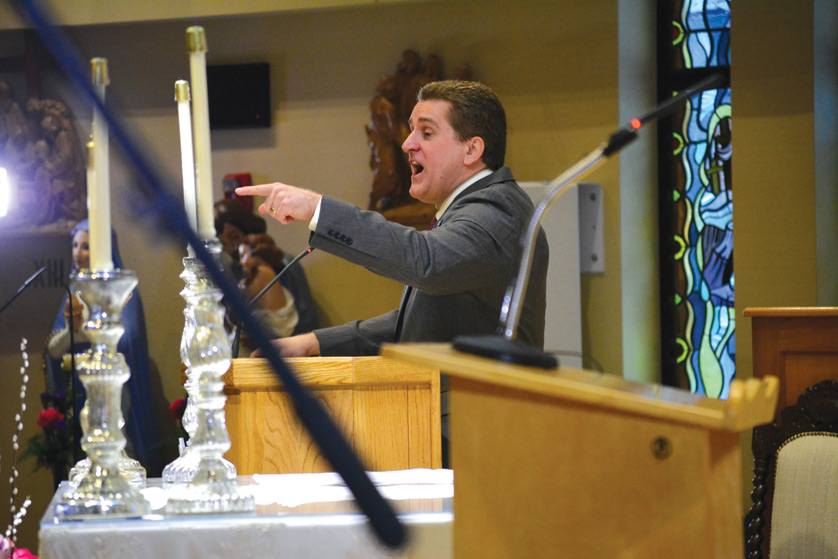
 Catholic apologist Tim Staples gives a spirited explanation of the Catholic understanding of purgatory during the Midwest Catholic Apologetics Conference at SS. Cyril and Methodius (Slovak) Parish, Sterling Heights, on Jan. 24. The second annual conference helped Catholics learn to explain and defend Church teaching against a range of common objections to the faith.
Apologetics conference explores Catholic rationale behind often-misunderstood teachings
Sterling Heights — Purgatory. Mary. The Eucharist. Confession.
If you’re playing Jeopardy, the correct answer might be: “What are common misunderstandings that keep non-Catholics away from the Church?”
If you were at SS. Cyril and Methodius (Slovak) Parish on Jan. 24, they were the topics of the second annual Midwest Catholic Apologetics Conference.
The daylong conference drew nearly 900 people, who gathered to hear talks from nationally known Catholic apologists Tim Staples, Gary Michuta, Marcus Grodi and Steve Ray that sought to demonstrate how such “stumbling blocks” could be overcome using Scripture, reason and history.
Three of the speakers were return guests from last year’s inaugural conference, with the exception of Staples, who replaced Patrick Madrid. Also new was a brief back-and-forth between the speakers and an “objector,” played by the conference’s host, Steven Piskorowski, and a 30-minute question-and-answer period.
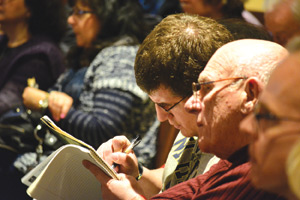 A man takes notes during Staples’ talk, which featured plenty of references to Scripture and the Church fathers.
Staples, director of apologetics and evangelization for Catholic Answers, was energetic and engaging as he explained that the Catholic concept of purgatory as a place of purification from minor sins after death is supported by Scripture.
Specifically, he cited 1 Corinthians 3:10-15, in which St. Paul speaks of man’s works being tested “with fire” at the day of judgment: “If the work that any man built upon the foundation stands, that man will receive a reward. But if any man’s work is burned up, that one will suffer loss, though he himself will be saved, but only as through fire” (1 Cor 3:14-15).
“What is being spoken of in 1 Corinthians 3?” Staples asked. “It’s not heaven because there’s imperfection there,” he said, adding that Revelation 21:27 tells us that “no unclean thing can enter into heaven.”
“It’s not hell because souls are being saved,” he added. “So what is it? People are being purified there ‘as through fire.’ … That is the definition of purgatory.”
Staples went on to explain that purgatory, far from being a denial of the sufficiency of Christ’s sacrifice as some non-Catholics suppose, is a place where the temporal effects of sins already forgiven can be remedied, adding that purgatory is the “ultimate example” of God’s mercy because He offers it even after death to those who die in His grace, but have yet to attain perfect holiness.
It also reflects the difference between what 1 John 5:16-17 distinguishes as “deadly sin” and “sin that is not deadly,” Staples said, or what Catholics call mortal and venial sin.
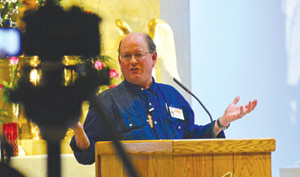 Steve Ray talks about confessing sins to a priest during the Midwest Catholic Apologetics Conference.
Making sense of Mary
Michuta, a Michigan Catholic columnist and author of many books on apologetics, spoke of the obstacles the Blessed Virgin Mary presents for many non-Catholics, such as her sinlessness and perpetual virginity.
Michuta drew parallels between the fall of Adam and redemption through Jesus. Just as Eve’s disobedience led to Adam’s sin, Michuta noted, Mary’s obedience through God’s special grace was necessary for the New Adam’s coming into the world to save it.
“How does God most perfectly redeem us from the fall? He brings about another woman, who’s also betrothed and conceived sinless (just as Eve was),” Michuta said. “This woman is approached not by a fallen angel, but by an unfallen angel, Gabriel. She believes, and she remains faithful. Where Eve changed alliances, Mary remains faithful and remains sinless.”
Michuta also explained that Scripture passages seeming to imply Jesus had brothers and sisters through Mary could be interpreted in a wider sense to mean simply relatives, just as Abraham had called his nephew Lot his “brother” in Genesis.
Abiding in love
Grodi, host of EWTN’s “The Journey Home,” focused on his own difficulty as a former Protestant pastor in accepting the Catholic understanding of the Eucharist, especially Jesus’ statement in John 6:53 that “unless you eat the flesh of the Son of Man and drink his blood, you have no life in you.”
However, he said, after years of avoiding serious consideration of John 6, he was drawn to it “through the back door.”
Grodi said one of his favorite Scripture passages was John 15, where Jesus as the “true vine” tells his disciples to “abide in me, and I in you.”
“So I asked myself this question: Does Jesus himself anywhere explain specifically how to abide in him?” Grodi said. “A search through the lexicon brought me to only one place in Scripture where he says this, and guess where it is? John 6:56 says, ‘He who eats my flesh and drinks my blood abides in me and I in him.’”
But while Scripture had ultimately forced him to consider the Catholic interpretation of the Eucharist, Grodi said love and relationship must come first if Catholics expect to make any progress toward evangelizing friends and neighbors.
“I believe if we focus on acknowledging Jesus in our lives, then our Lord can use us as channels to help our friends and family discover our Lord fully and his Church, and by grace to one day partake of that great memorial sacrifice, the Eucharist,” he said.
A confession to make
Ray rounded out the conference with his talk on the biblical rationale for confessing sins to a priest, which he acknowledged was a barrier before he became Catholic, especially growing up in a Baptist family.
During his talk, Ray touched on the Jewish roots of the priesthood and the Israelites’ confession of sins to the temple priests, who then offered sacrifice on the penitents’ behalf. He then pointed to the Gospels, in which Jesus gives his apostles — the New Testament priests — the authority to forgive and retain sins in the manner of “binding and loosing” (Matt 18:18; John 20:23).
However, Ray said, the whole idea of sacramental confession necessarily rests on another premise he had once rejected: that the church Christ founded is one, visible and apostolic.
“The Church needs an address,” he said. “We need to know where it is, and be part of it. If there is no Church, then the whole idea of confession is a moot point.”
“I know where the address is now,” Ray said, partly tongue-in-cheek: “Vatican City.”
Order the talks
CDs and DVDs of the second Midwest Catholic Apologetics Conference are available at www.midwestapologeticsconference.com.