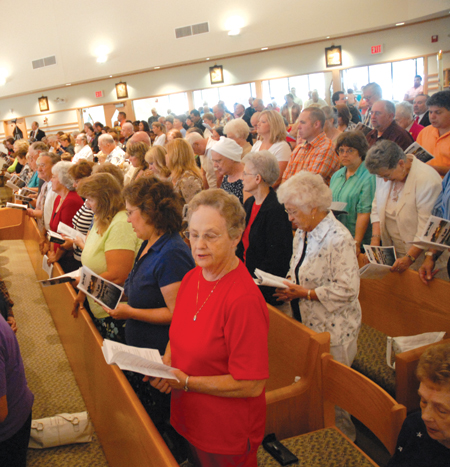
 Of the 41,178 people who completed the Archdiocese of Detroit’s parish survey last fall, 85 percent attend Mass at least weekly (compared with just 30 percent of the general Catholic population), and 68 percent of respondents are involved beyond just attending Mass. However, those who responded also gave their parishes and pastors high grades in most priority areas.
Detroit — Parishioners generally like their parish and their pastor, and for the most part think the Archdiocese of Detroit is fulfilling its mission, but could be doing more in a few key areas, according to the results of a widely distributed survey.
A report containing the results from the “Perceptions of the Faithful” survey taken by the Archdiocese of Detroit in November 2013 was officially released May 28.
The survey, which was answered by 41,178 people from Nov. 2-13, had been advertised via direct email invitations, social media, bulletin announcements, the Detroit Free Press and the archdiocese’s website.
Of the survey respondents, most of whom were parishioners within the archdiocese, 11,656 people filled out the paper survey and 29,522 took the survey online.
In conducting the survey, the archdiocese sought parishioners’ thoughts on a variety of topics concerning the state of parish life and how the Church in Detroit is fulfilling its mission, explained Julie Cprek, survey and research assistant with the archdiocesan Department of Parish Life and Services.
The survey also sought perceptions of the archdiocese’s seven mission priorities: evangelization and catechesis; Christian service and outreach; youth and young adult ministries; lay leadership; stewardship and administration; Catholic schools; and vocations.
“This survey was the most recent initiative in Together in Faith II’s planning process, which we are currently in,” Cprek said during a taped interview for the Catholic Television Network of Detroit. “In 2011 we started this process, and it set out a list of planning priorities we thought would guide the future of our local Church.”
Cprek explained that the goal was to learn about “the everyday things that affect people in their parishes,” and what parishioners see as doing well or as needing improvement.
“That was the heart of the survey, but in addition we asked some questions that gave us a little more information about who’s in the pews, and how we can better reach them,” she said.
Cprek said a few particular points stood out, such as that “most people really like their parish,” with 65 percent giving their own parish high grades overall.
“We asked a series of questions where we had parishioners evaluate how well their parish was doing in a certain number of areas,” she said. “For the most part, people said ‘good’ or ‘excellent.’ They also had some very good things to say about their own pastors.”
The second piece that stood out was that survey respondents’ overarching concerns involved growth, that is, “the future of the Church.”
“That was manifested in two ways,” Cprek said. “One was in vocations; making sure there are enough priests in parishes. The second was youth and young adult involvement in parishes.”
Furthermore, the survey attracted those who are very involved in their parish: 85 percent of the survey’s respondents “attend Mass at least weekly,” the report said, and nearly 68 percent “are involved in the parish beyond attending Mass each week.”
When it came to Catholic schools, Cprek said, 72 percent of parishioners reported that “maintaining a Catholic identity was something that they were doing fairly well in.” The largest concerns were over the schools’ financial viability and affordable tuition, she said.
Survey respondents also rated evangelization and catechesis efforts highly, “especially, explicitly proclaiming the Gospel — that was the No. 1 objective overall,” Cprek said, with 81 percent giving their parish a grade of “good” or better. But respondents also said a greater emphasis on reaching out to non-Catholics and inactive Catholics was needed, she added.
When it comes to vocations, survey respondents say parishes could be a doing a better job, Cprek said.
“It says across the board that people are concerned about vocations; they’d like to see more happening in their parishes, whether it’s praying for vocations, forming a vocations committee, reaching out to young people and helping them consider Church vocations,” she said.
Respondents also said youth and young adult ministries at the parish level are well-done, but could use greater emphasis.
Interestingly, while not many young adults took the survey — about 2,000 of the 41,178 respondents —those who did were generally among the most active in parish life.
In general, “except for those few key areas of concern: vocations, young adults,” respondents gave the archdiocese’s mission priorities high marks across the board for effectiveness, Cprek said.
Vocations and young adult ministry “are issues that we’d known about and issues that we’d been talking about, but to still see it come up as an issue that people don’t think is being as well addressed as it could be, is surprising,” Cprek said.
The survey also collected comments from many respondents, which Cprek identified as “very helpful” to addressing key areas of concern.
“Those are going to be things we take to heart and look at more closely,” she said. “It’s not just about saying, ‘the majority of people like their pastor,’ we look at the whole gamut of comments and look for areas that tie into what people said about the mission priorities.”
Lory McGlinnen, director of Parish Life and Services, said the survey results were overall “very affirming.”
“It is an opportunity for us to realize that people have certain expectations, and very affirming that the faithful know what they are looking for in their Church,” said McGlinnen.
To read the full results of the Perceptions of the Faithful Survey of the Archdiocese of Detroit, along with a letter from Archbishop Allen H. Vigneron, visit www.aod.org/parishes/survey-of-the-faithful.