This is the third in a six-part series in The Michigan Catholic highlighting the impact of Pope Francis on various aspects of Catholic life and ministry. For others in the series, visit the links below.
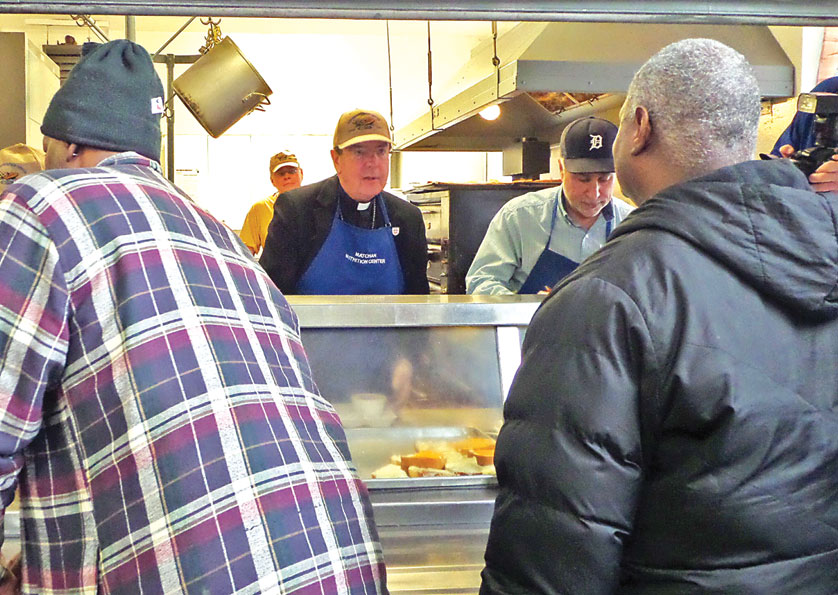 Archbishop Allen H. Vigneron serves food March 4 at the Matachan Nutritian Center, a service of the Society of St. Vincent de Paul, in Pontiac. The archbishop helped volunteer at the center, which serves meals to those in need every Tuesday and Thursday, in preparation for Lent.
Respect, understanding critical to ministering to poor, homeless
|
Detroit — Barbara Williams, director of the Catholic Community Response Team of the Pontiac Vicariate, knows they can never completely fix a struggling person’s problems.
“But you can still treat everyone you meet with respect,” said Williams, reflecting on how quickly people might judge someone who is poor or homeless, without knowing the person’s story.
And while much of what the CCRT does is to help people — be it housing assistance, food, clothing or furniture donations — Williams has come to realize that CCRT staff and volunteers are themselves helped through this ministry.
“A woman once came into our office with six kids,” said Williams, explaining that many would judge the woman for attempting to raise children in her difficult situation.
But Williams said the woman began to share her story: “She said she was raised in foster care herself,” and had a challenging childhood. Because of her own experience, “The one thing she wanted to do was be a good mom,” Williams said.
This, she said, was “one of the things you learn about when serving people.”
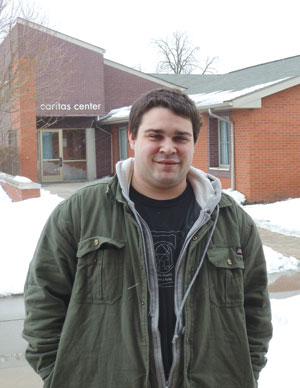 Steven Brown, a resident of Covenant House Michigan, shared his story with The Michigan Catholic.
‘Movers and shakers’
The CCRT was started 10 years ago when the Pontiac Vicariate realized the need to assist the “core of poverty” in the Pontiac area surrounded by the more affluent communities such as Bloomfield Hills and Birmingham.
“You always find some people in need all the time, but not this deep hole of need in Pontiac,” said Williams, who works with program supervisor Suzanne Kimmerly to assist diverse backgrounds and ethnicities, from low-income families to individuals recently released from prison.
A unique aspect to their outreach is a group of men they call the “movers and shakers,” who fundraise and coordinate donations for CCRT.
The “movers and shakers,” many of whom are retired General Motors executives, have an extensive network to pool their resources and talents. One activity includes collecting bicycles and bike locks for recently released prison inmates, who might not have any other mode of transportation.
One member, Joe Pauwels, recalled a time the group visited a family’s apartment and found all of the children were sleeping on the floor, since the family had no beds.
The grandmother, who was watching the kids at the time, told them the children were hungry.
Automatically, the men divided up — one went to McDonald’s to buy some quick meals for the family, another went to the CCRT office to obtain more food provisions for the week, others patched up the damaged windows and still others went to pick up donated beds.
“And one of us went to get a table for them to eat off of,” added Lou Elbert, a fellow “mover and shaker.”
Elbert recounted another story in which the group moved a couch with a foldaway bed into a home, and “the kids were thrilled like it was Christmas” because they, too, would no longer have to sleep on the floor.
Judy, a CCRT volunteer who requested that her last name not be used, shared the story of a client who came into the office with grateful tears for the help she had received.
“She said that as soon as she was financially stable again, she wanted to give back for everything CCRT had done for her,” said Judy. “She said that CCRT was the most helpful program she had ever worked with.”
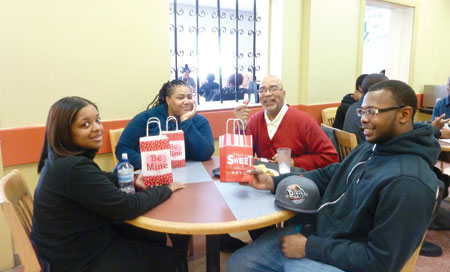 Covenant House Michigan residents Jaymie Morris, Aaliyah Ruffin, staff member Duval Evans and CHM resident Charles Glass receive Valentine’s Day treats.
A true ‘Franciscan’ approach
For Bro. Al Mascia, OFM, it is “important to recognize in one another, and of course in those whom we serve, that they are our sisters and brothers: that we are responsible for one another.”
Serving the poor and homeless for many years in Metro Detroit street ministry, Bro. Mascia says he is happy for Pope Francis’ frequent challenges to society to care for the less fortunate.
“As a Franciscan, I’m overjoyed that he chose the name of the founder of my way of life,” said Bro. Mascia. “He is a man who in many ways is countercultural.”
Bro. Mascia currently serves at the Song and Spirit Institute for Peace based in Berkley, and coordinates the efforts of the “Care’avan,” — a specially equipped van that drives around Metro Detroit to provide food, assistance and outreach in the community.
A particular aspect of the Care’avan is the “SnackPax” program, offering protein bars, fruit cups and juice for children living at or below the poverty line. The packages are assembled and decorated by local children for their peers, and are distributed during both the school year and the summertime.
“I think our culture, no matter how materialistic it may be, no matter how radically individualistic, still recognizes truth,” said Bro. Mascia, commenting on society’s fascination with the pope. “Today, our culture — not only Catholics — is recognizing in Pope Francis a tremendous amount of authenticity and truth.”
Bro. Mascia referenced a Vatican Insider interview with the then-Archbishop of Buenos Aires, Cardinal Jorge Mario Bergoglio, after Cardinal Bergoglio had attended a 2012 consistory with Pope Benedict XVI on the New Evangelization.
The future Pope Francis had drawn from Pope Benedict’s emphasis on the New Evangelization, explaining in the interview that “It is true that going out onto the street implies the risk of accidents happening, as they would to any ordinary man or woman. But if the Church stays wrapped up in itself, it will age. And if I had to choose between a wounded Church that goes out onto the streets and a sick withdrawn Church, I would definitely choose the first one.”
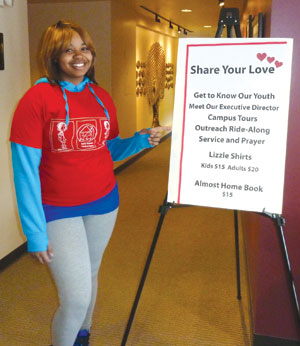 D’Shonda Atkins, a resident at Covenant House Michigan, posts at the recent Share Your Love Valentine’s event.
Brighter futures for youth
Covenant House Michigan serves young people in Metro Detroit who need help getting back on their feet after homelessness or difficult living situations.
“We make sure they know we’re making a covenant with them,” said Melissa Golpe, public relations director at Covenant House, explaining that the commitment to live and participate in its programs helps equip youth for a successful adulthood.
The 16- to 22-year-olds at Covenant House come from many backgrounds — some aging out of foster care, having untreated mental health conditions or suffering domestic abuse.
Steven Brown, 21, who is working on his associate’s degree in science, came to Covenant House after some family issues when he was 19. Due to his father’s illness, money had become tight for the family, and Brown moved out to make things easier for them.
“I was staying in the woods trying to find a place to live,” said Brown, who now plans to become a veterinarian technician while remaining in school to eventually earn his master’s degree. “Someone informed me about Covenant House.”
“With the groups they have here, they push you and drive you to motivate yourself more,” he said. “I’ve taken all of the motivational skills they put in me, to better myself.”
Getting their perspective
Jacques Pasquier, a “mover and shaker” with the CCRT, said helping those in need in his community is “important to my understanding of what the Gospel is about.”
Pasquier is one of the men who drive clients to appointments. When sharing a car ride with someone for 20 minutes, he said, “you get their perspective.”
“You don’t understand their story or where they came from” until you stop judging and just listen, he said, explaining that this ministry really is “the basis of my life — it’s what I live for.”
Help those struggling in Metro Detroit
• The Catholic Community Response Team is always open to donations and assistance from the community. Call (248) 499-9621, email [email protected] or visit www.pontiacareavicariate.org to learn how you can help.
• To find out more or donate to Covenant House Michigan, visit www.covenanthousemi.org or call (313) 463-2000.
• To contribute to Brother Al Mascia’s ministries, visit www.brotheral.org.