

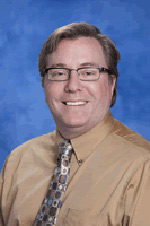
 Grabowski
STERLING HEIGHTS — Lowering carbon footprints and making the world a greener place will take everybody’s help, from world leaders to everyday people.
Pope Francis’ encyclical Laudato Si’ lays out the importance of taking care of the planet and promoting a culture of sustainability, said Greg Grabowski, biology department chairman at the University of Detroit Mercy, during a Nov. 30 talk at St. Blase Parish in Sterling Heights.
“In Laudato Si’, Pope Francis lays out the tragic consequences of exploiting the Earth,” Grabowski told about 60 people gathered for the presentation. “Development has to have a moral aspect to it, in regards to how we treat the environment as society progresses and how we treat each other.”
Grabowski focused on the problem of climate change, how human activity can contribute to it, and what can be done to curb its effects.
“It all boils down to power, energy and where you get it from,” Grabowski said. “In my lifetime, the amount of ocean water has increased seven inches. Oceans absorb energy from the sun; as it absorbs energy, it expands and rises. For every one degree Celsius the global temperature rises, it’s a 7 percent increase in water.”
Grabowski said not all the Earth’s environmental problems are caused by climate change; some are man-made and can be fixed with more sustainable solutions.
“We’re not losing forests to global warming or climate change; we’re losing it to industrialization, deforesting and forest fires” Grabowski said. “So does global warming or climate change cause all our problems because of an increase in CO2? No, some is manmade.”
The talk was part of St. Blase’s Café series, in which speakers give talks about today’s issues and where the Church stands.
“The Catholic Church is the largest worldwide organization, and it can be an avenue for discussion,” Grabowski said. “For Jesuits, education is empowerment, and the pope is trying to get everybody to engage in an avenue of discussion.”
Grabowski expressed skepticism much would be accomplished at the global climate talks taking place in Paris, arguing instead that sustainable living must begin at the local level.
“We need people to think local; we’re going to have to look at how much we have,” Grabowski said. “Why do you have four TVs? Why do we need a new phone every two years? Do you really have to throw out that couch or can you upholster it?”
Grabowski said Detroit can be a prime example of environmental and community stewardship if it embraces sustainable practices.
“We’re starting to rethink how we’re going ahead with big businesses getting rid of certain green areas,” Grabowski said. “There’s a greening of Detroit with urban farms and more community gardens.”
“We need to improve rapid transit in the city; everyone can do something. It’s about living a life that puts value into people, not things. It all boils down to how we can be more energy efficient and live with a sense of community.”