

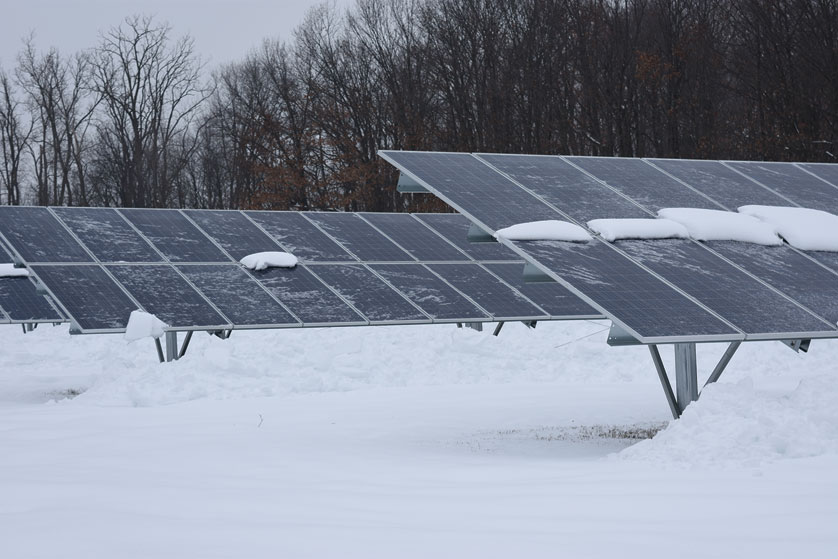
 Solar panels were recently installed at the Felician Sisters’ Livonia complex, which includes the Montessori Center of Our Lady and Madonna University. The panels are part of a nationwide sustainability effort on the part of the sisters, who plan to install more than 9,000 solar panels at six different locations across the country.
Felician Sisters install 1,032 solar panels at Madonna University, Montessori center
LIVONIA — In the depths of winter, the Felician Sisters are holding out for brighter skies and lighter utility bills.
The Livonia-based sisters have caught the “green bug” with a series of solar panel installations through a program sponsored by the Beaver Falls, Pa.-based Our Lady of Hope Province of the Felician Sisters.
This past November, the sisters installed 1,032 solar panels at their Livonia complex, designed to deliver power to the Montessori Center of Our Lady and Madonna University, two Felician-run ministries.
“We’re looking at this from a moral standpoint,” said Sr. Mary Jean Sliwinski, CSSF, the Felician provincial sustainability coordinator for Our Lady of Hope Province. “Pope Francis called on us to make more sustainable choices. It’s not just about saving money, but reducing our carbon footprint any way we can. By doing this, we’re not just talking the talk, but walking the walk.”
Sr. Sliwinski attended an energy symposium in New York in April 2014, where she learned more about the use of renewable energy in the state and its goals for the future, and afterward set out to convince her provincial leadership of the necessity of embracing renewable energy to care for God’s creation.
“It’s part of our mission to take care of the poor and the Earth,” Sr. Sliwinski said. “As Franciscans, we have a lot to do with taking care of creation.”
Sr. Sliwinski researched the idea before pitching it to the administration in Beaver Falls, who signaled the go-ahead with the national solar power project; across the U.S., solar panels would be installed at six different Felician locations.
“After working with the financial team, the facility management team, the communication and legal team, we got through all the things we had to go through. The administration was very supportive and was concerned about our carbon footprint. This is a continuation of what we have done environmentally at all our locations,” Sr. Sliwinski said.
Six hundred solar panels were installed in November along Newburgh Road in Livonia. Once operational, the panels are expected to provide 98 percent of the electrical power at the Montessori Center of Our Lady.
Meanwhile, 432 solar panels were installed on the roof of the Franciscan Center at Madonna University, which will directly supply a portion of the power to the already LED-certified building, which was constructed in 2009 with a design intended to save on energy.
Madonna University plans to incorporate the solar panels into its sustainability program, offering students first-hand experience with solar technology. Information regarding the amount of power generated from the solar panels is displayed on monitors in the student center at the Franciscan Center.
“The foundations of this project were laid out in the summer, with teams assessing how we were going to integrate solar energy into the science curriculum,” said Karen Sanborn, marketing director at Madonna. “One of the core values of the Felicians, and Madonna, is reverence for the environment. The Felician Sisters have been leaders in sustainability. We’re thrilled to be part of this project, not only for the university, but for the educational benefits for the students and the Livonia community.”
The Felician Sisters’ solar panel program entails 9,162 solar panels, which will generate 3.3 megawatts of electricity a year, according to Sr. Sliwinski. The project includes solar installations in Buffalo, N.Y.; Lodi, N.J.; Chicago and Coraopolis, Pa., and its headquarters in Beaver Falls.
Sr. Sliwinski said the solar panels work as long as there is ambient light, meaning even on a cloudy day the panels will still generate some power — provided they aren’t completely covered by snow. The nationwide project is expected avoid sending 110 million pounds of CO2 emissions into the atmosphere over the panels’ 35-year lifespan.
“This solar power project represents the next chapter in our ongoing efforts to care for and repair the earth,” Sr. Sliwinski said. “The vast scope of this project represents a new level of commitment by the sisters, enabling us to sustainably generate a significant amount of electricity. An initiative that helps protect the environment is a wonderful opportunity to educate the larger community about renewable energy.”