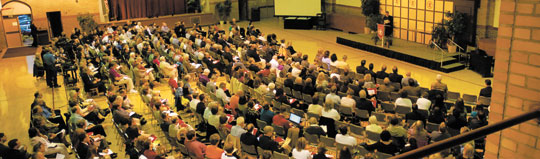
DETROIT — That the Second Vatican Council was renewal in the spirit of evangelization was the theme of a two-day conference at Sacred Heart Major Seminary marking the 50th the anniversary of the council’s opening.
Archbishop Allen Vigneron addressed the council’s pastoral reassessment of the Church’s engagement with the modern world in his Sept. 21 keynote addresses to open the conference, and Ralph Martin, S.T.D, a professor at the seminary, focused on the council’s importance to the New Evangelization in his address the following morning.
The archbishop recalled that, “at the opening session, Blessed John XXIII said the aim of the council was no less than a renewed appropriation of the Church’s perennial mission in our own time.”
The pope had stressed that the aim of the council “was no different from that of all other councils that proceeded it,” involving a solemn declaration of the union that exits between Christ and His Church, and to provide guidance to men both as individuals and as a society.
But while in some sense the same, there was also something new about this council, the pontiff had continued, explaining that what was needed at that time was a new enthusiasm, a new joy and serenity of mind in the unreserved acceptance by all of the entire Christian faith.
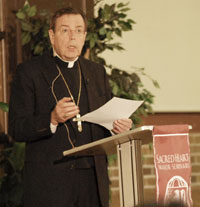
“What is needed is that this certain and immutable doctrine, to which the faithful owe obedience, be studied afresh and reformulated in contemporary terms,” Archbishop
Vigneron said.
“This understanding of the aim of the council was affirmed by Pope Paul VI, when at the closing of the council in December 1965, he said that the Church’s aim for the council that was then concluding was to find in herself active and alive the Holy Spirit, the Word of Christ, and to probe more deeply within herself the presence of God above and within herself — revitalize in herself that faith which is the secret of her confidence and her wisdom, that love which impels her to sing without ceasing the praises of God,” he added.
In Archbishop Vigneron’s assessment, the council worked in hope of leading to a new Pentecost for the Church.
It “asked for a fresh start,” with the aim of “winning the world for Christ, both through personal conversion and reshaping the culture, and at this point I would underscore that these two things — a personal conversion and reshaping of culture — are not detachable things; in the mind of the Church they can only proceed together.”
The Second Vatican Council was, in Archbishop Vigneron’s view, “a preparation for the New Evangelization.”
Blessed John XXIII called the council to reject the predominant note of pessimism that had characterized much of the Church’s attitude toward the modern world.
“In contrast to that pessimism, Blessed John XXIII expressed his conviction that present indications are that the human family is on the threshold of a new era,” the archbishop said.
The French Revolution, which began in 1789, had long be considered by many Catholic thinkers as a key turning point in history, launching European civilization on a fundamentally new course that constituted a new world that was hostile to the Church and its message.
“It is my understanding that, at the Second Vatican Council, the council’s fathers said everything in the world that has been shaped by the French Revolution is not bad; the French Revolution is not irretrievably evil,” Archbishop Vigneron said.
Taking, for example, the slogan of the Revolution — “Liberte, Equalite, Fraternite” — he said that despite the many unhealthy things that were done under that banner, there were also “many healthy and wholesome things.”
And by the 1960s, the pope could detect some positive things among the “signs of the times.” Those included trends such as the work of a number of theologians who were writing in the post-World War I era, such as Henri de Lubac, and the philosopher Jacques Maritain.
Also, there was the work that had been done in the area of Scripture studies and the liturgical movement.
“I believe that all of these gave the pastors of the Church a certain confidence about being able to not only to say no to the unhealthy aspects of modernity, but to address and be able to create a new cultural synthesis with the healthy aspects of modernity,” the archbishop said.
Martin, in his Sept. 22 address, echoed the message of Archbishop Vigneron that the council sought a renewal for the sake of evangelization, renewal in the Church to get a better hearing for the Gospel.
But Martin said, “That was not exactly what happened. There was lot of confusion after the council.”
Many people misinterpreted the council’s documents to mean that the Church no longer sought the conversion of Protestants or people of different religions, he said.
And some of the post-conciliar Bible scholarship led people to lose their trust in the reliability of God’s Word, Martin continued.
“There was a spirit of rebellion, a spirit of novelty,” he said.
But the popes — from Paul VI through Benedict XVI — have consistently emphasized that what is needed is “Christian conversion — a complete and sincere adherence to Christ through His Gospel and faith,” Martin said.
The message has been that Catholics are called to become Christ’s disciples. The Church is “asking from Catholics nothing less than Jesus asked, and offering Catholics nothing less than Jesus offered.”
Martin, who heads the seminary’s graduate program in the New Evangelization, said Catholics need to understand two things to understand what the phrase means: “The first thing is who is it directed at,” he said, explaining that it is directed at people who may have been baptized and raised Catholic, but who “have lost the living sense of the faith.”
And he continued, “Something else that’s new: who does it. It’s not just priests and nuns.”
People need to understand that there is a “universal call to holiness, and a universal call to salvation,” he added.