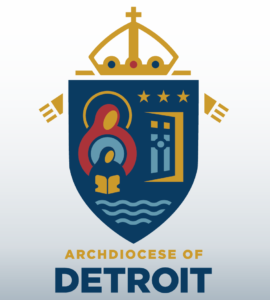
 The Archdiocese of Detroit's new coat of arms was unveiled June 3 as part of Archbishop Allen H. Vigneron's pastoral letter, "Unleash the Gospel." Symbols incorporated into the new crest include St. Anne and her daughter, the Blessed Virgin Mary; an open door symbolic of Venerable Solanus Casey -- as well as the Church's need to "go out" and invite others in -- and rippling water denoting both the cleansing power of baptism and the geography of the Great Lakes region.
 Today, synod members will gather for a final time to consider one more element critical to the local Church’s life: Archdiocesan Central Services.
While not every Catholic in southeast Michigan is familiar with the workings of the local Church’s “downtown headquarters,” it is something that impacts — directly or indirectly — every parishioner in the six-county archdiocese.
“All of us, personally and through our parishes, enjoy the fruits of the work of the Archdiocesan Central Services departments and offices seeking to carry out the mission of the archdiocese of sharing Christ in and through the Church,” reads a description from the annual Catholic Services Appeal, which funds a large majority of the work of the Archdiocesan Central Services.
To put it briefly, Archdiocesan Central Services helps the archbishop in carrying out his duties as chief pastor of the Archdiocese of Detroit, from the practical side — think finances, real estate and technology — to the spiritual.
Through such efforts, the CSA description reads, “we join with our sisters and brothers in Christ throughout the archdiocese to do the Lord’s work — work that no one individual or parish could possibly do alone.”
Archdiocesan Central Services staff, which consists of approximately 180 individuals, serve mostly from the archdiocesan Chancery building in downtown Detroit, but others, such as the Office of Priestly Vocations, conduct their work from Sacred Heart Major Seminary or other locations.
In total, Archdiocesan Central Services support more than 100 projects, ministries or programs that directly or indirectly support the archbishop in his ministry to the six-county archdiocese.
The Office of Young Adult and Campus Ministry, for example, coordinates formation, evangelization and social events for Catholics ages 18 to 35, serving as a liaison for young adult Catholics from multiple parishes to connect and share their faith and ideas.
“Some of the things that we do focus on taking our young adults outside of the parish and going into the marketplace — going into places like the bar,” said Chris Gawel, the office’s coordinator. “It’s a lot easier to invite somebody to a bar and invite them to a drink, especially for those who haven’t been to church in a while, or have never been to a church.”
Other offices that focus on corporal or spiritual works of mercy include special departments for ministry to African-Americans, Hispanics, men, women, youths and families.
To help communicate and publicize the efforts of those ministries — as well as other messages and information from the archbishop — the Department of Communications offers several vehicles for keeping local Catholics connected with one another.
The Michigan Catholic, the 144-year-old archdiocesan newspaper, prints biweekly and daily online to keep Catholics abreast of current events and news from all over the region, including special Masses, efforts and events of importance to the archbishop. The archdiocesan Public Relations Office, on the other hand, handles media inquiries from secular and outside news organizations who report on the Church, as well as internal communications efforts. Other vehicles, including social media channels, the archdiocesan website, the Catholic Television Network of Detroit and printing and graphics teams, are overseen by the Office of Digital Media.
While some departments are directly responsible for ministry, others are tasked with supporting the local Church in a “behind the scenes” way.
The Office of Catholic Schools, for example, serves as a support structure for the archdiocese’s 65 grade schools and 24 high schools, providing financial, curriculum and enrollment aid for students, teachers and parents. Closely connected are the offices for the Catholic Youth Organization and Catholic High School League, which support athletic and service formation for students at all grade levels.
Direct support to parishes comes from the Department of Parish Life and Services, which offers resources and support for planning, Christian worship and liturgy, technology and music, as well as a special department focused on relations with non-Catholic faiths.
In the departments of Development and Stewardship, Finance and Human Resources, Archdiocesan Central Services employees work to advance the mission of the local Church from a practical perspective, from fundraising and encouraging good stewardship to managing practical assets such as real estate, payroll and staff.
Still other departments serve specialized roles by promoting vocations to the priesthood, religious life and diaconate, as well as offering practical resources and spiritual formation. In the Archdiocesan Tribunal, cases for marriage nulity and canonical inquiries are fielded and addressed. Still another office supports efforts to ensure a safe environment through procedures designed to protect the Church’s most vulnerable.
And that’s certainly not all of them.
While it’s difficult to place all of Central Services under one umbrella, the unifying theme, as the vision statement for Synod 16 describes, must be an Archdiocesan Central Services that “is positioned to provide strategic and structural support to parishes and other Catholic entities, and that models the personal, spiritual and leadership characteristics of joyful missionary disciples.”
And that, ultimately, is what synod members will be tasked to consider.