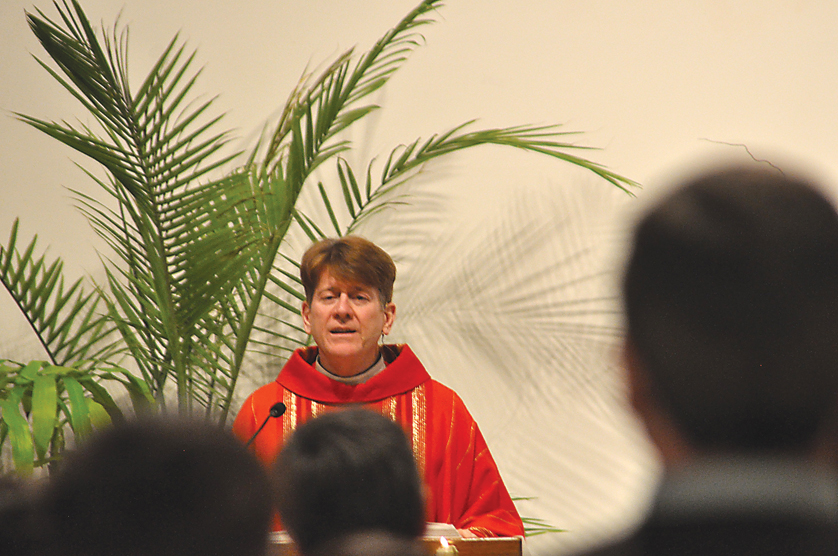
 Fr. Jim McNulty, pastor of St. Edith Parish in Livonia, said he prays with the Scriptures all week and reads several commentaries before preparing his Sunday homily.
Metro Detroit — There are as many styles of homilies as there are priests who give them, but several local priests have a few key tips to making the 10-12 minute timeframe memorable and inspiring.
Fr. Jim McNulty said that when he begins his Sunday homily, “I have everybody’s attention and I have to keep it.”
“When I say ‘The Gospel of the Lord,’ everyone sits down and looks at me,” explained Fr. McNulty, pastor of St. Edith Parish in Livonia. “I try to do something within the first two minutes that will keep their attention.”
Fr. McNulty said his weekend homilies tend to follow the same pattern. He often starts with a short story, sings a song, reads a poem, shows a short video clip or a piece of art.
"Make sure everyone can walk out being able to say 'the homily was about...' and say it in one sentence."
-Fr. Patrick Casey
“After those first couple of minutes I want them to think, ‘I wonder where he’s going to go with this,’” said Fr. McNulty. “Then I talk about the Scriptures — it’s always Scripture-based.”
After discussing the message of the day’s reading, he explains how it applies to real-life today, “to bring it to the present.”
Fr. Patrick Casey said one of the lessons he learned in seminary was to “make sure everyone can walk out being able to say ‘the homily was about…’ and say it in one sentence.”
Fr. Casey, administrator of Divine Savior Parish, pastor of St. Theodore of Canterbury Parish and St. Damian Parish, a clustered group in Westland, said it’s crucial to “get to know your parishioners.”
“I had been ordained about a year, and a (classmate) in the seminary a year behind me asked me how important were confessions in my life,” he said. “I thought about it, and told him — and stand by it today — I wouldn’t know how to preach to my parishioners if I didn’t listen in confession.”
He said that when hearing confessions, “I learn what their real concerns in life are.”
Fr. Casey pointed out that he has had several permanent deacons over the years, and “every deacon I had was outstanding because they really got to know their parishioners.”
Fr. McNulty also said he focuses on listening to his parishioners — “the problems they bring me; the issues that come up” — in order to identify their priorities: “You always have to speak to your audience.”
Fr. McNulty said he spends “a lot of time” on his weekend homilies, usually reading next week’s Scriptures on Sunday evening.
“I read them, pray with them all week,” he said, adding that he probably reads “half a dozen commentaries” as well. By the weekend, he has memorized the content he plans to deliver.
Fr. McNulty said he always writes his homilies out, “three pages double-spaced” not necessarily to read them on Sunday, but to upload onto the parish website. He said his homilies are also recorded and placed on the website.
Fr. Casey said his first pastor after ordination, Fr. Nicholas Zukowski (currently pastor of St. Martin de Porres Parish in Warren), set a great example in giving homilies.
“His style is different than mine, but I always look forward to listening to his homilies,” said Fr. Casey, describing Fr. Zukowski’s homilies as “well-prepared, thoughtful, relevant.”
“I think every priest would agree with me that you are a much better preacher three months after ordination than the day after,” said Fr. Casey, adding he has also enjoyed Archbishop Allen Vigneron’s preaching style dating back to his time as a philosophy professor at Sacred Heart Seminary.
“I sense I keep improving as a preacher because it takes practice, practice, practice,” said Fr. Casey.
Fr. McNulty said he appreciates feedback on his own homilies as he asks for details and what parishioners “thought was good” that weekend.
“The people of God really form your preaching style if you let them,” he said.
Stirring hearts, renewing faith
“In announcing 2012-13 as a ‘Year of Faith,’ Pope Benedict XVI declared: ‘What the world is in particular need of today is the credible witness of people enlightened in mind and heart by the word of the Lord, and capable of opening the hearts and minds of many to the desire for God and for true life, life without end.’ More than ever, therefore, an increasingly important objective of the Sunday homily in our day is to stir the hearts of our people, to deepen their knowledge of the faith, and to renew their living the faith in the world and participation in the Church and her sacraments.”
U.S. Conference of Catholic Bishops
“Preaching the Mystery of Faith: The Sunday Homily” (January 2013)